
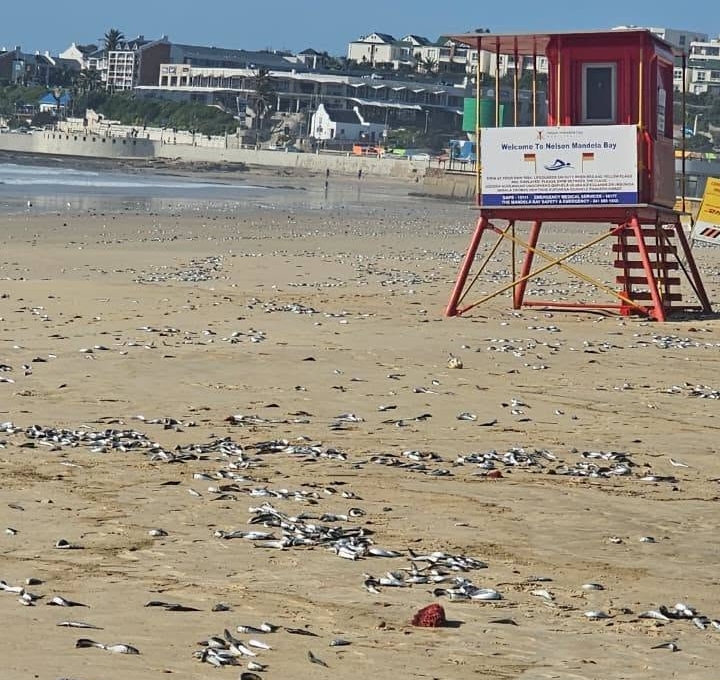
GQEBERHA -Beachgoers in Gqeberha have been warned not to touch, collect or consume sardines that have washed ashore at five beaches along the city’s beachfront.
The Nelson Mandela Bay Municipality’s Beaches and Resorts Sub-Directorate has issued the precautionary warning after sardines were reported at 1st Beacon, Pollok Beach, Hobie Beach, Humewood Beach and Kings Beach.
The municipality has advised members of the public not to touch, collect, consume, sell or distribute the fish.
The sardines may have been exposed to environmental conditions or contaminants for an unknown period after washing ashore, and the municipality has urged the public to avoid handling or consuming them
People have also been advised not to feed the fish to animals.
The warning comes as authorities continue monitoring a separate mass sardine mortality event along parts of the Western and Southern Cape coastline.
Western Cape sardine deaths investigated
Large numbers of dead and dying sardines have washed ashore at several locations along the Cape coast since early August, with reports stretching from the West Coast to the Southern Cape.
According to the Department of Forestry, Fisheries and the Environment (DFFE), no new mass-mortality incidents had been reported since 16 August, suggesting that the acute phase of the event may have eased. Monitoring and testing are continuing.
DFFE is investigating the cause of the mortality, with pilchard herpesvirus (PHV) increasingly emerging as the leading explanation.
Approximately 75 sardines have been included in the PHV testing programme. Initial testing by the South African Institute for Aquatic Biodiversity and Rhodes University detected PHV genetic material in all 15 fish examined.
Of these, 10 fish collected during the mortality event had consistently high viral levels, while viral levels varied among five sardines that had been caught alive and appeared healthy when collected.
DFFE has since processed about 60 additional samples for PHV screening, with preliminary results from roughly half indicating high viral levels. Further pathological examinations are under way to establish whether the fish show the gill inflammation and damage associated with active PHV disease.
Virus not confirmed as cause
Although the evidence increasingly points to PHV, DFFE has stressed that its presence does not yet prove that the virus caused the mass deaths.
The fact that PHV has also been detected at lower levels in some apparently healthy sardines suggests the virus alone may not be sufficient to cause mass mortality.
Researchers are also examining environmental conditions that could have contributed to the deaths, including unusually cold nearshore water, low oxygen levels and enhanced upwelling.
DFFE said investigations so far have found no evidence that harmful algae were the primary cause, although environmental conditions cannot yet be ruled out as contributing stressors.
DFFE has also stressed that PHV is a fish virus and poses no known risk to human health. Its detection does not, by itself, mean commercially caught or canned sardines are unsafe to eat.
Sardine deaths disrupt Koeberg
The Western Cape mortality event has also had an unusual impact on Koeberg Nuclear Power Station.
Eskom reduced generation at Unit 1 to 50% after a cooling pump automatically shut down because of a buildup of marine material in the seawater intake area.
Eskom said the reduction was a controlled safety precaution and that nuclear and operational safety at the station was never compromised. The utility also said there was no impact on South Africa’s electricity supply.
Koeberg Unit 2 was offline at the time for planned maintenance, leaving Unit 1 as the only operational unit.
Eskom subsequently increased Unit 1’s output to 70% on 26 August after the seawater intake issue was addressed.
No confirmed link to Gqeberha
There is currently no evidence or confirmation that the sardines washing ashore in Gqeberha are part of the Western Cape mortality event or that they are affected by PHV.
The Gqeberha warning is therefore being treated as a precautionary measure by the municipality because the fish have washed ashore and their condition and exposure are unknown.
Members of the public are urged to leave the sardines where they are and follow the municipality’s advice not to touch, collect, consume, sell or distribute them.
ALSO READ: Sardine die-off forces Koeberg nuclear plant to cut power generation