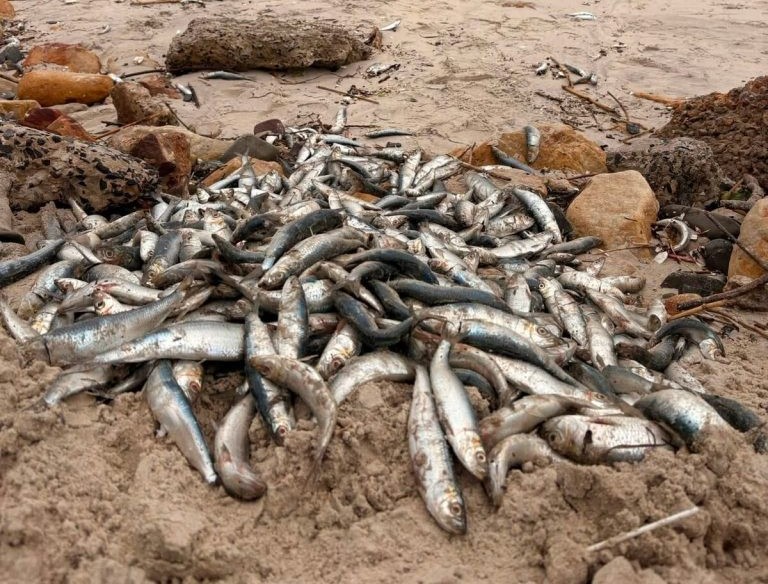
There is currently no sign of another widespread sardine die-off, but authorities are keeping a close eye on the situation as scientific investigations into the 2026 mortality event continue.
The Department of Forestry, Fisheries and the Environment (DFFE) says the only new report during the past week was an isolated fresh sardine stranding near Mbotyi on the northern Wild Coast on 11 September.
For now, a temporary precautionary restriction on the sardine fishery remains in place until 2 October.
Under the measure, each fishing right holder may land no more than 25% of its outstanding 2026 directed sardine total allowable catch. The restriction applies both west and east of Cape Agulhas.
DFFE says the available evidence does not show that the mortality event has reduced the sardine population to a level requiring the fishery to be completely closed.
The current restriction is described as a precautionary, time-limited measure and could be reviewed sooner if conditions worsen.
Rough seas hamper fishing
The weather has also played a role in recent fishing activity.
Industry representatives reported that strong winds prevented fishing west of Cape Agulhas, while fishing opportunities in Algoa Bay were similarly limited by poor weather.
Only one sardine catch, totalling 26 tonnes, has been landed since the beginning of September.
Meanwhile, scientists continue to investigate the cause of the mortality.
Pilchard herpesvirus (PHV) remains the strongest identified biological factor associated with the event. It has been confirmed in affected sardines from the Western Cape and Algoa Bay.
Further sampling and laboratory testing are under way.
Initial samples from KwaZulu-Natal tested negative for PHV, although only a small number of fish were tested.
More samples are expected. If these also test negative, it would support — although not prove — the view that the mortality event did not extend into KwaZulu-Natal.
This would be consistent with reports that the mortality front ended before reaching the province.
No effects on sardine-dependent seabirds or marine mammals have been confirmed.
Scientists to review fishery
The Small Pelagic Scientific Working Group will meet on 29 September to assess the latest evidence and reconsider management of the sardine fishery before the temporary restriction expires.
A hydroacoustic survey planned for October and November will also be important.
It will provide the first fisheries-independent estimate of sardine biomass and distribution following the mortality event.
For West Coast fishing communities and the wider small-pelagic fishing industry, the survey could provide valuable information about the condition and distribution of the sardine stock following the die-off.
Public warned against collecting sardines
DFFE has reiterated that pilchard herpesvirus is a fish virus and is not known to infect people.
Commercially produced sardine products sold through regulated channels remain safe.
The public is nevertheless urged not to collect or eat dead or dying sardines found on beaches or floating near the shore.
Dead fish should also not be fed to pets or used as bait.
For now, the focus remains on monitoring the coastline, gathering samples and allowing scientists to build a clearer picture of what happened to the sardine stock — and what it means for the fishery in the months ahead.