
As South Africa grapples with a national water crisis in all regions and ageing infrastructure nationwide, a new model for resource resilience is emerging from the country’s mining heartlands.
In the Northern Cape, water is not a given. It is a negotiation between rainfall and demand, industry and community, between today’s needs and tomorrow’s survival.
It is in this context that Anglo American’s Kumba Iron Ore has built an ambitious water stewardship approach.
The results are tangible: up to 80% of water used across Kumba’s mines is recovered through advanced technologies, thousands of rural residents have reliable clean water, and local municipalities can plan and manage their systems independently.
Around Kolomela mine specifically, innovative water solutions have been developed in partnership with local municipalities to address the particular challenges of the local catchment. The operation also contributes to the regional water supply scheme through diversion of surplus water volumes and treats and reuses effluent from the Gamagara Municipality wastewater works for plant operations – turning a municipal challenge into a shared resource.
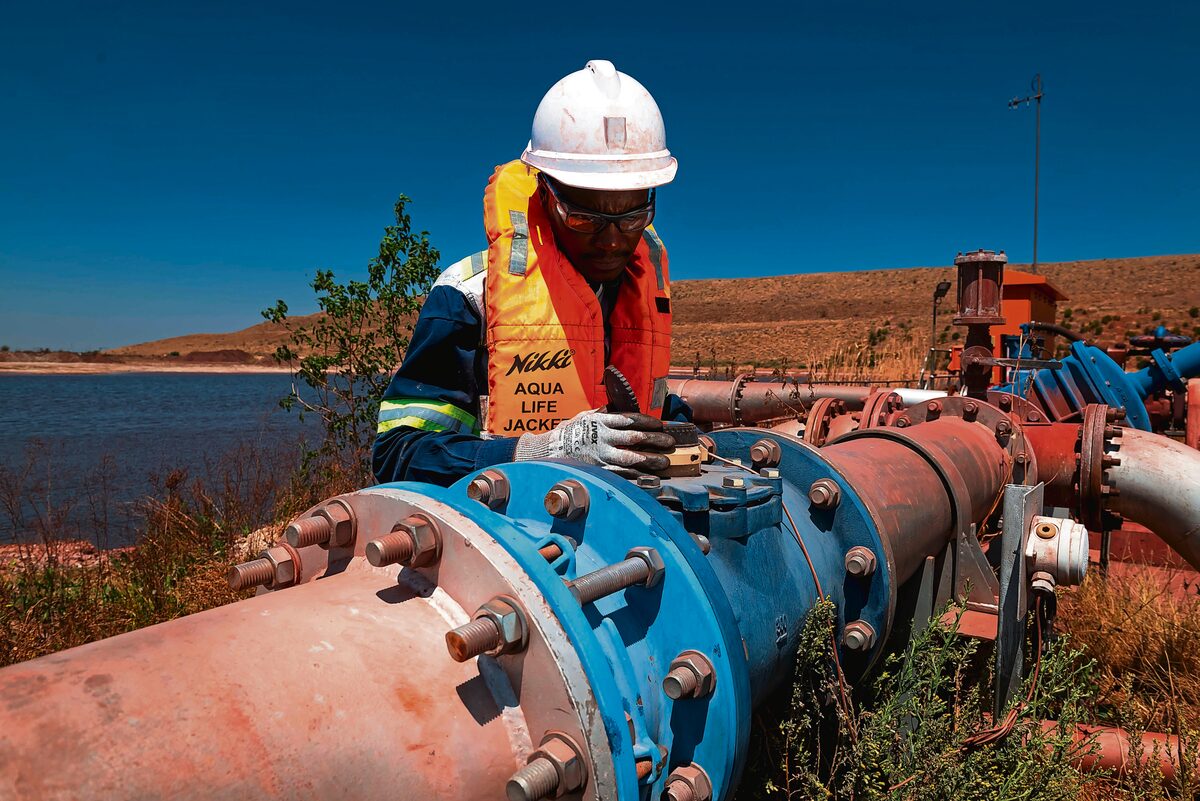
In the Joe Morolong Municipality, Sishen mine completed a major upgrade to the bulk water scheme serving the villages of Sesipi, Perth, Kome, and Tsiloane. The R11 million project refurbished nine boreholes, installed two booster pumps, and delivers an average of 480 kilolitres of clean water every day to more than 6 000 residents.
Engineering for long-term sustainability
The engineering choices made here are designed with sustainability in mind. Nine of the boreholes are primarily solar-powered, with Eskom connections retained as back-up. Construction followed the Department of Water and Sanitation’s design criteria for rural community water supply, embedding the project within the national regulatory framework from the outset.
ALSO READ: Supervisor earns national recognition for advancing women in mining
“The hydrology of this region demands precision, discipline and long-term thinking,” says Hamilton Moswathupa, specialist hydrogeology and water management at Kumba. “Our water recovery rates reflect rigorous science and continuous improvement – directly reducing pressure on the shared water sources that communities and ecosystems both depend on.
“While physical infrastructure can be built in months, however, the institutional capacity to maintain, manage and improve it takes years. This is the gap that Anglo American’s Municipal Capability and Partnership Programme (MCPP) was designed to close.
Building municipal capacity
Operating in the Tsantsabane and Gamagara local municipalities – the two municipalities where Kumba’s mines are located – the MCPP partners with the Department of Co-operative Governance and Traditional Affairs and the CSIR to build genuine municipal capability.
The results are measurable. In Tsantsabane, Blue Drop water quality compliance scores rose from 0% to 56% for the Postmasburg scheme and in Gamagara from 11% to 54.71% across all its schemes.
Municipal teams that once depended entirely on external contractors to maintain boreholes are now doing so themselves, guided by groundwater management plans and standard operating procedures they developed in-house.
“You can’t separate a mine from its catchment,” says Musa Jack, MCPP programme manager at Anglo American. “We share the same water, the same risks, the same consequences. Our sustainability approach is to protect, preserve and restore our water catchments to support resilient operations, communities and the environment. The MCPP exists because we take that seriously and partner with local stakeholders to address challenges.”