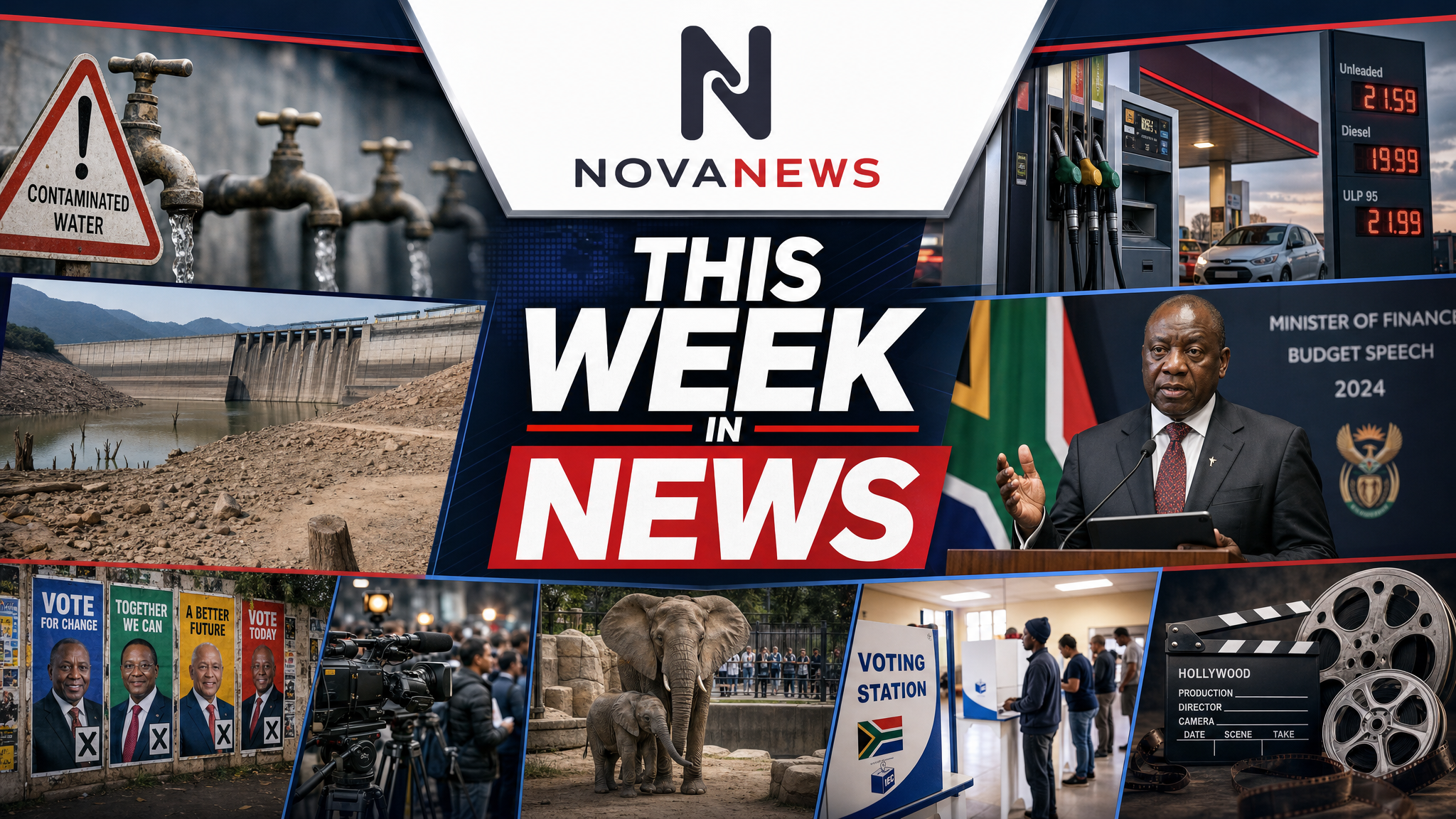
From contaminated taps in Tshwane to dam levels dropping in the Cape, water dominated the headlines this week. Meanwhile, political tensions rose ahead of local elections and Hollywood took aim at tech titans.
Ramaphosa intervenes as Tshwane water crisis sickens hundreds
More than 400 people, mostly children under four, fell ill after drinking contaminated tap water in parts of Tshwane between 7 and 18 October. Tests found high levels of E. coli in water from the Bronkhorstspruit treatment plant, which went without chlorination for three weeks. Stool samples from patients showed norovirus, campylobacter and shigella. New cases peaked at 72 on 13 October, but no deaths were reported.
President Cyril Ramaphosa said the national government intervened and aimed to resolve the crisis within days. Residents were told not to drink tap water and could only use the supply for flushing toilets.
Western Cape dam levels drop as summer nears
Dam levels across the Western Cape declined as the region heads into summer. The Western Cape Water Supply System fell to 73,48% from 74,39% the previous week, while the Western Cape State of Dams dropped to 79,18% from 79,95%. Theewaterskloof, the region’s largest dam, declined to 73,56% from 74,66%. The Berg River catchment fell to 73,73% from 74,48%, compared with 99,87% at the same time last year.
The Department of Water and Sanitation will re-run its water-resource model on 2 November to decide if restrictions are needed. Residents and businesses were urged to continue conserving water and avoid unnecessary wastage.
Fuel relief welcomed but parties split on budget’s economic impact
Finance Minister Enoch Godongwana announced temporary fuel-levy cuts in the Medium-Term Budget Policy Statement tabled on 21 October. Diesel will drop by R3 per litre and petrol by R1,50 per litre from 4 November to 1 December, then R1,50 off diesel and R1 off petrol until 5 January.
Godongwana lowered the 2026 growth forecast to 1,2% from 1,6% in February but said debt stabilised at 78,4% of GDP. The deficit is projected to narrow from 3,9% in 2026/27 to 2,5% by 2030. Tax revenue came in R17,1 billion above February estimates, driven by commodity corporate tax gains. The minister identified R38,1 billion in savings over three years, including about R6 billion from stopping grant-payment fraud.
Political parties split on the budget’s impact. The DA welcomed ratings upgrades and lower inflation but warned growth remains weak. ActionSA called the fuel relief insufficient and criticised the lack of a credible plan for growth and unemployment. The MK Party rejected the framework, saying it fails development needs and does not tackle debt or corruption. The Patriotic Alliance supported the fiscal framework and welcomed the sovereign-rating upgrade.
McKenzie bans local media from interviews
Patriotic Alliance leader and Sport, Arts and Culture Minister Gayton McKenzie imposed a ban on local media interviews before the 4 November local elections. The PA said South African outlets were “extremely biased” against the party. The move came after a leaked dossier alleged PA-linked cadre deployment to cultural bodies and municipal agencies. PA deputy president Kenny Kunene dismissed the dossier as a DA smear.
Two armed PA bodyguards told journalists in Johannesburg “no media” and tried to prevent filming in public. McKenzie said he would still do interviews in his ministerial role and that supporters would protect journalists.
ALSO READ: PA leader Gayton McKenzie bans local media from interviews
Ramaphosa warns of US trade deal exit
President Cyril Ramaphosa warned South Africans to brace for possible removal from the African Growth and Opportunity Act, the US trade programme that gives eligible countries duty-free access to American markets. South Africa is the programme’s biggest beneficiary, but inclusion is reviewed annually by the US president.
Losing AGOA would remove duty-free access for key exports, particularly cars, and could cost tens of thousands of jobs in the auto sector and supply chain. The move would cause major economic damage and force the country to search for alternative markets.
Teen stabs six-year-old after bomb plot arrest
A 16-year-old boy attacked and stabbed a six-year-old girl at a school in Umhlali, KwaZulu-Natal,. The child suffered three stab wounds and underwent surgery. The teen entered the classroom armed with a knife and a homemade gun that failed to fire.
He had been arrested in March for allegedly placing an improvised explosive device in the Ballito Junction mall food court. The device smoked but did not detonate, and he was released after the case was not enrolled. He reportedly circulated a manifesto on Telegram referencing Columbine and wore a T-shirt reading “Wrath” during the attack. Police said he remains in custody and faces charges including attempted murder.
ALSO READ: Troubled teen stabs 6 year old
Nine-year-old stabbed to death in Upington
Heinrich Human (9), a Grade 2 pupil at Frank Biggs Primary School, was stabbed to death in his bed in Raaswater, Upington. A man forced his way into the informal dwelling while Heinrich and his paralysed stepmother slept and stabbed the boy about eight times with a sharp object. The stepmother screamed for help, but emergency personnel declared Heinrich dead at the scene.
The suspect fled but was arrested later that morning. He was reportedly on parole and had earlier killed someone in an adjacent dwelling. He was allegedly romantically involved with Heinrich’s cousin and had argued with her the day before. The suspect appeared in Upington magistrate’s court on 21 October.
Court rules zoo elephants must stay
Judge Noluntu Bam ruled that Lammie, Mopane and Ramadiba, the last three zoo-kept elephants in South Africa, must remain at Johannesburg Zoo. The Gauteng Division in Pretoria found no fault with the City of Johannesburg’s keeping permits and made no order as to costs.
Conservation groups EMS Foundation and Animal Law Reform South Africa, along with Khoi chief Stephen Fritz, had sought the elephants’ release and relocation to a rehabilitation centre for eventual rewilding. The applicants identified suitable land, but the court dismissed their challenge to the zoo’s permits.
Hollywood turns tech billionaires into villains
Hollywood is increasingly depicting tech billionaires as villains in new films and documentaries. Alex Gibney’s documentary “Musk” and Aaron Sorkin’s “The Social Reckoning” probe Silicon Valley’s darker side. Nathan Fielder and Lance Oppenheim are making a documentary about Elizabeth Holmes, while Luca Guadagnino cast Andrew Garfield as Sam Altman in “Artificial”.
Filmmakers are responding to public fears about concentrated power, political influence, harmful algorithms, misinformation, privacy issues and scandals. The movies cast tech figures as cautionary examples demanding scrutiny and accountability.
Voters urged to prioritise service delivery
With local elections set for 4 November, voters are being urged to prioritise service delivery when choosing parties. Campaign groups said residents should scrutinise party manifestos, hold elected officials accountable and assess performance on water, sewerage, garbage removal and other basic services before voting.
Small parties can be decisive in forming coalitions, making every vote count. Voters were urged not to vote blindly but to use manifestos to hold politicians to their promises.