South Africa, and the world, has a new grape variety.
Mullineux, the Swartland winery of Mullineux & Leeu Family Wines has established the world’s first officially certified Sémillon Gris vineyard at its Roundstone estate between Malmesbury and the Riebeek Valley. After more than a decade of careful selection, propagation and certification work with the help of industry organisations, this historic naturally occuring Cape mutation of Sémillon has now been formally recognised as a distinct variety and entered on the International Organisation of Vine and Wine (OIV) list of grape varieties for the first time.
Natural mutation emerges from Cape’s viticultural history
Whereas most modern new varieties are created by careful crafting in the laboratory, Sémillon Gris has emerged from the crucible of the Cape’s long viticultural history, explains co-owners Chris and Andrea Mullineux in their latest press release.
Now, after more than a decade of painstaking selection, analysis and propagation, the historic grape at last exists as an officially recognised and certified variety, and the wide world of wine’s first vineyard of Sémillon Gris is planted and thriving.
Distinct variety gains international status
It is planted at the Mullineux estate Roundstone, the Swartland home of Mullineux and Leeu Family Wines on the slopes of the Kasteelberg. The lengthy project to establish and fix the status of Sémillon Gris has been driven by Andrea and Chris with Analjit Singh of Mullineux and Leeu. The near-hectare of vines is the first officially certified propagation block of the variety in South Africa – and has been entered on the International List of Vine Varieties of the International Organisation of Vine and Wine (OIV) as a distinct variety for the first time.
“This journey has been about preserving a living piece of world wine history,” says winemaker and viticulturalist Andrea. “Sémillon Gris is part of the Cape’s viticultural DNA. By officially recognising and certifying it, we are ensuring that future generations can continue to grow, study and understand a grape that has quietly been part of our story for centuries.”
While the OIV certifies Blanc, Gris and Noir variants of many grape varieties, only the Blanc form of Sémillon has been internationally recognised until now. Through centuries of cultivation in the Cape, Sémillon Gris developed as a genetically unique, natural mutation of Sémillon Blanc in the vineyards of the region, adapted to the dry and sunny climate experienced there.
dark pink berries
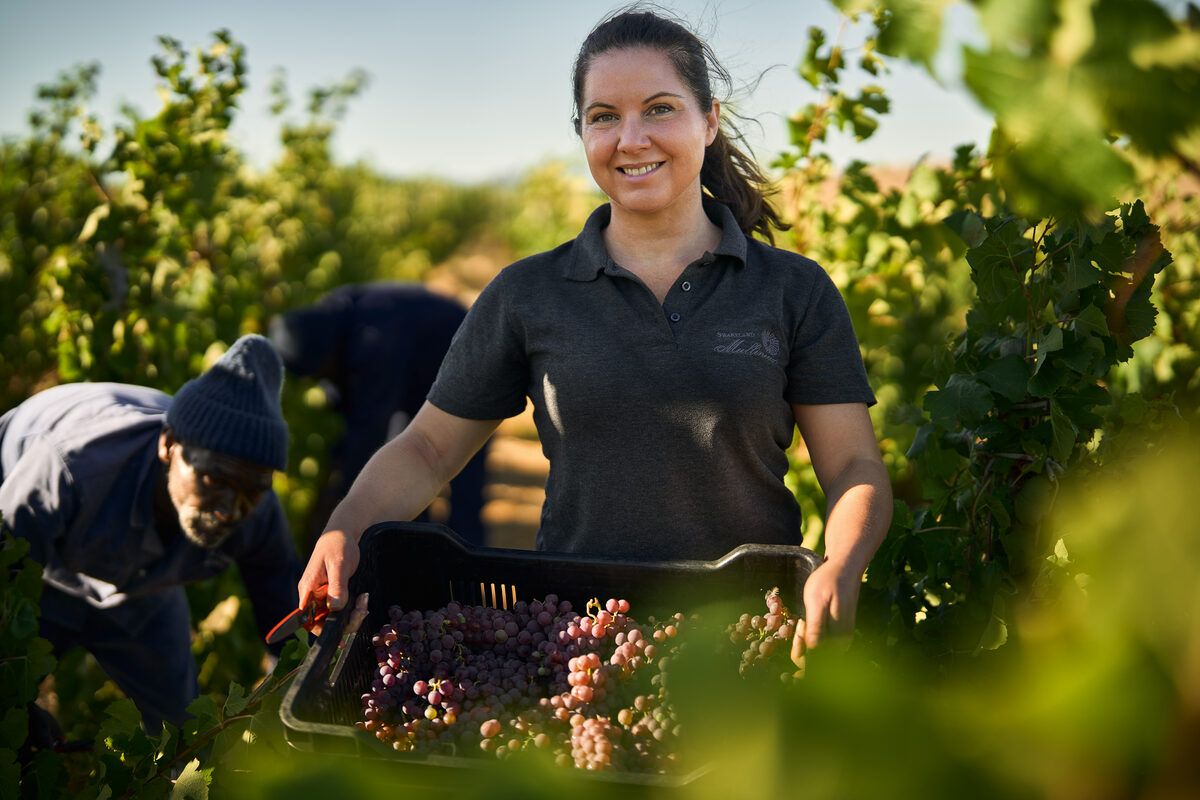
The variety is distinguished by its dark pink berries, naturally balanced yields, concentration and healthy acidity.
Pink-berried variant dominated 19th century vineyards
Long before Chenin Blanc became South Africa’s signature white grape, Sémillon dominated the vineyards of the Cape.
It is believed that Sémillon’s presence in the Cape’s vineyards goes back to the 17th century.
Then, in the 19th century, plantings of Groendruif, or Green Grape, as it was known, grew exponentially as the industry rapidly expanded. Due to it’s affinity for growing conditions in the Cape, it achieved overwhelming dominance, with an estimate made in the 1820s that it accounted for well over 90% of plantings. At some stage, a pink-skinned mutation emerged naturally in the vineyards of the Cape, and Red Green Grape (Rooi Groendruif or Sémillon Gris) became at least as quantitatively important as the original white-skinned version.
The two variations grew together, were harvested and vinified together and what we know now as Sémillon Gris was never distinguished as a separate variety. And in fact the identification of Groendruif as Sémillon was only made in the early 20th century. As post-phylloxera replanting proceeded apace, the pink mutation was being gradually excluded, to eventually survive only as isolated vines or vine groupings.
Though it became exceedingly scarce, Sémillon Gris was never completely lost. A few wines were made this century from selected pickings of the pink Sémillon grapes, and interest grew as the post-1994 South African wine revolution increasingly acknowledged and paid heed to its past. This growth went beyond pride and nostalgia and included a viticultural appreciation of vines and varieties that had long been adapting to local conditions.
South African wine-writer Tim James, who has helped unearth and record the story of the Sémillon mutation over time, is thrilled by the latest development in the tale: “this is”, he says, “a huge achievement in reclaiming and consolidating the past as a vital element of the present, a living connection to wines today – and an offering of value to the world.”
Andrea’s highly successful (and carefully named) offering on the Cape Winemakers Guild annual auction for more than a decade was all about this: “The Gris” Sémillon which was made from Red Semillon vines harvested from an old Swartland vineyard planted to both Semillon Blanc and Gris, but with the Gris vines not officially recognised. Future releases from the newly planted vineyard at Roundstone can be proudly labelled, more simply and assertively, Sémillon Gris .
Decade-long certification process
The project began in a dry-farmed vineyard planted in 1960 that still contains both Sémillon Blanc and significant populations of Sémillon Gris. Working with Rosa Kruger, whose vision led to the founding of the Old Vine Project, the team identified and selected individual Sémillon Gris vines. The process began in 2012 when cuttings were taken and subjected to in-vitro thermotherapy to eliminate pathogens.
In close collaboration with Vititec, SAWIS and the Department of Agriculture, the plant material underwent years of propagation, evaluation and official vineyard and wine certifications after the mother block was established at Roundstone in 2022. The Mullineux Roundstone block ensures that healthy, certified Sémillon Gris plant material is available for growers and researchers through Vititec, while the OIV listing gives the variety formal international standing for the first time.