The Springboks delivered a performance of brutal scrum dominance and tireless work rate against the All Blacks, but costly yellow cards and disrupted backline combinations prevented them from turning territorial control into a commanding victory. Our player ratings reveal a tale of forward brutality undermined by moments of indiscipline that gifted New Zealand opportunities they simply shouldn’t have been handed.
Ox Nche and Wilco Louw monstered the All Blacks scrum with a display of set-piece savagery that had New Zealand’s front row in absolute tatters. Paul de Villiers covered every blade of grass with his tireless work rate, whilst centurion Damian de Allende celebrated his 100th Test cap by crossing the gain line every single time he touched the ball.
But yellow cards to Cobus Reinach and Marco van Staden disrupted momentum at crucial moments, whilst forced positional changes, Jesse Kriel shifting to the wing after Kurt-Lee Arendse’s early HIA departure, robbed South Africa of the cohesion their dominance deserved.
This was a match the Springboks should have controlled more emphatically. The ratings tell you why they didn’t.
Front-Row Brutality: Nche and Louw Dominate
Ox Nche (8/10) was simply too strong for New Zealand in the scrum. The Bulls powerhouse completely dominated his opposite number, providing a rock-solid platform that allowed South Africa to build attacking momentum and relieve defensive pressure whenever required. But Nche’s contribution extended far beyond set-piece work – he carried well into contact, made important tackles, and showed the kind of work rate that separates good props from great ones.
On the other side of the front row, Wilco Louw (8/10) delivered an equally commanding performance. The All Blacks simply couldn’t deal with him at scrum time, with their tighthead struggling to contain Louw’s power and technique throughout. When your starting props both rate 8/10 for set-piece dominance, you know you’ve won the physical battle up front.
Malcolm Marx (7/10) completed a formidable front-row performance by delivering crucial turnovers at the breakdown, winning vital possession in moments when New Zealand threatened to build attacking pressure.
The Workhorses: De Villiers, De Allende and Kolbe shine
Paul de Villiers (8/10) produced the kind of performance that often goes unnoticed by casual observers but is absolutely cherished by coaches. His work rate was immense – tackles all over the park, carries when needed, defensive sets completed with unwavering commitment. This was selfless, tireless rugby that provided the platform for others to shine.
And shine they did. Damian de Allende (8/10) celebrated his 100th Test cap in vintage fashion, crossing the gain line every single time he carried the ball. That’s not hyperbole – that’s the kind of dominance in contact that defines world-class inside centres. De Allende’s physicality and ball-carrying prowess gave South Africa front-foot ball repeatedly, and his milestone Test deserved this kind of performance.
Out wide, Cheslin Kolbe (8/10) delivered a complete display. Good under the high ball, he grabbed every scrap of possession, showed excellent defensive line speed, and maintained the kind of high work rate that makes him one of world rugby’s most dangerous weapons. Kolbe wasn’t just a finisher on Saturday – he was a workhorse who happened to possess electric pace.
Mixed performances and forced disruptions
Not everyone enjoyed such productive afternoons. Ruan Nortje (6/10) had a mixed outing – doing well in the lineout and winning crucial ball, but missing a critical tackle that nearly proved catastrophically costly. At Test level, those moments define performances, and Nortje’s good work couldn’t quite outweigh that defensive lapse.
Grant Williams (6/10) provided decent service from the base but was guilty of a few poor kicks that cost territory and momentum. Functional rather than spectacular, Williams did his core job adequately without ever stamping his authority on proceedings.
The disruption caused by Kurt-Lee Arendse’s early HIA departure had a ripple effect throughout the backline. Jesse Kriel (5/10) had to shift from outside centre to the wing – not his natural position – and struggled out of position. It wasn’t Kriel’s fault, but the forced positional change clearly affected his performance and robbed South Africa of the backline cohesion they’d worked to establish.
Jasper Wiese (7/10) delivered important turnovers, carried well, and tackled effectively, but was guilty of a silly mistake when he ran into teammate Damian Willemse, disrupting an attacking opportunity. Good overall, but that error cost him a higher rating.
Discipline disasters cost momentum
The most damaging aspect of South Africa’s performance came from the bench, where two yellow cards undermined the dominance their starters had established.
Cobus Reinach (4/10) made a poor decision that resulted in a yellow card, putting his team under unnecessary pressure at a crucial stage of the match. At Test level, that kind of indiscipline is simply unacceptable.
Marco van Staden (4/10) followed suit with another yellow card for a disciplinary breach. When your team needs composure and experience from the bench, two yellow cards in quick succession is the last thing any coach wants to see.
Zachary Porthen (5/10) also disappointed after his introduction, struggling in the scrum and failing to maintain the dominance established by Ox Nche. It was a disappointing cameo that highlighted the drop-off in set-piece power when the starting front row departed.
The Positives: Bok finishers who delivered
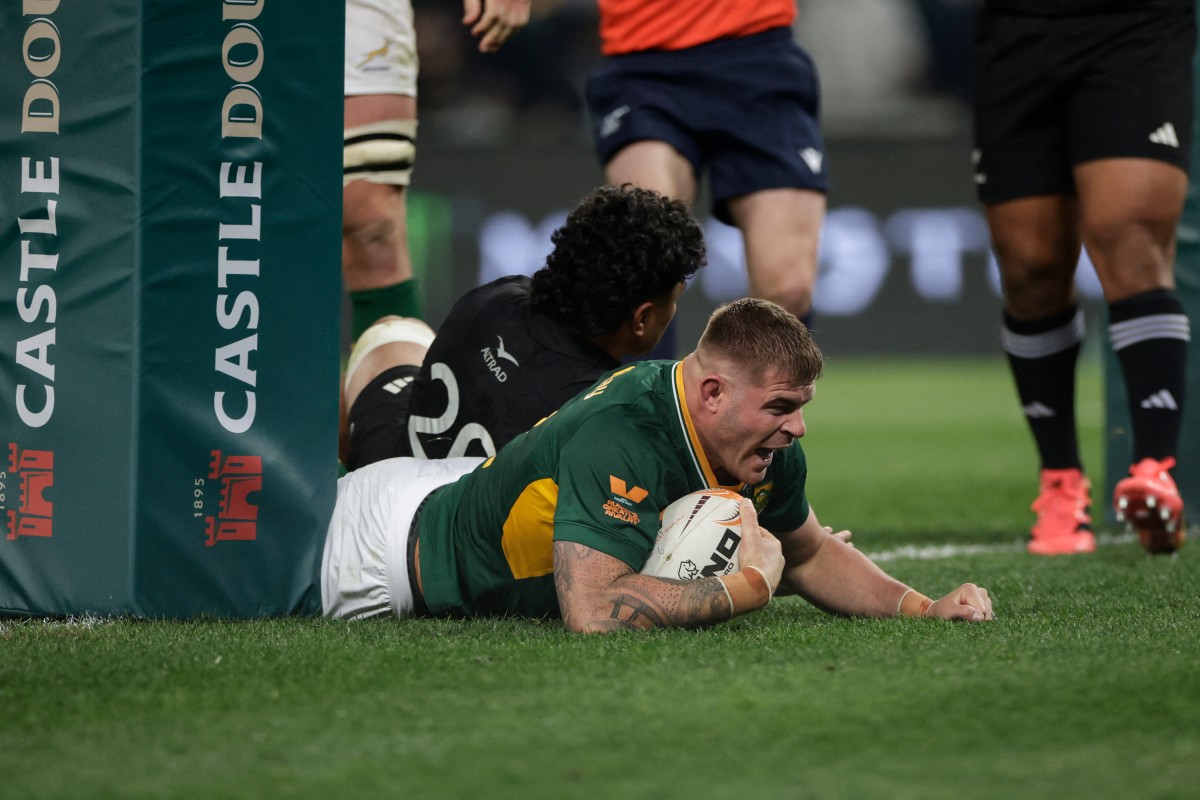
Not all the replacements disappointed. Andre Esterhuizen (7.5/10) made an immediate impact, running good lines, scoring a try, and showing his class when given space to operate. His power and footwork created problems for tired All Blacks defenders, and his try was reward for intelligent running and clinical finishing.
Sacha Feinberg-Mngomezulu (7.5/10) continued to impress at flyhalf, showing good defence and attacking the line with purpose and intent. His maturity in such a big Test match bodes well for the Springboks’ future.
Damian Willemse (7/10) was solid under the high ball at fullback, providing the security and positional awareness required from the last line of defence.
The Verdict
The Springboks’ forward dominance, particularly in the scrum where Nche and Louw monstered the All Blacks – provided a platform for victory. Tireless performances from De Villiers, a centurion’s masterclass from De Allende, and Kolbe’s all-round excellence gave South Africa genuine quality across the park.
But two yellow cards from the bench and forced backline disruptions prevented the Boks from converting territorial control into a commanding scoreline. At Test level against New Zealand, those margins matter enormously.
The ratings tell the story: when South Africa’s starters were on the pitch, they dominated. When discipline wavered and disruptions mounted, opportunities were squandered. Against the All Blacks, you can’t afford either.