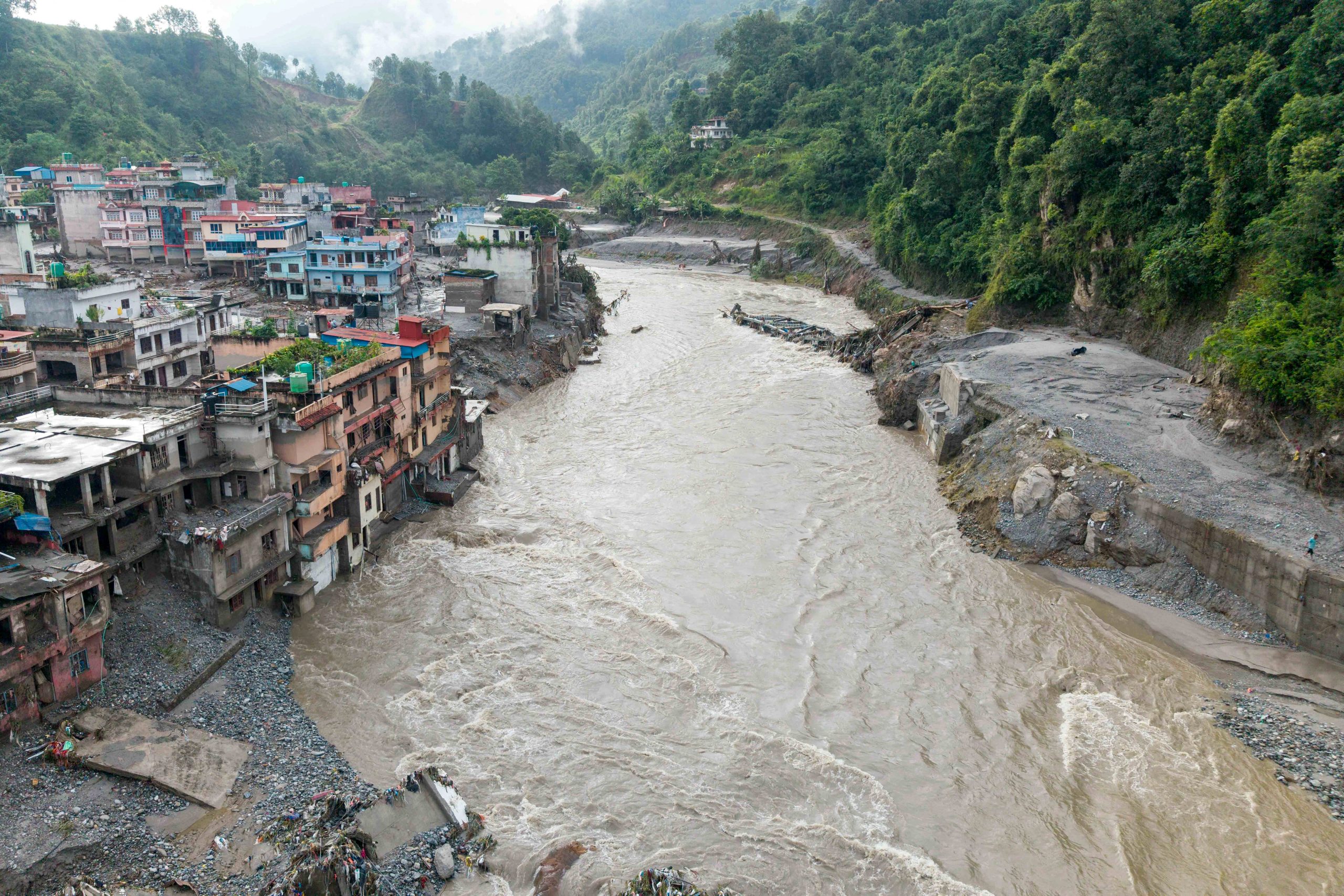
Scientists have confirmed climate change played a central role in last month’s deadly glacial mountain collapse on the China-Nepal border that killed more than 1 400 people and left at least 6 600 missing.
The World Weather Attribution (WWA) group said on Thursday the disaster did not result from a single extreme weather event. Instead, scientists described it as a “compound crisis” shaped by long-term warming, glacier retreat, permafrost thaw and geological instability.
“Relentless warming has lifted the altitude of the freezing threshold on the high Himalaya, exposing ice and permafrost deep in the bedrock to higher and longer thaw temperatures, weakening mountain slopes,” the WWA report said.
A massive section of rock and glacier broke away from Langtang Lirung mountain on 26 August, triggering a huge flood of water, ice and debris that swept downstream, destroying communities and infrastructure.
Mountain slopes facing irreversible shifts
Walter Immerzeel, a mountain hydrologist at Utrecht University and report co-author, said the region faces “fundamental, irreversible shifts” as glacier retreat and permafrost degradation undermine mountain stability.
“We conclude that this was a geologically vulnerable slope, potentially weakened by the 2015 earthquake, but it was destabilised further by glacier retreat and permafrost fall,” Immerzeel told reporters.
Nepal, a largely rural nation of 30 million people, contributes a tiny fraction of global greenhouse gas emissions compared to industrialised nations.
The study found July and August 2026 were the warmest months locally recorded, while heavy snowfall in late 2025 contributed to increased meltwater before the collapse.
A magnitude 7,8 earthquake in Nepal in 2015 may have further weakened the slope, although its precise role remains uncertain, the report said.
ALSO READ: Nepal flash floods: 919 dead, nearly 5 000 missing including ten from South Africa
Nepal PM to address UN on climate crisis
Last month’s disaster has raised concerns about the limits of adaptation to climate change.
Prime Minister Balendra Shah will take his first foreign trip as Nepal’s leader to address the UN General Assembly on the urgent issue next week.
Nepal estimates the reconstruction bill after the deadly floods will amount to R78 billion.
“There is no doubt that climate change is one of the drivers, and therefore obviously it needs to be discussed in the context of loss and damage,” Friederike Otto, a professor of climate science at Imperial College London, told reporters.
Death toll continues to rise
Nepal’s disaster authority said on Wednesday it had sharply revised up the number of people considered missing to 6 150, following data collection and verification in affected districts.
The number of bodies retrieved stands at 1 403, with 105 identified, according to the disaster agency.
In China, the toll stands at 43 dead and 519 missing, according to state media.
The combined toll from both nations now stands at 1 446 people dead and at least 6 669 missing.