

PRETORIA — Statistics South Africa (Stats SA) has completed a major overhaul of the nation’s Gross Domestic Product (GDP), updating the base year from 2015 to 2022 and incorporating refined methodological tools, new data sources, and expanded coverage of the non-observed economy.
The comprehensive rebasing and benchmarking exercise reveals that South Africa’s economy is noticeably larger than previously reported. Under the updated calculations, nominal GDP for 2025 was revised upward by 5.3%, rising from an initial estimate of R7,642 billion to R8,044 billion. For the 2022 base year, the new estimate stands 4.9% higher, adding R324 billion to total national output.
Finance industry and household spending
To maintain accuracy in line with international best practices, national statistical agencies periodically update their benchmarks to reflect structural shifts across industries.
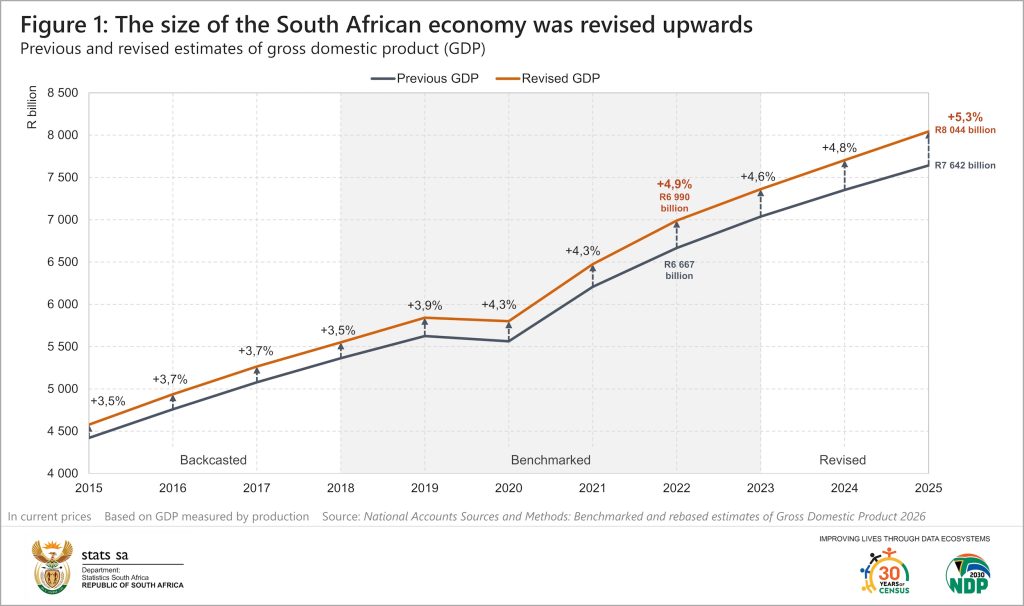
The R324 billion expansion in the 2022 base year was primarily driven by the finance industry, which contributed R127 billion to the upward revision. This surge was largely due to an improved methodological framework for measuring owner-occupied rent. The trade and mining sectors also added R61 billion each to the refreshed baseline.
On the expenditure side, household consumption expenditure recorded the largest upward shift. This adjustment reflects newly integrated data from the Income and Expenditure Survey, along with better capture of informal trade and owner-occupied housing costs.
Shining light on the non-observed economy
Stats SA has systematically tracked informal, illegal, and illicit activities since 1995, gradually broadening coverage during each benchmarking cycle from spaza shops and informal taxis to street hawkers, shebeens, and informal recycling.
For the 2022 base year, Stats SA incorporated several previously uncounted activities into its official calculations, including illegal mining, e-hailing services, and unregulated gambling.
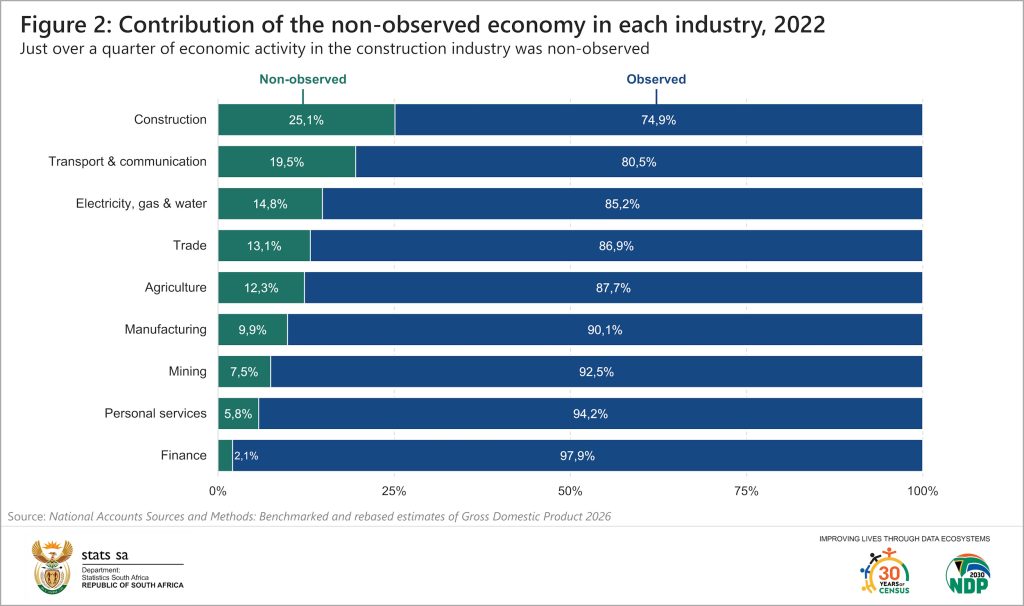
In total, the non-observed economy accounted for 8.7% (R551 billion) of total value added in 2022:
- Industry Breakdown of Non-Observed Activity: For every R100 generated within the non-observed economy, trade generated R21.00, followed by transport and communication (R17.30) and manufacturing (R14.90).
- Prevalence by Sector: Construction exhibited the highest concentration, with non-observed activities accounting for just over a quarter of total sector output. Conversely, the finance industry recorded the lowest prevalence at 2.1%.
The structural adjustments provide policymakers, investors, and financial analysts with a clearer, more accurate foundation for assessing South Africa’s economic capacity, debt ratios, and growth trajectory moving forward.
ALSO READ: SA Agriculture thrives despite headwinds, posts record Q2 trade surplus


You must be logged in to post a comment.