

Oxford University Press (OUP) has named ‘brainrot’ as the Oxford Word of the Year 2024, following a public vote that saw more than 37,000 people worldwide have their say.
‘Brain rot’ was one of the six contenders shortlisted by OUP’s language experts to reflect some of the moods and conversations that have shaped the past year.
Selected through a combination of voting results, public commentary, and analysis of OUP’s language data, ‘brain rot’ gained new prominence in 2024 as a term used to capture concerns about the impact of consuming excessive amounts of low-quality online content, especially on social media.
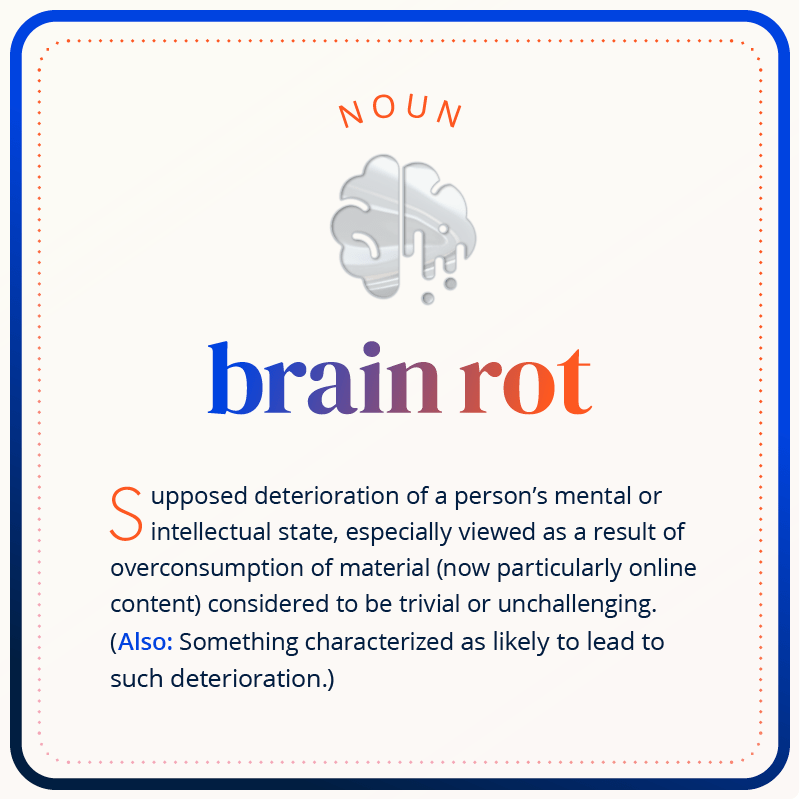
Defined as ‘the supposed deterioration of a person’s mental or intellectual state, especially viewed as the result of overconsumption of material (now particularly online content) considered to be trivial or unchallenging’, ‘brain rot’ saw an increase of 230%* in its frequency from 2023 to 2024.
With the first recorded use of ‘brain rot’ in 1854 by Henry David Thoreau in his book Walden, the term has taken on a new significance in the digital age, especially over the last 12 months.
Initially gaining traction on social media platforms, particularly among Gen Z and Gen Alpha communities on TikTok, ‘brain rot’ is now seeing more widespread use, such as in mainstream journalism, amidst concerns about the negative impact of overconsuming online content.
In 2024, ‘brain rot’ is used to describe both cause and effect, referring to low-quality, low-value content found on social media and the internet, as well as to the subsequent negative impact that consuming this type of content is perceived to have on an individual and society.
Speaking about Oxford Word of the Year 2024, Casper Grathwohl, President, Oxford Languages, says, “It’s been insightful and deeply moving to see language lovers all over the world participate and help us select the Oxford Word of the Year 2024.”
“Looking back at Oxford Word of the Year over the last two decades, you can see society’s growing preoccupation with how our virtual lives are evolving, the way internet culture is permeating so much of who we are and what we talk about. Last year’s winning word, ‘rizz,’ was an interesting example of how language is increasingly formed, shaped, and shared within online communities.
‘Brain rot’ speaks to one of the perceived dangers of virtual life, and how we are using our free time. It feels like a rightful next chapter in the cultural conversation about humanity and technology. It’s not surprising that so many voters embraced the term, endorsing it as our choice this year.
“I also find it fascinating that the word ‘brain rot’ has been adopted by Gen Z and Gen Alpha, those communities largely responsible for the use and creation of the digital content the term refers to. These communities have amplified the expression through social media channels, the very place said to cause ‘brain rot’. It demonstrates a somewhat cheeky self-awareness in the younger generations about the harmful impact of the social media that they’ve inherited.”
This was the third consecutive year that language enthusiasts were invited to have their say, with the six contenders—brain rot, demure, slop, dynamic pricing, romantasy, and lore— opening for public vote on November 14 for two weeks. Once the voting closed, language experts at OUP conducted a final detailed analysis, considering corpus data, votes, and public commentary on the finalists, before naming the definitive Word of the Year for 2024.
Oxford Word of the Year is a word or expression that reflects a defining theme from the past twelve months, either having potential as a term of lasting cultural significance, or providing a snapshot of society at a certain time.
For two decades, it has highlighted the language that has shaped conversations and reflected the cultural shifts, patterns, and sentiments of a particular year. Supported by evidence of real language usage, OUP’s experts track candidates throughout the year via a 26-billion-word corpus of global language data. Previous words chosen by OUP have included ‘selfie’ (2013), ‘climate emergency’ (2019), and ‘vax’ (2021). Since 2022, OUP has opened the selection process to the public, resulting in ‘goblin mode’ (2022) and last year’s winner, ‘rizz’.
Shortlisted words – definitions
- Brain rot (n.): Supposed deterioration of a person’s mental or intellectual state, especially viewed as the result of overconsumption of material (now particularly online content) considered to be trivial or unchallenging. Also: something characterized as likely to lead to such deterioration.