
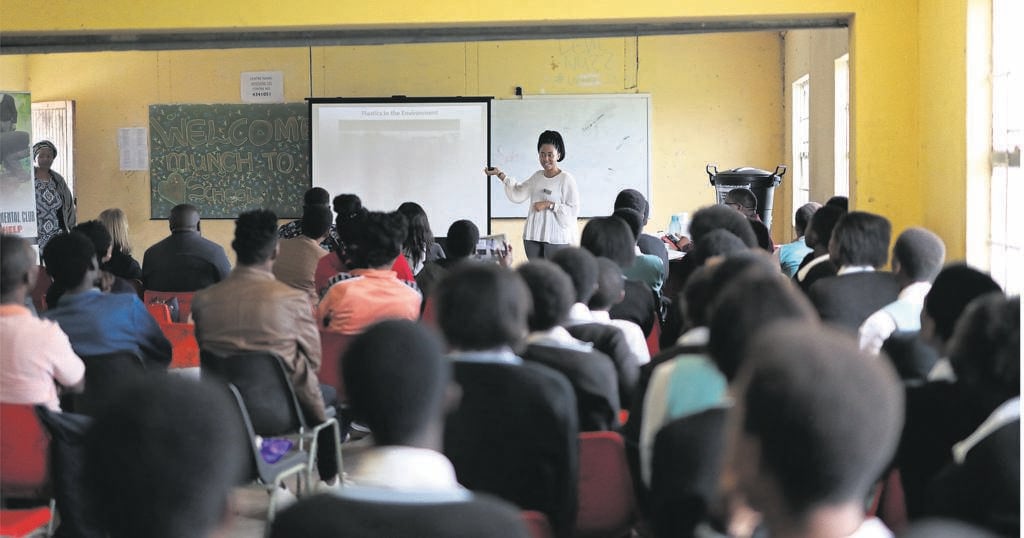
ON February 28, Mfesane Secondary School in Motherwell was the first institution in Nelson Mandela Bay to take part in the Munch-on-the-Move training programme and adopt Munch for a month.
Created by local non-profit Sustainable Seas Trust (SST), Munch is a large wirework coelacanth fish and a recycling deposit that is moved around schools to help collect and sort waste at the source before it ends up in the ocean.
SST’s education team trained the teachers, the school’s governing body and the children from the environmental club at Mfesane Secondary School on how to conduct litter audits within the school’s grounds and how to use Munch.
“It’s a great project because it can give us a chance to recycle and clean our environment and make it a better and safer place,” said a Mfesane Secondary School learner.
The fish wirework is divided into five waste components: plastic caps, PET bottles, paper, HDPE plastic items and aluminium cans. SST will set up a recycling programme within the school, and the Waste Trade Company will collect the recyclables. The programme is set to continue even after Munch leaves for the next school.
Environmental club coordinator, founder and teacher, Patricia Mapuma, said, “We’re extremely grateful to SST for bringing Munch to our school.
“The environmental club learners are always seeking opportunities to reduce the waste within our school, and this is going to be a fun project for them to champion. We take pride in being the first school to roll-out the Munch litter monitoring education programme; we won’t disappoint!
“This programme is going to encourage environmental responsibility to all the learners, and hopefully they’ll take the message back to their homes,” said Mapuma.
The aim of the Munch on the Move education programme is to measurably reduce plastic pollution on school grounds around Africa. This will be achieved by assessing the abundance and accumulation rates of plastic litter in schools, as well as monitoring changes over time.
Munch is used as the key tool to get the children excited about recycling. The programme supports both learners and the teachers through simple and fun educational resources and activities such as games, workbooks, films and comic strips.
The concept of Munch was founded and introduced to SST by two Port Elizabeth siblings, Jemima (eight) and Gabriel (12) Reilly, who wanted to raise awareness about plastic pollution after watching a video of a turtle with a straw lodged in its nose.
“We wanted to get Munch because there’s a lot of rubbish on the beach, so we don’t want the fish to eat it,” said Jemima. Gabriel added, “All the plastic that goes into this metal fish structure will actually be how much plastic the fish in the sea would eat.”
Between March and May 2020, Munch will be launched in four new schools: Motherwell’s Empumalanga Primary School, Pearson High School in Summerstrand and two schools in Johannesburg – Pinnacle Kayalami College and Dainfern College.
Global trends indicate that Africa is the second most polluted continent on Earth and will soon become the most polluted if these trends continue.
This is a major concern, and it is why SST has developed an education programme calling upon schools to take action and lead the way for their communities. SST head of education, Nozi Mbongwa, said, “Today has been amazing! It gives me so much hope working with teachers and learners who want to make a difference within their respective communities.
“About 60 learners from the environmental club, 20 teachers and five adults from the school governing body of Mfesane High School attended the training workshop.
“We want to encourage schools to be the hubs that drive litter monitoring initiatives and increasingly involve the surrounding community areas, growing the scale of influence and in doing so cleaning larger areas,” Mbongwa said.