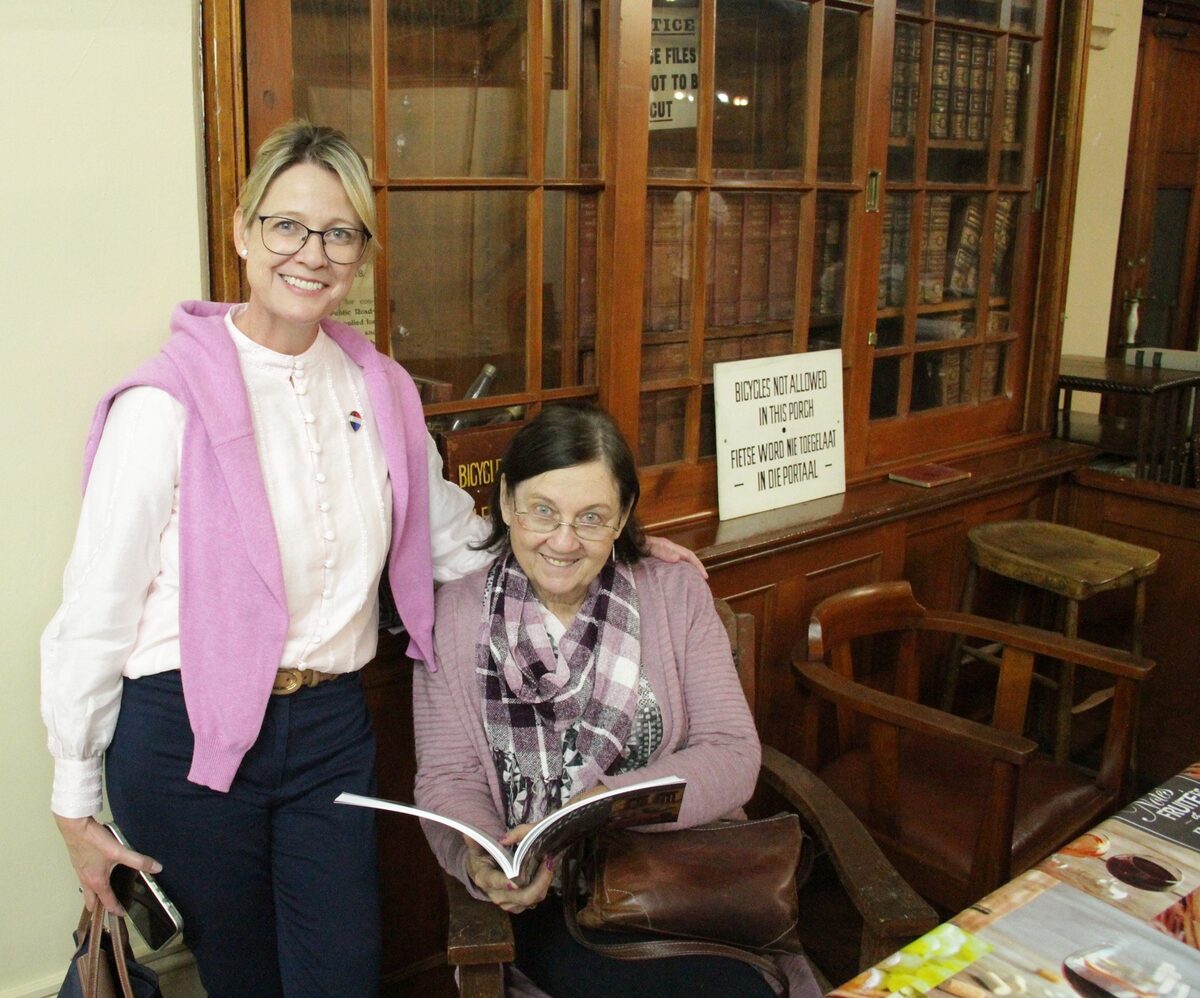

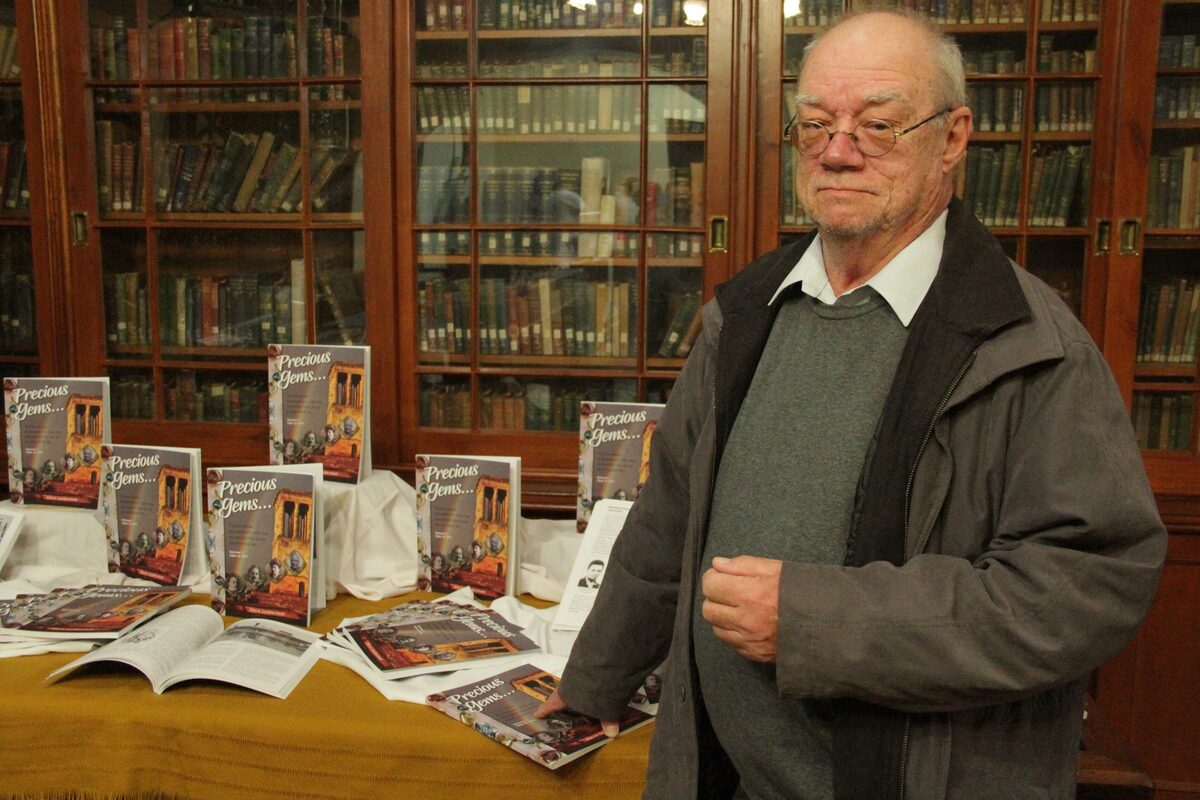
Kimberley author Steve Lunderstedt stood next to the towering shelves of the Africana Research Library, all too familiar to him, and looked out at a room filled with peers, familiar faces and friends who had gathered for the launch of Precious Gems on 27 May. They sat on old wooden and leather library chairs, there to celebrate his latest work.
His new book, featuring “tales from Kimberley and the Diamond Fields of days gone by”, covers the period from 1866 to 1971.
Lunderstedt considers the library, where more than 90% of his research is done, “as the best of its kind in the country. I have spent decades here, becoming part of the furniture.”
To his right stood the striking pale green cast-iron spiral staircase that stands as a central architectural feature within the library. It features intricate Victorian scrollwork on its railings and ornate cutouts on the risers, winding gracefully upward towards a mezzanine level.
Surrounding this staircase are massive, floor-to-ceiling dark-wood bookshelves that are densely packed with old, leather-bound volumes, some of which are protected behind glass doors.
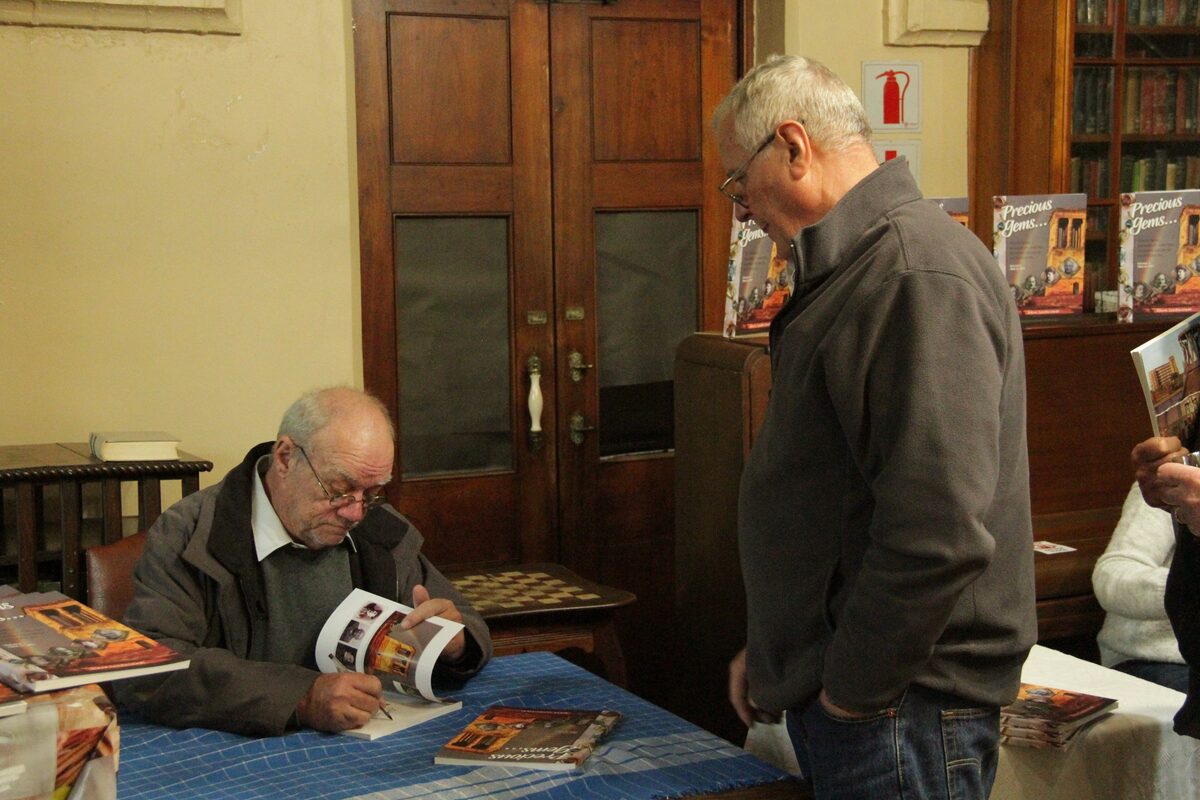
A characteristic welcome
He opened his talk with characteristic dry wit, welcoming those who had travelled from “as far as Beaconsfield and Roodepan”, joking that with the current price of petrol, he was considering investing in a mule and a Scotch cart for his own travels.
The origin of the new book is the Facebook page Kimberley Calls and Recalls, on which he has written more than 1500 stories about historic events in the City of Diamonds since 2013, even though he was initially opposed to social media. Out of the stories posted online, he narrowed this first volume down to about 50 or 60 “gems”.
ALSO READ: Discover hidden literary treasures with author, historian Steve Lunderstedt
Lunderstedt spoke with pride about the book’s cover, which he designed himself. It features an iconic photograph of the Honoured Dead Memorial framed by “a genuine, un-Photoshopped rainbow”. At the centre of the design is the iconic 616-carat diamond containing the portraits of four pivotal figures: Cecil Rhodes, Ernest Oppenheimer, Olive Schreiner and the struggle hero Kgosi Galeshewe. The giant 616-carat octahedral diamond originates from the Du Toitspan mine in the city.
Lunderstedt notes the importance of including Kgosi Galeshewe, “a man who fought in three wars and served 22 years in prison, yet had been largely overlooked by slanted history”.
Galeshewe (c. 1840–1927) was a revered traditional leader of the Phokeng/Tlharo faction of the Batlhaping people, a prominent Tswana tribe. He is celebrated as a fierce anti-colonial revolutionary who spent decades fighting British imperial expansion and land dispossession in the Northern Cape and Northwest.
Hidden histories revealed
The presentation was peppered with the kind of historical anecdotes Lunderstedt is known for. He shared stories of Dr John Daniel Kestell (1854–1941), affectionately known as Vader Kestell, who was one of the most prominent and revered spiritual, cultural and literary leaders in Afrikaner history. His nickname reflects the deep affection and respect he earned as a compassionate, unifying figure who dedicated his life to the spiritual and physical well-being of his people, particularly during and after the devastation of the Anglo-Boer War (1899–1902).
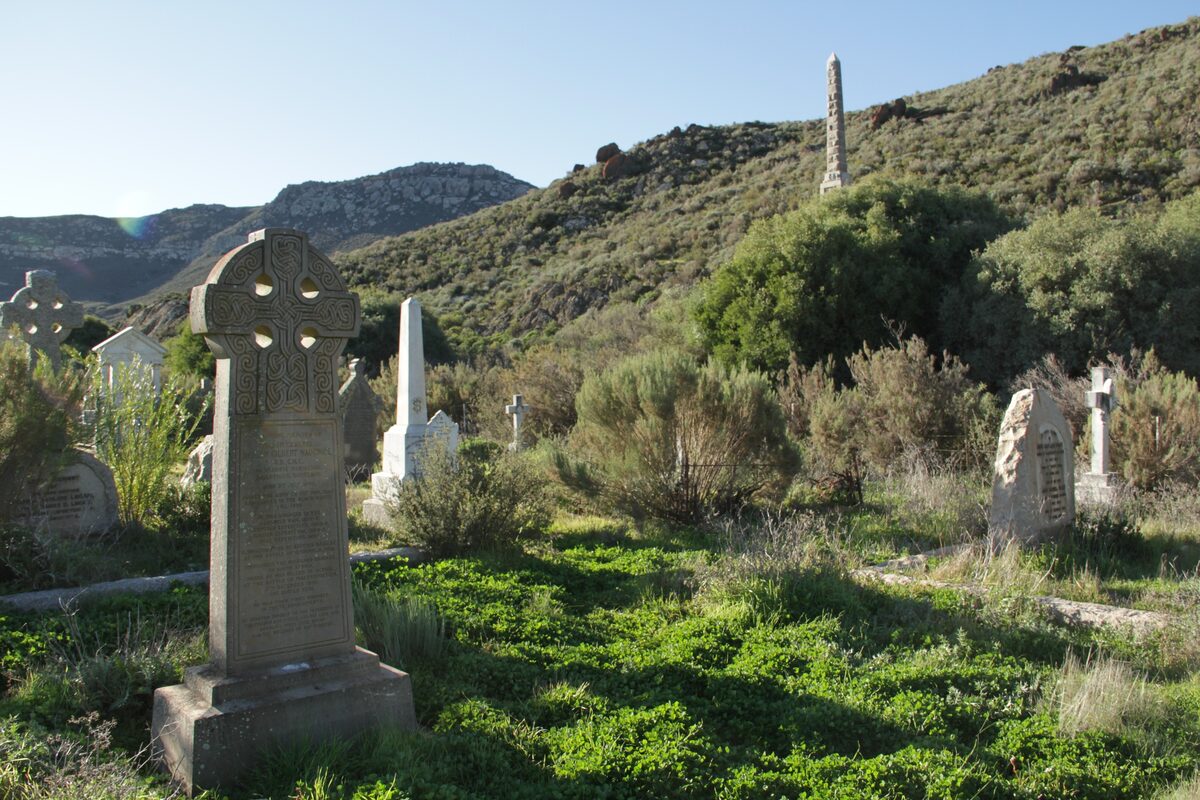
Lunderstedt also shared the poignant image of a South African nurse laying a wreath at her brother’s grave at Delville Wood, where many from Kimberley also perished.
ALSO READ: Historic Africana Research Library seeks help for garden restoration
The Battle of Delville Wood (15 to 20 July 1916) was one of the most brutal engagements of the First World War’s Somme Offensive, and it remains the most famous, tragic and defining chapter in South African military history. For six days and five nights, a single brigade of South African volunteer soldiers held a crucial piece of dense woodland against a relentless, overwhelming onslaught of German artillery and infantry.
Lunderstedt went on one of his famous “tangents”, recounting the entrepreneurial spirit of JD Logan, who ran railway tuck shops and had a British Major-General, Andrew Wauchope, who died at the Battle of Magersfontein in 1899, buried 600 kilometre away from his intended resting place due to a spelling confusion between Magersfontein and Matjiesfontein.
Lunderstedt visited the Wauchope family in Scotland specifically to clarify the correct pronunciation of the surname, as he had heard many different versions.
Gratitude and future plans
He was quick to credit his “poor editing team” for turning his daily social media posts into formal prose, confessing he was “horrified to find he was making mistakes” in his initial drafts.
He also thanked the staff at the library, noting that he had taken staff members like Africana Research Library head Bernice Nagel and Africana Research Library Friends secretary Annelize Rowan to Swift Print printers so they could learn the technical side of book production for the future.
As he concluded, Lunderstedt teased that Volume 2 was already in the works, featuring figures like Robert Sobukwe and Sailor Malan.
When asked why he continues to dig through the archives, the popular historian simply smiled.
For him, the satisfaction comes from the research itself: the great enjoyment of discovery and the joy of ensuring that Kimberley’s hidden histories are captured.
- The book is available under the auspices of the Africana Research Library on 053-830-6247, or it can be purchased at Steve’s Book Sales at the MOTH Centre on Memorial Road on Saturday mornings.