Part Three of Nova News’ Legends of the World Cup Series
In an era when footballers are sculpted like Greek gods and engineered for peak athletic performance, it’s almost impossible to imagine a player described as “short, squat, and awkward-looking” terrorising the world’s best defences. Yet that’s precisely what Gerd Müller did, and he did it better than almost anyone who’s ever laced up a pair of boots.
Also read: Legends of the World Cup: Lev Yashin changed football forever
‘Der Bomber’ didn’t just score goals; he obliterated the concept of what a world-class striker should look like. With 68 goals in just 62 appearances for West Germany, an obscene ratio of 1.08 goals per game, Müller turned the penalty box into his personal hunting ground, leaving defenders bewildered and goalkeepers helpless in his wake.
The numbers that still astound
Even in the modern era of analytics and Expected Goals models, Müller’s statistics remain jaw-dropping. His tally of 14 World Cup goals places him third on the all-time list behind Ronaldo (15) and Miroslav Klose (16), but here’s where the numbers tell the real story. Müller’s goals-per-game ratio of 1.08 obliterates both Brazilian legend Ronaldo (0.79) and compatriot Klose (0.67).
Alsor read: Legends of the World Cup: Andrés Iniesta, the illusionist who made history
When Klose finally surpassed Müller as Germany’s all-time leading scorer in 2014, it came with an asterisk the size of Bavaria, the modern striker required 132 appearances to notch his 69th international goal. Müller had managed 68 in just 62 matches, a testament to efficiency that borders on the absurd.
Golden years: 1970 and beyond
The year 1970 marked Müller’s coronation as football royalty. Fresh off a blistering season with Bayern Munich, he arrived in Mexico for the FIFA World Cup and proceeded to dismantle opposition defences with ruthless precision. Ten goals later, he claimed the Golden Boot as the tournament’s top scorer, then capped off the year by winning the Ballon d’Or.
But Müller wasn’t finished. The 1972 European Championship saw him claim another golden boot with four goals, including a brace in the final as West Germany lifted the trophy. Then came the crowning moment of his international career.
Munich magic: The 1974 world cup final
On 7 July 1974, with his home stadium in Munich serving as the stage, Müller wrote the final chapter of his international story in the most dramatic fashion imaginable. Facing Johan Cruyff’s Netherlands, the creators of Total Football and the tournament’s mesmerising favourites, West Germany found themselves trailing before roaring back.
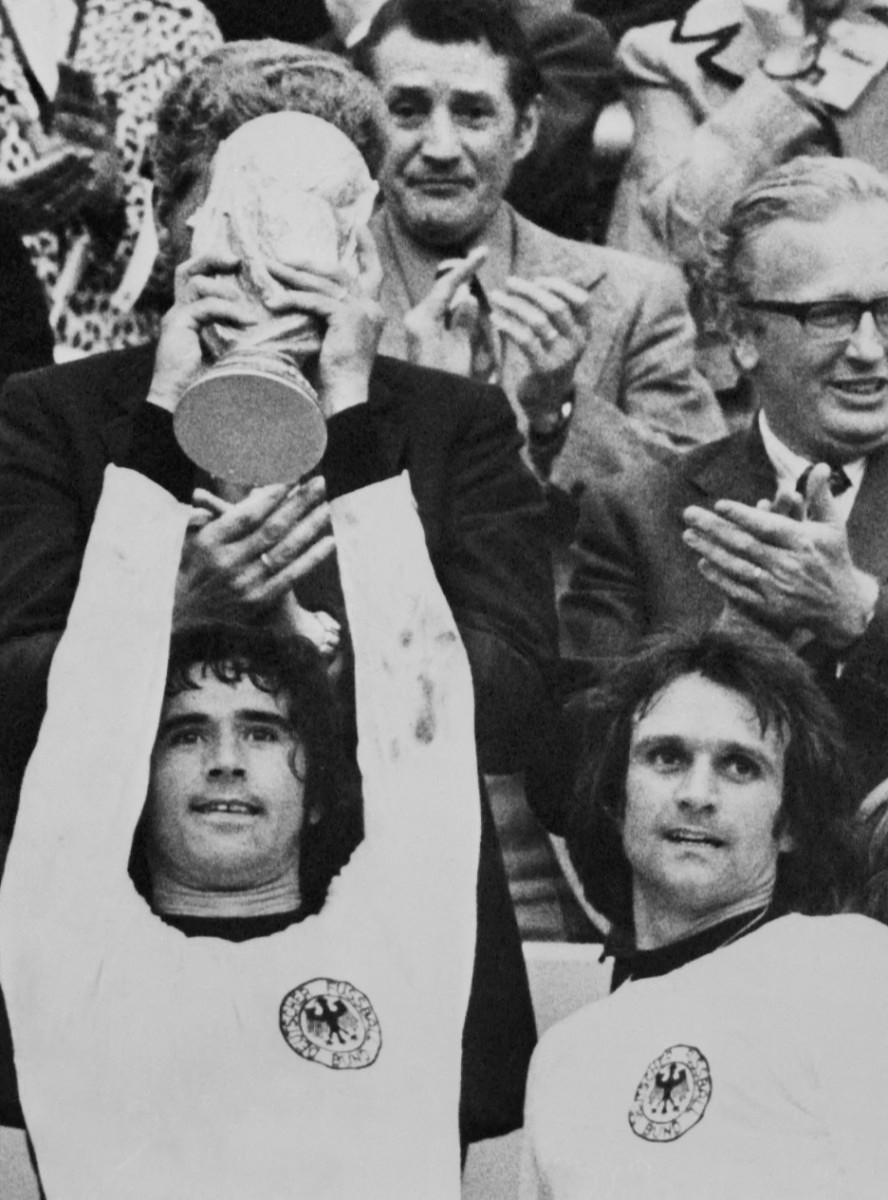
With the scores level at 1-1, Müller did what Müller did best. He found space where none existed, positioned himself perfectly, and buried the winner to secure a 2-1 victory and West Germany’s second World Cup crown. It was his fourth goal of the tournament, bringing his World Cup tally to 14 – a record that would stand for 32 years until Brazil’s Ronaldo finally surpassed it during the 2006 World Cup, coincidentally held in Germany.
That Munich final proved to be Müller’s international swansong. Despite an apparent dispute with the German Football Association at the post-tournament celebration over players’ wives not being invited whilst officials’ wives were, Müller later revealed he’d made the decision to retire before the tournament even ended. He walked away on top, World Cup winner, with nothing left to prove.
The striker who defied convention
So how did a player described by author David Winner in his book Brilliant Orange: The Neurotic Genius of Dutch Football as “short, squat, awkward-looking and not notably fast” become one of the most lethal finishers in football history?
The answer lay in attributes that couldn’t be measured in sprint tests or vertical leap assessments. “He never fitted the conventional idea of a great footballer, but he had lethal acceleration over short distances, a remarkable aerial game, and uncanny goalscoring instincts. His short legs gave him a low centre of gravity, so he could turn quickly and with perfect balance in spaces and at speeds that would cause other players to fall over. He also had a knack of scoring in unlikely situations,” Winner wrote
Explosive, deceptive, unstoppable
Müller’s game was built on extreme acceleration, agility, and deceptive changes of pace that allowed him to reach loose balls first and slip past defenders who thought they had him covered. His teammate and fellow legend Franz Beckenbauer once marvelled at Müller’s deceptive speed: “His pace was incredible. In training I have played against him and I never had a chance.”
Inside the penalty area, Müller became something close to clairvoyant. His movement, coordination, and intelligence allowed him to manufacture scoring opportunities from positions and angles that would leave other strikers scratching their heads. He possessed the rare ability to score with virtually any part of his body, head, left foot, right foot, shin, chest, often from awkward positions that defied conventional finishing technique.
A legacy that endures
Gerd Müller retired from international football at just 28 years old, his body of work already complete. In eight years wearing the West German shirt, he’d won a World Cup, a European Championship, a Ballon d’Or, and established himself as one of the most prolific goalscorers the sport has ever seen.
His international record stood for nearly four decades. Even as the modern game evolved, with sophisticated training methods, sports science, and tactical innovations, it took until 2014 for another German to surpass his tally, and even then it required more than double the number of appearances.
Der Bomber redefined what a striker could be, proving that goalscoring genius comes in all shapes and sizes. Sometimes it arrives in a compact, unassuming package with short legs and awkward movement. And sometimes, that package contains the most lethal finisher the World Cup has ever seen.