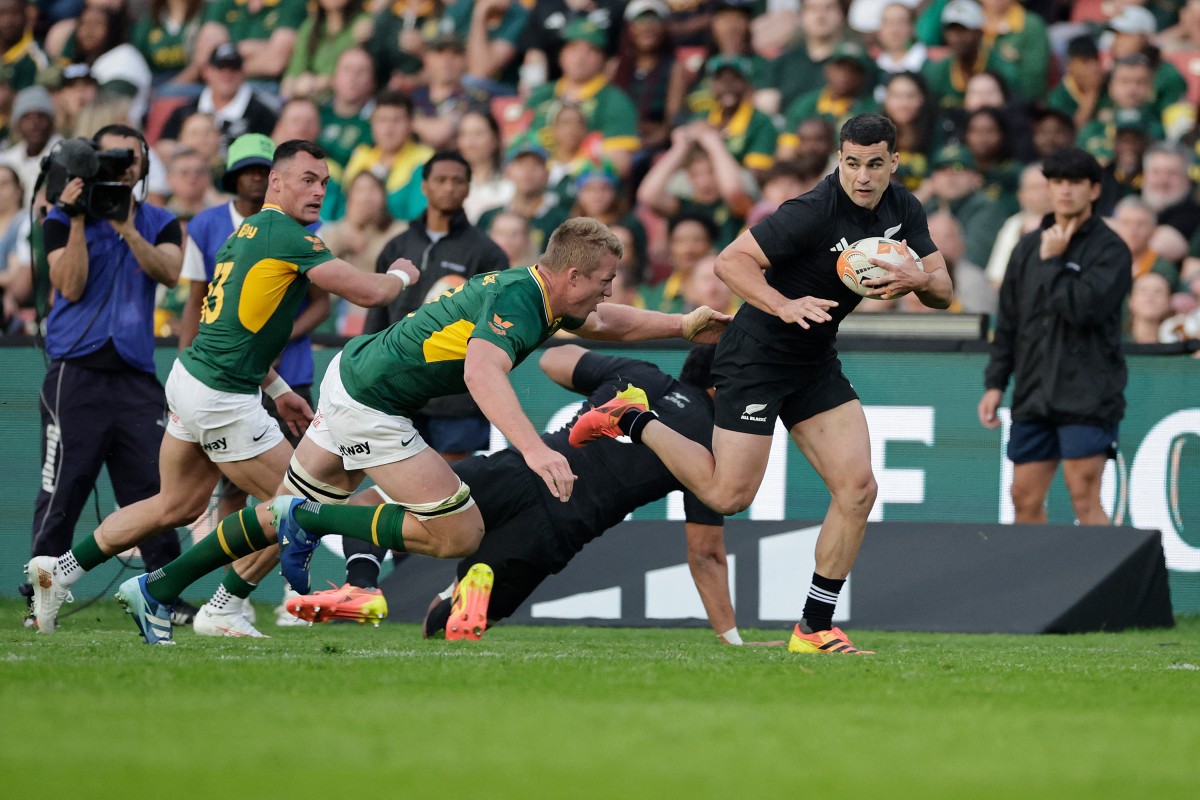
The chess match has begun, and the opening moves are being played out in public.
Dave Rennie has a masterplan to beat the Springboks, we explore exactly how the All Blacks coach intends to crack South Africa’s formidable defensive shell.
Unlocking the Springbok fortress
Here’s where it gets properly fascinating. The Springbok defensive system isn’t designed like most international defences. It’s not primarily about getting the ball back or creating jackal opportunities, it’s about something far more insidious.
South Africa’s defence is built to push you backwards, to come at you hard from angles outside your peripheral vision, to tackle you behind the gain line and force mistakes or panicked kicks. It’s suffocating, relentless, and brutally effective.
So how do the All Blacks unlock it? Squidge rugby has identified multiple tactical avenues, and here’s where the masterplan gets deliciously complex.
The attrition approach
One option is to fight fire with fire, congesting the Springbok defence through hard forward carries against the grain and relentless pick-and-drive phases. The theory is simple: keep hammering away with big bodies until you’ve pulled in enough defenders to create the space New Zealand craves out wide.
It’s attritional rugby, not traditionally the All Blacks’ preferred method, but it can be devastatingly effective. Once those forwards are sucked in, committed to stopping the close-quarters battering ram, suddenly the space opens up for New Zealand to do what they do best, play wide with pace and precision.
Think of it as the rugby equivalent of a boxer working the body to open up the head. You grind, you wear them down, you force defensive compression, then you strike where the gaps appear.
Playing with fire
The alternative approach is far more audacious, play extremely flat, invite Springbok defenders onto the ball carrier, then make late offload decisions to keep the ball moving through contact.
This requires nerves of steel and exceptional skill execution. You’re deliberately putting yourself under pressure, banking on your ability to make a good read on what the defence is doing whilst South African forwards are hammering down towards you at full tilt.
If the Springbok wings come hard out of the defensive line, the bridge pass to the outside becomes available, a tactic New Zealand deployed brilliantly against France. The risk? One mistimed offload under that immense defensive pressure gifts possession to a side that punishes mistakes ruthlessly.
Embracing the system
Here’s the truly counterintuitive element of Rennie’s approach, according to Squidge: the All Blacks actually want the Springbok defensive system to work.
Rather than trying to break it down or force South Africa to abandon their structure, New Zealand are backing their skill level to adapt and find solutions within the framework the Boks provide. It’s remarkably confident, essentially saying “bring your best defensive system, we’ll figure it out anyway.”
The Springboks have built a defence with multiple fail-safes, layers of coverage designed to handle various attacking scenarios. The All Blacks are betting their skills trump those fail-safes.
The short-side weapon
One specific tactical avenue is overloading the short side to combat those defensive fail-safes and catch-up defenders.
The theory is elegant: if Springbok wingers are forced to make tackles on the short side, they’ll hit the ground and be temporarily out of the defensive picture. The fold defender covering behind them will probably be a forward. Meanwhile, if New Zealand overload that short side with backs, they’ve potentially created a mismatch, Kiwi back versus Springbok forward.
That’s the kind of scenario where New Zealand’s skill advantage becomes decisive. A forward trying to mark Cheslin Kolbe or Will Jordan one-on-one in space? Good luck with that.
World Cup reconnaissance
Critically, whatever combination of tactics Rennie deploys this weekend isn’t just about winning the immediate series, it’s reconnaissance for next year’s World Cup.
Every variation attempted, every defensive response analysed, every tactical wrinkle explored becomes valuable intelligence for the tournament that truly matters. This series becomes the ultimate laboratory where tactical hypotheses meet reality.