
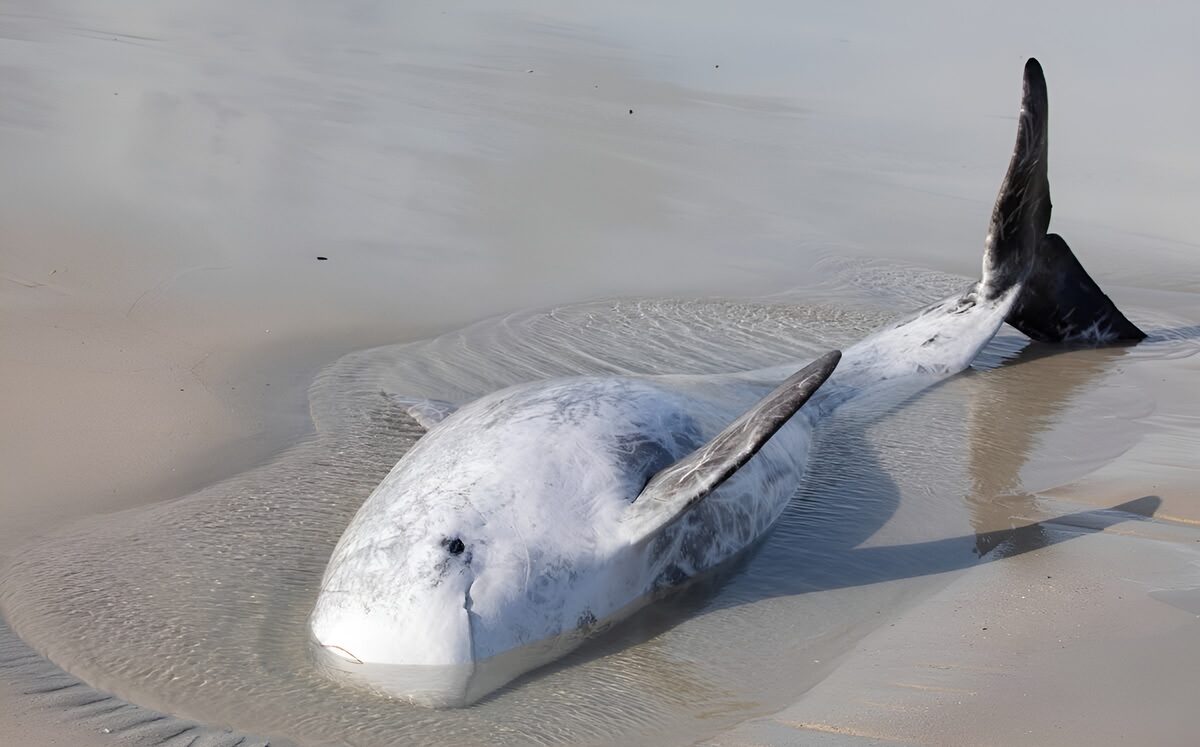
When more than 80 people come together to rescue a stranded Risso’s dolphin, you can be sure that this is a community to be reckoned with.
That is exactly what happened over the weekend (16 August) when news of the stranded Risso’s dolphin was posted on social media. Within minutes, not only were residents on the scene with buckets and towels, but CapeNature had also arrived to assess the situation. The Stranded Risso’s dolphin was found on the west end of Silversands Beach at Seafarm’s first houses and safely return to the sea.
After they released the dolphin, CapeNature confirmed that the dolphin was swimming upright and seems to be navigating away from the shoreline. “It is visibly weak but we can only hope that it survives the ordeal,” the Betty’s Bay Conservancy said on their Facebook page.
Scars
Facebook users were particularly concerned about the scars on the dolphin but according to the International Association for Aquatic Animal Medicine Risso’s dolphins are known for their heavily scarred skin, which is usually caused from teeth raking between dolphins, as well as circular markings from cookie-cutter sharks.
The report explains that the scars are usually gray to white, making them more noticeable on Risso’s dolphins. “But there is something more than a simple white scar on Risso’s dolphins; it has a unique and highly repetitive pattern.
Healed white scars, deep wounds previously created by cookie-cutter sharks, are mainly divided into four parts from the center to the outermost layer: The white scar in the center, the migrating black lines, the gray scar on the periphery and the black scar on the outermost periphery,” they stated.
“Furthermore, in mature healed white scars, the rete and dermal ridges, collagen bundles, and adipose tissue were restored under histologic examination. These structures weren’t found in the healed deep wounds in humans and pigs.”
According to Marine Dynamics if the public comes across any dead animal or live animal seemingly in need of help, please contact your local conservation network (can likely find someone on Google).
“Anything in the Overberg region can be reported to us (Dyer Island Conservation Trust). If you cannot find an organisation in your area, contact whoever you know of as the stranding networks are quite well connected and the right people should be able to be contacted. Important to make sure you get advice from people who know what they are doing. Often well meaning members of the public do more harm as they did not get advice from experts,” they said. The contact number for the Dyer Island Trust is 082 907 5607.
Southern Right Whales
• Hermanus Times reported on 5 August about the two southern right whales – an adult and a newborn calf – that were found dead near Dyer Island. An adult southern right whale was found on 2 August during a Marine Big 5 tour by Marine Dynamics. The crew encountered the deceased adult whale floating offshore. On 3 August, the next day, a second deceased southern right whale was found floating offshore. “Examinations revealed that this was a male calf with an unhealed umilicus which meant that it had been born quite recently.” Marine Dynamics confirmed that the adult female died by ship strike. “It is assumed that the second deceased southern right whale was her calf and died because such a young calf cannot survive without its mother. We are still waiting on genetic tests to confirm, ” they said.