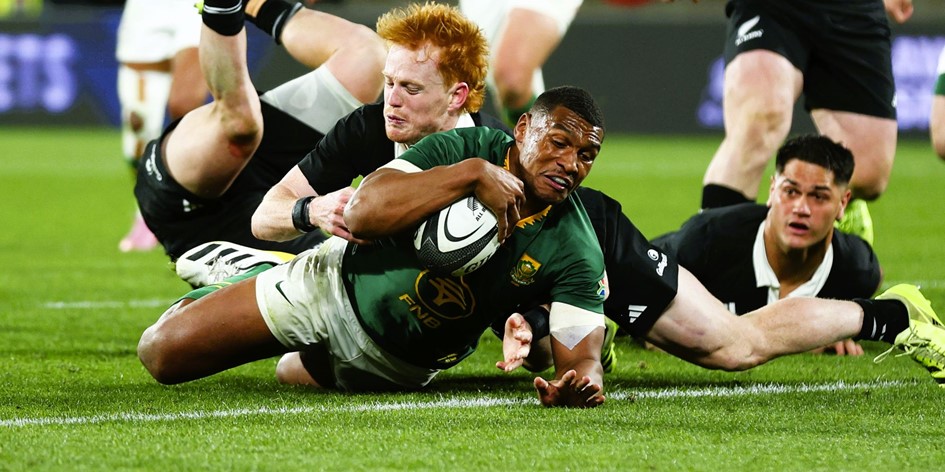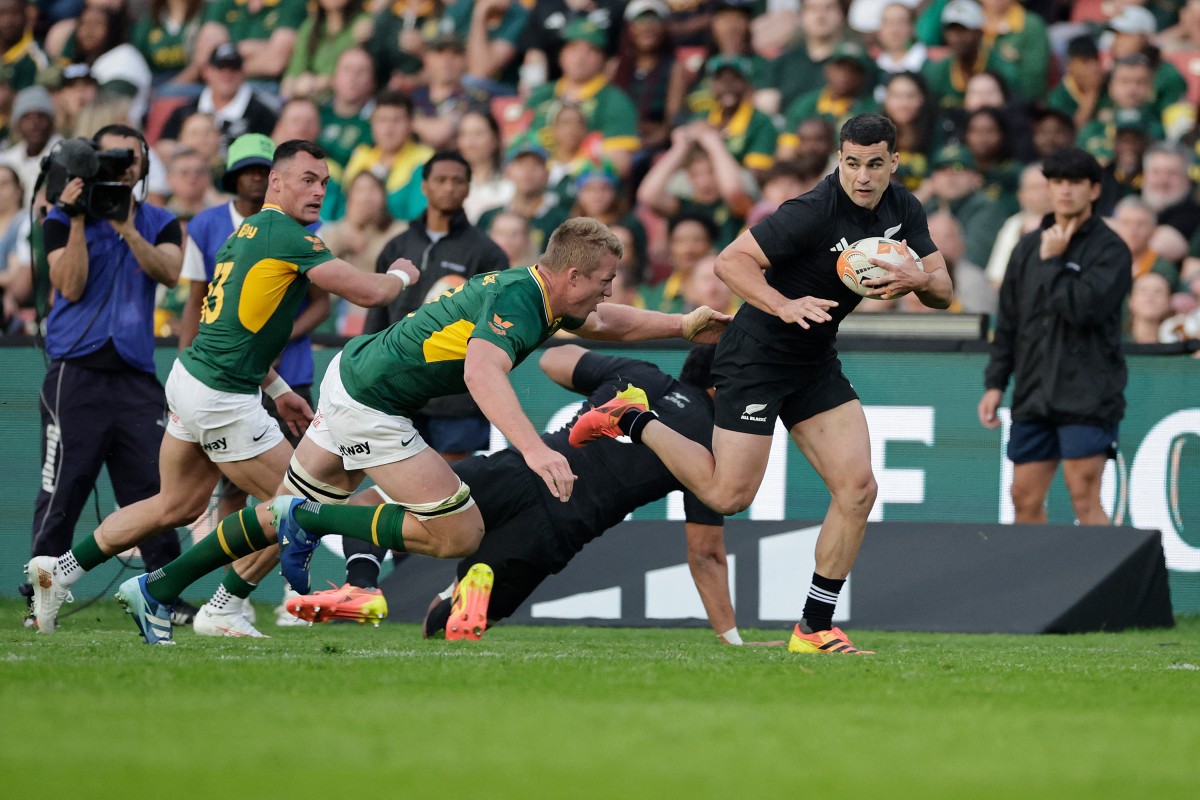
The All Blacks didn’t beat the Springboks by going toe-to-toe in a brutal arm wrestle. They beat them by being smarter, sharper, and more clinical when opportunities arose, exploiting South Africa’s aggressive defensive line speed with precisely the kind of change of direction rugby that turns defensive strength into vulnerability.
That’s the compelling tactical breakdown delivered by Ben Herring on the Megafoon Rugby podcast, where the elite coach dissected exactly how Dave Rennie’s side engineered a 5-1 try count that barely seemed believable given the Springboks’ defensive excellence throughout most of the contest.
Targeting the change of direction
The All Blacks identified South Africa’s aggressive line speed as both a strength and a potential weakness, and they built their entire attacking strategy around exploiting the gaps that appear when defenders commit hard in one direction.
“Particularly around the lineout they would go one or two phases and swing back to try and target Grant Williams on the short side,” Herring explained. “Typically teams will be a little softer on their short side, but South Africa come hard all the time. They leave Grant Williams on the end.”
That tactical insight is crucial. Most teams defend their short side with reduced numbers and slightly less aggression, knowing the attacking side has less space to work with. But the Springboks don’t operate that way, they come hard everywhere, all the time, trusting their line speed and physicality to shut down attacks before they develop.
New Zealand recognised that commitment and targeted it ruthlessly. Two of their tries came directly from change of direction plays that caught South African defenders flowing hard in one direction whilst the ball went the other way.
The fake maul
Herring highlighted the All Blacks’ tactical sophistication in the opening 20 minutes, where they set up fake maul situations designed specifically to disrupt the Springbok defensive structure.
“In the first 20 minutes the All Blacks would set up these little fake mauls and Jacobson would break off, then you would just get one pass with someone carrying,” Herring noted. “The idea is that they try and suck in as many of those tight forwards as possible, then catch them when they are coming hard around the corner or stuck on the short side.”
It’s textbook attacking rugby, create a threat that demands defensive resources, then attack the space those resources have vacated. The Springbok forwards, committed to stopping the maul threat, found themselves trapped on the wrong side of the ruck or committed to a defensive pattern that left space elsewhere.
New Zealand exploited that space with clinical efficiency.
Matching physicality, not testing skills
One of Herring’s most interesting observations was that the All Blacks chose not to test their skillset against South Africa’s high line speed and world class defensive organisation. Instead, they matched the Springboks physically and waited for opportunities to arrive.
“They were matching the Springboks physically. They didn’t try and test their skillset against a high line speed, good defensive team,” Herring said.
It’s a fascinating tactical choice. New Zealand possess some of the most skilful backs in world rugby, players capable of executing complex attacking moves under pressure. But against the Springboks’ rush defence and brutal tackling, those skills become liabilities, turnovers waiting to happen, phases lost to handling errors forced by defensive pressure.
So the All Blacks simplified. They matched South Africa’s physicality, absorbed pressure, and struck with precision when defensive structures cracked.
Wiese brilliant, but final pass missing
Herring praised Springbok number eight Jasper Wiese for his ball-carrying prowess, acknowledging the physical damage he inflicted on New Zealand’s defensive line throughout the contest.
“He was amazing, but they never quite got that last bit. The All Blacks scrambled very well. The South African forwards did very well,” Herring observed.
It’s the story of South Africa’s attacking performance in a nutshell. The forwards did the hard yards, Wiese crashed into contact and made metres, the platform was established, but the final execution, that killer pass or clinical finish, never quite materialised.
Rennie’s hard work philosophy and All Blacks resilience
Herring identified Dave Rennie’s coaching philosophy as a crucial factor in New Zealand’s performance, highlighting the Australian mentor’s commitment to rewarding players who embrace the hard graft and get on with the unglamorous work that wins Test matches.
“To me that is the biggest difference between previous All Blacks teams and this one, they are resilient and just get on with the next job,” Herring said.
It’s a telling observation. This version, under Rennie, simply gets on with it. No drama. No complaints. Just relentless execution of the next task.
That mentality proved decisive against the Springboks.
The unbelievable try count
Herring could barely believe the final try count, five to one in New Zealand’s favour, given the quality of South Africa’s defensive performance for large stretches of the match.
“I think the All Blacks defence was good. I think the Springboks defence was better than five tries,” Herring admitted. “I think when opportunities came for the Springboks, they didn’t take them. And when they came for the All Blacks, they did take them.”
Clinical finishing. It’s the difference between valiant efforts and victories. The Springboks created chances but couldn’t convert. New Zealand created chances and buried them ruthlessly.
Arendse injury breaks cohesion
The injury to Kurt-Lee Arendse that forced him off permanently had a ripple effect throughout the Springbok backline that Herring identified as tactically significant.
“The centre combination in rugby is very important for a team’s cohesion on both attack and defence. Twelves and thirteens’ experience together is huge. When you lose that experience together, they didn’t look as sharp or connected,” Herring explained.
Jesse Kriel’s forced shift from outside centre to the wing to cover Arendse’s absence disrupted the combinations South Africa had worked to establish. Communication suffered, and the cohesion that makes defensive systems work seamlessly began to fray.
New Zealand noticed. And they exploited it.
High standards, harsh criticism
Herring acknowledged the intense scrutiny the Springboks face, both internally and from their passionate public, where anything less than excellence attracts severe criticism.
“The Springboks hold themselves, and the public hold them, to a very high standard. So anything less than exemplary gets critiqued very hard,” he noted.
It’s the price of being world champions. The expectations are sky-high, the tolerance for imperfection minimal. South Africa’s performance wasn’t poor, but against their own standards and their public’s demands, the 5-1 try deficit feels like a crisis rather than a competitive defeat.
Roigard: The All Blacks’ X-factor
Perhaps Herring’s most intriguing tactical insight concerned Cam Roigard’s importance to New Zealand’s attacking threat. It’s not just his bullet pass from the base, it’s his genuine running threat that keeps Springbok forwards honest around the fringes.
“He is quick and deceptively strong. It just puts the big South African forwards on high alert around the fringes of the breakdown,” Herring explained. “When you have those guys just hanging around that little bit longer and checking him, it makes the world of difference on the outside. Grant Williams looked a little bit rattled in the game.”
That’s the tactical ripple effect of having a genuine dual-threat scrumhalf. South Africa’s forwards can’t commit fully to wider defence because Roigard might snipe around the fringes. That hesitation, just a fraction of a second, creates space elsewhere that New Zealand’s backs exploited ruthlessly.
Williams, by contrast, looked rattled and unable to impose himself on the contest. The contrast was stark, and it mattered enormously.
The Verdict
Herring’s breakdown reveals a New Zealand side that won through tactical intelligence, clinical finishing, and relentless resilience. They identified South Africa’s defensive strengths, found ways to turn those strengths into vulnerabilities, and executed their game plan with ruthless precision.
The Springboks played well. But well wasn’t good enough. And when you’re held to the standards South Africa set for themselves, anything less than victory feels like failure.