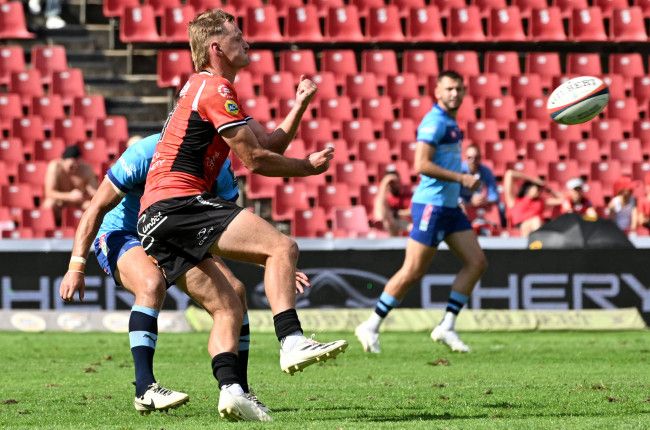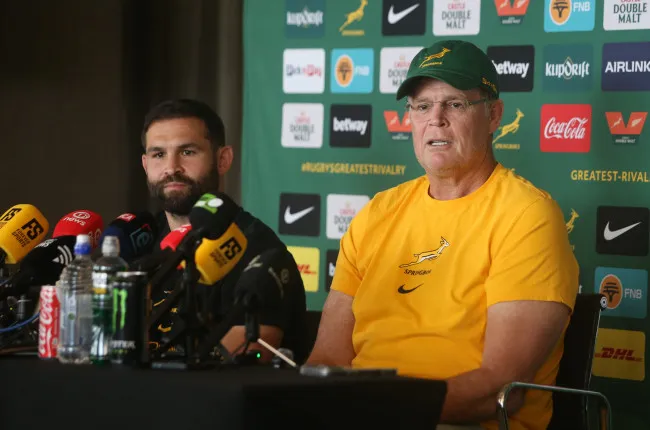
Lions defence coach and former Springbok legend Jaque Fourie has delivered a tactical breakdown of exactly how the All Blacks dismantled South Africa’s defensive structures in Saturday’s 33-16 victory at Ellis Park, and his insights offer a fascinating glimpse into the challenge awaiting his Lions side when they face the same opposition on Tuesday night.
Also read: Erasmus on Boks’ Ellis Park implosion: ‘Plans didn’t work, that’s on me’
Fourie, who earned 72 Springbok caps and remains one of South African rugby’s most astute defensive minds, didn’t mince words when asked by reporters to analyse the match that saw New Zealand take a 1-0 lead in the four-Test Greatest Rivalry series.
The All Blacks didn’t just outscore the Springboks. They tactically outmanoeuvred South Africa’s vaunted rush defence by playing deeper, using superior hand speed, and exploiting the spaces created when defenders committed too hard to the line.
And on Tuesday night at Ellis Park, the Lions will attempt to solve the same riddle that left the world champions searching for answers.
Playing deeper to beat the rush
Fourie identified the All Blacks’ deeper attacking alignment as the key tactical adjustment that unlocked South Africa’s aggressive defensive system.
“The hand speed that the All Blacks have been playing, they’re playing a little bit deeper. So they’re getting around us,” Fourie explained. “They force the Springboks to get off the line a lot harder. And if we don’t make our tackles, it’s very difficult to set again.”
It’s a chess match in rugby boots. The Springboks employ one of world rugby’s most aggressive rush defences, flying off the line to pressure ball carriers and force errors. The All Blacks countered by positioning their attacking players deeper, giving themselves time and space to execute before South African defenders arrived.
When the rush defence connects, it’s devastating. But when it misses, as it did several times on Saturday, the All Blacks exploited the gaps with clinical precision, and South Africa couldn’t reset their defensive structure quickly enough to prevent line breaks.
The rip technique that caught South Africa out
Fourie also highlighted the All Blacks’ ball-stripping technique, a tactic that Springbok coach Rassie Erasmus admitted caught South Africa by surprise on Saturday.
New Zealand’s approach was methodical and effective: the first defender tackles low, pinning the ball carrier’s legs and halting forward momentum. The second defender immediately targets the ball, attempting to rip possession before the ball carrier can present or support arrives.
“I think what the All Blacks did well is they have improved defensively,” Fourie said. “We saw Saturday that at stages, at times, they went very low. They tackled the guys low and the second guy was on the ball.”
It’s a high-risk, high-reward strategy that requires precise timing, excellent communication between defenders, and ball carriers isolated long enough for the rip to succeed. The All Blacks executed it repeatedly on Saturday, winning crucial turnovers that shifted momentum and gave them attacking platforms.
Dominating contact: The counter strategy
So how do you stop it? Fourie’s answer is deceptively simple but brutally difficult to execute under Test match intensity: dominate contact.
“I think you have to dominate contact first. I think that’s the main thing,” Fourie explained. “First of all, we have to dominate contact. The supporting player needs to get on his back [the ball carrier] and get him over that advantage line. Then it’s very difficult to rip the ball.”
The theory is sound. If the ball carrier wins the contact, drives through the tackle, and gets over the advantage line before hitting the ground, the ripping defender has minimal time to strip possession. And if supporting players arrive quickly, binding onto the ball carrier and driving him forward, the window for a successful rip closes entirely.
But executing that consistently against an All Blacks side hunting turnovers requires supreme physicality, superior body height in contact, and lightning-fast support play – precisely the areas where South Africa struggled on Saturday.
Tuesday’s Test: Can the Lions succeed where Springboks failed?
It will be fascinating to see whether the All Blacks employ the same tactical blueprint against the Lions on Tuesday night. Fourie’s analysis suggests they likely will, why abandon strategies that worked so effectively against the world champions?
The Lions don’t possess the Springboks’ international experience or physical firepower, but they do have home advantage, altitude on their side, and a defence coach in Fourie who’s just spent four days dissecting exactly how New Zealand dismantled South Africa’s structures.
If the Lions can dominate contact, support ball carriers quickly, and avoid the aggressive rush defence mistakes that left the Springboks exposed, they have a chance. But that’s a lot of “ifs” against an All Blacks side riding momentum and confidence after their Ellis Park triumph.
Kick-off is at 19:00. The tactical chess match continues.