
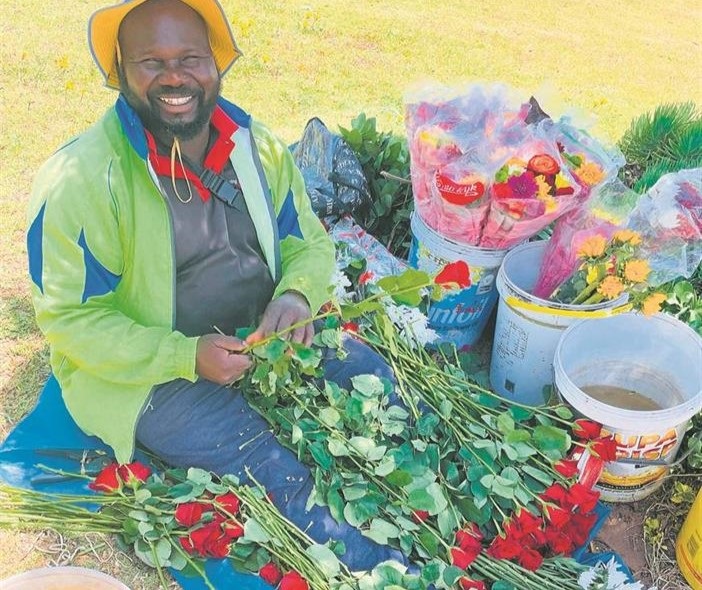
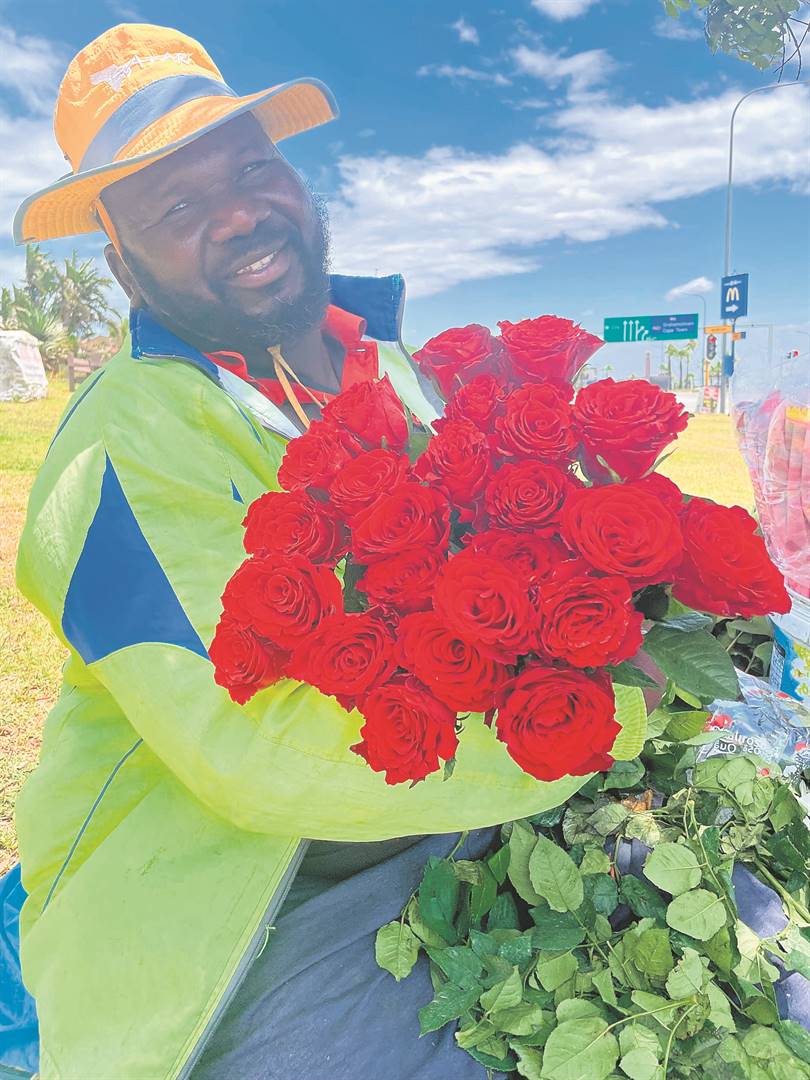
It is a blustery, typically windy-city day in Gqeberha, when I make myself comfortable under a tree with flower seller, Wilson Mthalane, next to bustling Humewood Road. He welcomes me with a smile and a proudly Zulu greeting, “Sawubona”. During our conversation, Mthalane prepares his bunches of flowers. Every now and then, when thinking deeply, his hands rest around stems and foliage for a moment and his gaze stretches out across the busy road, beyond the harbour wall, to where the foamy crests of the waves’ white caps are wildly bobbing about on the ocean.
Surrounded by a variety of fresh flowers in water-filled buckets and his lap and legs covered in long-stemmed roses and white daisies, Wilson cuts a rare, surprisingly unusual figure opposed to the road with its roaring traffic, exhaust fumes and urban congestion. In the shade – with the flowers like a bright, colourful blanket spread out around him – Wilson works amid the hues and sweet fragrances of sunflowers, purple and green dahlias, white and yellow daisies, and the peachy, deep burnt orange shades of cherry brandy and pink roses.
It is here, on the corner of Humewood Road and Walmer Boulevard, that Wilson spends his days selling his flowers and turning many a driver’s swift sojourn at a red light into an altogether different, more pleasant experience.
Born in 1974, he hails from Ladysmith in Kwazulu-Natal. Wilson now lives in New Brighton, from which he arrives daily by bus. Once a week he gets his fresh flowers from the airport, flown in from Johannesburg.
“I have worked here since 2000, for 24 years,” he tells me. “I am usually here Tuesdays to Sundays from 14:00 to 18:00.”
But if one is lucky, one can also find him trading during the mornings. Before selling flowers, he worked as a tiler. But Wilson is not fussy.
“I work and do a job to put food on the table for my family.”
His six children – three sons and three daughters – are his pride and joy and it is important to Wilson that his children will get a proper education.
“People buy my flowers for Christmas, for birthdays, and especially on Valentine’s Day.”
Excitedly he tells me how once someone put him on Facebook and, as a result, many customers stopped to buy flowers and told him that they saw him online. He loves flowers himself, and his favourite is a red rose.
He laughs as he recites Roses are Red, Violets are Blue and then adds, “But my wife loves a pink rose best.”
Sometimes he creates bunches of his favourite red roses only; other times, he mixes red roses and white daisies in stunning contrast; but mostly he mixes them all up in the most startling, vivid bouquets, enlivening the road. R100 a bunch.
As with most things in life, the job has its challenges.
“The weather of Gqeberha is difficult. You can have all kinds of weather in one day. A while ago, someone stole seven bunches of flowers when I went to get water quickly.”
Even so, neither the heat, the sun, the rain, or the wind, nor the ill will of others, deters Wilson from braving the road.
Some days he dreams of having a small florist space, perhaps in a mall, from where he can make flowers for bigger events, like funerals and weddings.
But for now, festooned with armfuls of bouquets, like a shield of goodwill, he greets the oncoming traffic like a festive warrior of benevolence and beauty.
It is only later that I learn that the greeting, Sawubona, literally means “I see you”. The term encapsulates the importance of recognising and acknowledging the dignity of every individual.
Now, when I see Wilson in all his humble resilience among the traffic, my day brightens. I shout “Sawubona” if he is further away, and the traffic light switches to green too soon. Other times I buy flowers. And when I don’t see him, the road feels strangely empty.