

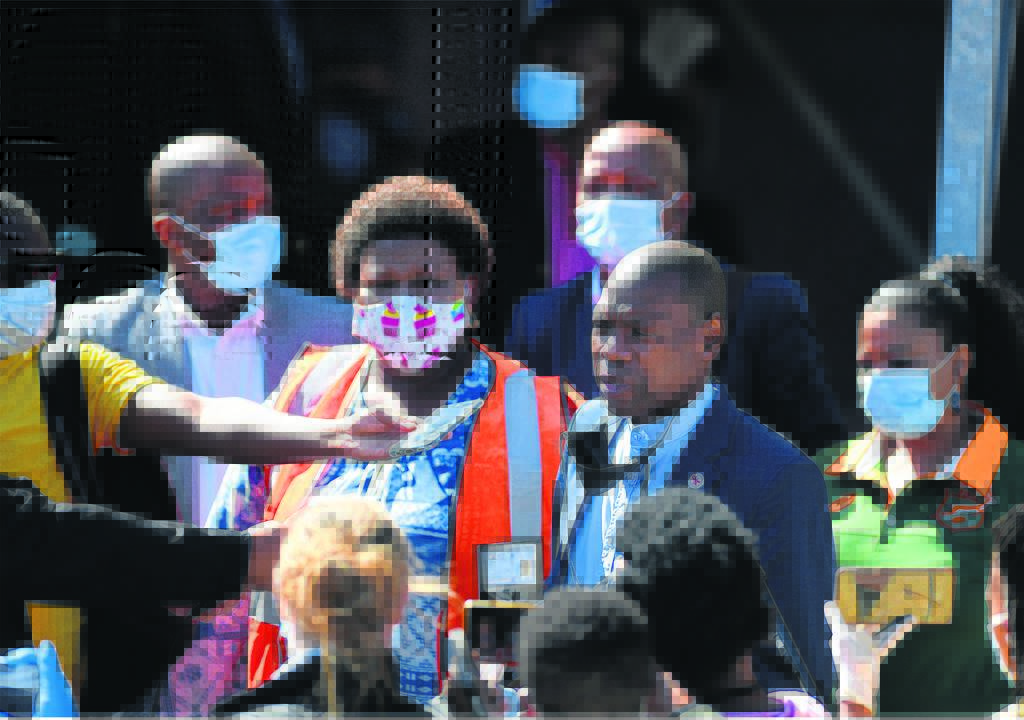
ASENIOR official from the Eastern Cape Health Department’s head office will be deployed to the Nelson Mandela Bay Metro immediately, to take charge after a rapid increase of positive Covid-19 cases in the metro.
This announcement was made by Health Minister, Dr Zweli Mkhize, during his recent visit to the Bay.
Mkhize said that Dr Litha Matiwane, one of the department’s deputy directors-general, who is in charge of the various districts, would be stationed in the metro.
“The deputy director-general will provide leadership in order to put together a very strong, coherent response to be followed by the teams involved with tracing, testing and screening in the community,” he said.
Matiwane will also be dealing with some of the challenges faced by the metro, which include a shortage of hospital staff, constraints regarding available hospital beds and the increased demand for personal protective equipment (PPE).
Mkhize also said that the sharp increase of confirmed positive cases in the metro, that totalled 167 at the time of his visit, was a major concern, especially since these numbers were specifically linked to two funerals held in KwaDwesi and Zwide.
“We actually saw a lot of problems arising from this. In one of the families affected, it has been reported that both parents have passed away, leaving the children orphaned.
“There have also been six fatalities. This basically indicates that there is an increasing desperation building up in the area,” Mkhize added.
He also mentioned that they have identified at least 1 000 people who came into contact with the 167 infected people.
However, it would be difficult for them to self-isolate, as they come from densely populated areas.
“The (Health) MEC has actually reached out to Nelson Mandela University and they have offered 800 beds to accommodate most of these individuals.
“It is extremely important that they (the people who have potentially come in contact with those infected with the virus) are moved to a place where they can be quarantined for the next 14 days.
“Hopefully they won’t develop any symptoms, but if they do, they’ll be admitted to hospital,” he explained.
“Those who are sick and need high care treatment will go to hospitals that have been decanted to ensure more space.
“The group that is asymptomatic and cannot self-isolate at home, even though they don’t need treatment, will be moved to some of the field hospitals.
“They will be kept there for 14 days or until they have tested negative.
“The last group is those that are well but have been in contact and need to be monitored to ensure that they don’t develop symptoms and turn positive. They will go to the quarantine sites.”
CONTINUED ON PAGE 2