
Nelson Mandela
University Council has re-elected Dr Geraldine Fraser-Moleketi as its Chancellor for a second term of office. The
announcement of the Chancellor’s re-election was met with enthusiastic support from
Council, affirming the role she has played, and contribution she has made to
date to the university and beyond.
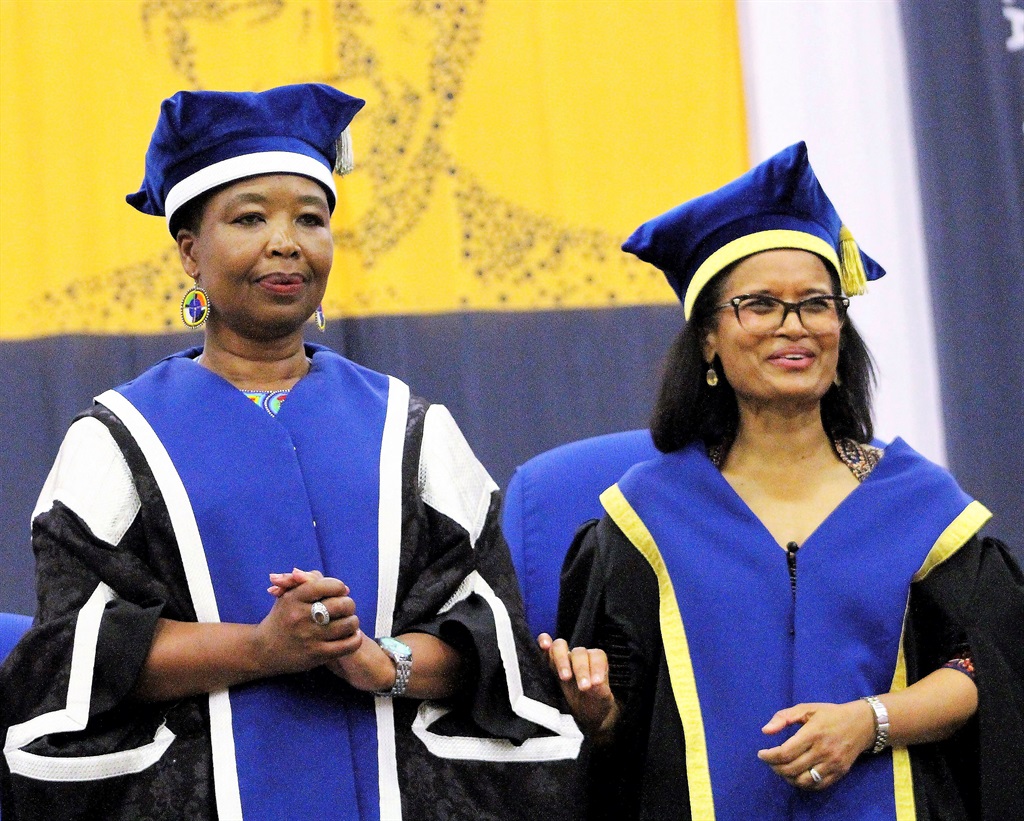
Dr Fraser-Moleketi has served as Chancellor of Nelson Mandela University
since 2018, joining, at the time, Professor Sibongile Muthwa, the
Vice-Chancellor, and Ambassador Nozipho January-Bardill, the Chair of Council,
at the helm of the institution.
The Mandela University Chancellor is an eminent, respected and
international public management leader whose steadfast work in public
management and gender advocacy has positively impacted the African continent
and beyond. As the former Special Envoy
on Gender at the African Development Bank, and an active advocate and champion
of women’s economic empowerment, she spearheaded the strategy to mainstream
gender in the bank’s policies and operations, making the bank a reference
institution on gender equality on the Africa continent.
“She has worked in inter-governmental structures,
interacted with political leaders, business leaders and in civil society, and
has been involved in complex negotiations across different issues and sectors.
Her illustrious career is characterised by a commitment and approach to social
justice and economic participation that is purposefully inclusive and
sustainable,” said Chief of Council, Nozipho January-Bardill.
She is the former Director of Global Democratic Governance Practice of
the United Nations Development Programme (UNDP); has served as a member of the
Reference Group on the quadrennial comprehensive policy review of the United
Nations Development System; and is a member of the Advisory Group of Gender and
Adolescence Global Evidence (GAGE).
“Dr Fraser-Moleketi serves on several boards across academia, the
business sector, government and development organisations, notably on issues
including youth, women’s empowerment, capacity development and education,
governance and poverty eradication. She
is the outgoing chairperson of the Council of the Mapungubwe Institute for
Strategic Reflection (MISTRA) and the incoming Chair of the Thabo Mbeki
Foundation,” she added.
“In addition, she is chairperson of the Committee of Experts on Public
Administration (an expert body of the United Nations Economic and Social
Council) and former member of the Advisory Board of the Institute for the Study
of International Development at McGill University in Canada. She served on the
Africa Advisory Committee of Women’s World Banking until 2018.”
The university has also appointed Professor Sibongile Muthwa as Vice-Chancellor for the second term, with effect from January 1, 2023.
Announcing the reappointment, January-Bardill said that Council
and the broader university community had noted with deep appreciation Prof
Muthwa’s demonstrable achievements at the helm of a Mandela University firmly on
course to change lives.
“Professor Muthwa’s visionary, transformative and
empowering leadership; her approach to strategic management, and her total commitment
to entrenching ethics and integrity into the DNA of the Mandela University, has
been impactful. She is determined to
create an identity for Mandela University as a leading institution in service
of society, through our key strategic areas of learning and teaching, research,
innovation and internationalisation; engagement and transformation as well as a
variety ground-breaking academic projects,” January-Bardill said.
Prof
Muthwa formally stepped into the Vice-Chancellor role in January 2018 when the
higher education sector and country was emerging from the effects of the #FeesMustFall
movement and campaign of 2015 and 2016. Prior to her appointment, she had
already made huge contributions to help steady the ship at Mandela University
and within the sector, during the fees campaign moment, and in a period
immediately after.
“This current tenure has seen the
Vice-Chancellor working hard to enable and
widen access, and provide financial and material support for students largely
drawn from poor and working class communities, while ensuring the long-term
sustainability of the University and the sector.
“At her inaugural lecture in 2018, Prof Muthwa articulated
a compelling vision for the university that was fitting and resonant with the ambitions
of the institution named after our internationally renowned stateman, former
President Nelson Mandela. She stressed the
importance of a close and deeper working relationship between the university
and communities to enable mutually beneficial and transformative outcomes and a
qualitatively richer and responsive academic enterprise,” she added.
“In its deliberations, the University Council noted that
significant progress has been made in the quest to become a university truly in
service of society, notably through the establishment of the Hubs of
Convergence (a platform and programme that ensures active engagement with
communities); in the expansion of the
work of the Ocean Sciences Campus (South Africa’s first and only campus
dedicated to the study of oceans); the
revitalisation of the Humanities; the establishment of the country’s 10th
medical school and the launch of the university’s Vision 2030, amongst others.”