
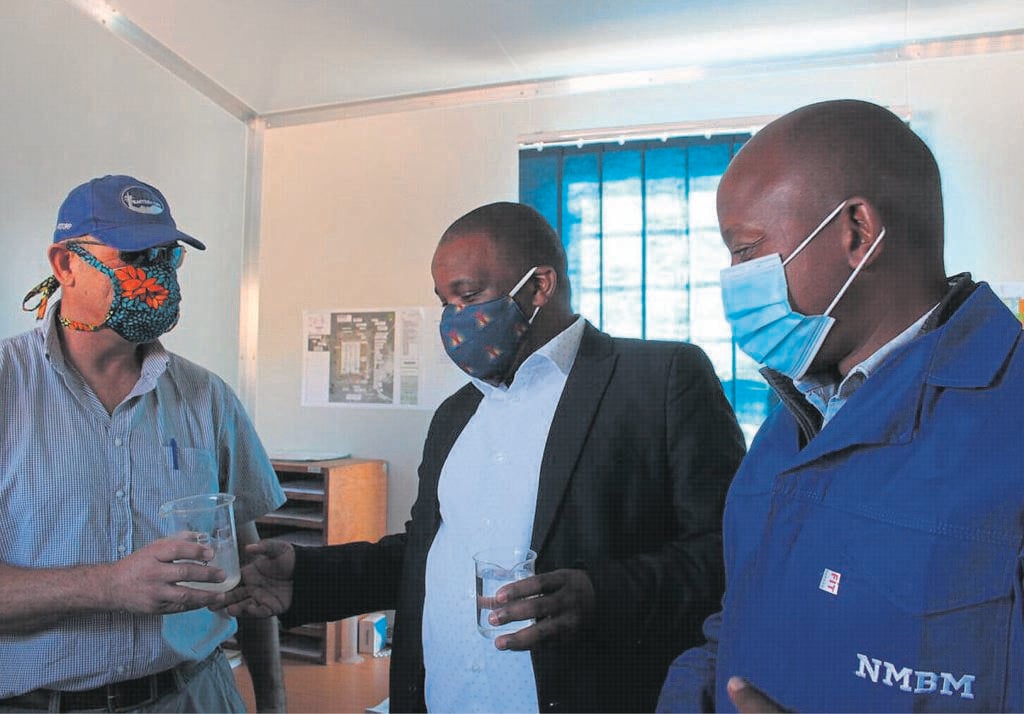
THE Nelson Mandela Bay Municipality is hard at work, extracting as much water from the Nooitgedacht Water Treatment Works as possible, to increase water supply to the metro and avoid taps running dry.
Water and sanitation director in the metro, Barry Martin, said during a recent oversight visit to the facility, that once phase three was completed, they should be able to augment approximately 200 Megalitres of water per day, compared to the 170 Megalitres currently being extracted from Nooitgedacht.
Construction at the treatment works, that augments water from the Gariep Dam to Nelson Mandela Bay, has been ongoing for a few years, however phase three was expected to be completed by June 2021, Martin said.
According to him, phase three consists of building clear wells for the purpose of improving water treatment.
“The whole idea is to increase the amount of water that we treat at the works.
“We’ve got the licence for an average of 160 Megalitres per day, with a peak of 210 Megalitres and in terms of the drought conditions, we are allowed to run the plant as close to the maximum capacity as possible,” Martin explained.
“That is exactly what we are doing at the moment.
“Through the existing plant, we are treating 140 Megalitres of water per day and an additional 30 Megalitres is being pumped to the high-level scheme at the Grassridge reservoir for treatment,” he added.
“Ultimately, we would like to pump 200 Megalitres from here, which means that approximately 60-80 Megalitres a day will go through to Grassridge for treatment.
“We hope to achieve that within the next three weeks.”
Martin also explained that although there have been quite a few debates regarding the procurement of a barge at Impofu Dam to extract dead storage, they would not be following that route.
“The barge is not running and we’ll keep it that way because if we can get maximum use of water from this facility, we save water at Impofu Dam.”
Interim Bay Mayor, Tshonono Buyeye, who also attended the oversight, said that the municipality was happy to see the contractors on site.
“There must be movement.
“Phase three needs to come to completion because there have been delays here before.
“The end result will be the metro getting more water coming from this scheme,” he said.
When asked whether the metro would be implementing other water-saving measures such as stricter tariffs, MMC for infrastructure and engineering, Andile Lungisa, said that tariffs would not be increased.
“What we have agreed upon, as a city, is that we will only implement what comes from the national level, as they are responsible for water tariffs.
“Our communities, including the business sector, have been battling through Covid-19 and as a city, we don’t have money to assist and subsidise businesses,” Lungisa added.
“What we can do is to ensure that the tariffs are managed so we don’t hit households hard.”
At the time of going to print, the Loerie Dam was below average, at 46.1%, a decline from 49.8% the previous week.
Meanwhile, the Kouga Dam was at a devastating low of 8.6% from 8.8% from the week prior.
During a similar period last year, it was at 44.7%.
Also at an extreme low is the Impofu Dam remaining at the previous week’s 17.0%.
This time last year, it was at 24.6%.
At the time of going to print, the dam level for Kouga Dam was at 8.22%.
Churchill Dam stood at 59.72% and Impofu Dam was at 16.79%.
The Groendal Dam was standing at 31.07% and Loerie Dam was at 49.17%.