
MODERN DAY families love to have sport utility vehicles (SUV)s in their garages – whether they can afford them or not – or need them or not. That’s why so many manufacturers are turning small entry level vehicles into crossover or compact SUVs.
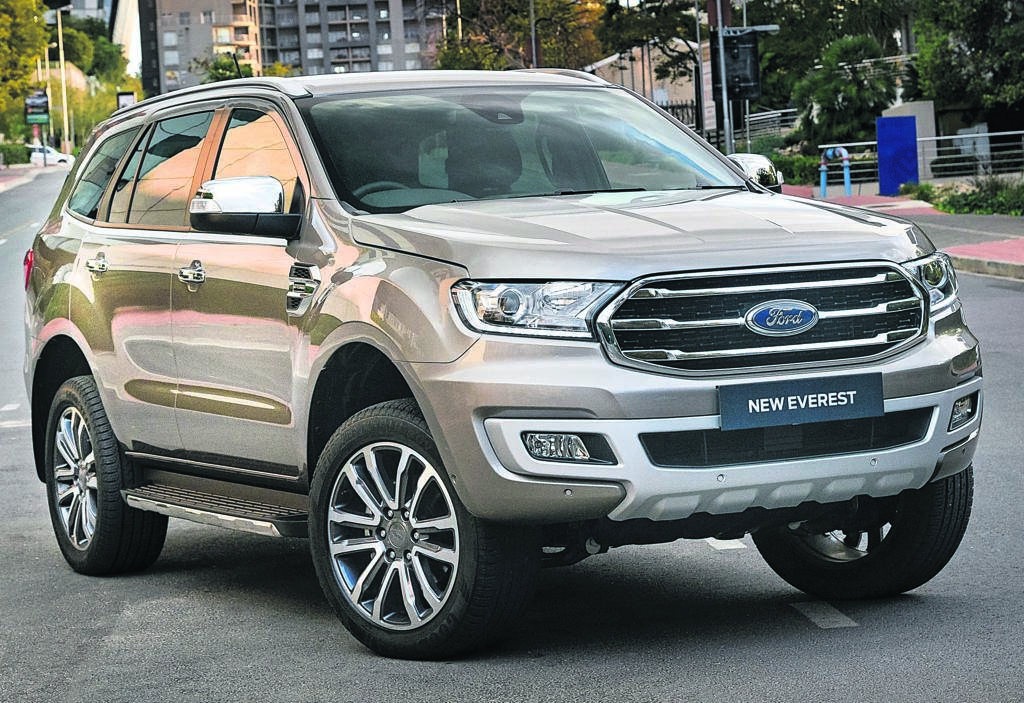
But the new Ford Everest, which was taken on the mom’s taxi route for this week’s Express on Wheels, is the real deal – a family car offering the benefits of a vehicle built on a bakkie platform, with the safety, comfort and luxury features needed for the practicalities of a family vehicle, while offering seven seats in a decently spaced cabin.
I have often found that while many manufacturers have succeeded in giving these types of vehicles a car-like interior, creature comforts and technologies, they have not often succeeded in getting those gearboxes to be less bakkie-like. So for me the ideal SUV is one with an automatic gearbox.
And here is where Ford has definitely upped the ante with its new smooth operating 10-speed automatic gearbox which was introduced in the Ranger last year and is now also available in the refreshed new Ford Everest.
As with the New Ranger, Ford has also introduced the new-generation 2.0-litre bi-turbo and single turbo engines to the Everest range.
The existing 2.2 and 3.2-litre Duratorq TDCi engines are still available in some of the models where they are paired with a six-speed automatic transmission.
According to Ford technical info, the 2.0 Bi-T engine uses a small high-pressure turbo combined with a large low-pressure unit.
They work in series at lower engine speeds for enhanced torque and responsiveness especially when pulling away from standstill.
At higher engine speeds, the smaller turbo is bypassed and the larger turbo provides boost to deliver high power.
The maximum power output for the 2.0 Bi-Turbo engine is 157kW, matched to a peak torque figure of 500Nm. It is available in the Everest XLT 4×2 and 4×4 models, as well as the top-of the-range Everest Limited.
A new 2.0-litre single turbo unit has also been added to the line-up, and this engine is offered in the XLT 4×2 specification. It delivers a peak power output of 132kW, matched to 420Nm of torque – with up to 340Nm available from 1 250 r/min.
The current 2.2-litre Duratorq TDCi engine, with 118kW and 385Nm, is available in the Everest XLS 4×2 model, while the 3.2-litre five-cylinder TDCi engine, with 147kW and 470Nm, is still offered in XLT 4×4 model.
Styling
The new Everest has had a subtle nip and tuck on the outside and inside. Its refreshed design offers a more luxurious interior and improved comfort.
Also offered is a keyless passive entry and passive start (PEPS) system on the XLT and Limited models.
The keyless entry and passive start allows one to unlock the vehicle and start the engine without removing the key from your pocket or bag. The key simply has to be in the vehicle for the driver to start the vehicle by pushing the stop/start button and putting their foot down on the brake pedal.
As far as infotainment goes, SYNC3 with Navigation is standard on the higher end XLT and Limited models. This is linked to an integrated eight-inch touch-screen colour display, two USB ports and Bluetooth connectivity.
The Everest XLS uses Ford’s SYNC 1 system with Bluetooth voice control and audio streaming, a 4.2-inch colour screen, as well as USB and Aux ports.
Customers can order SYNC3 with Navigation on the XLS as an option.
The Everest seats seven occupants but with all the seats up, there isn’t huge bootspace available. You can however, fit in a good number of shopping bags or book cases.
The third row does fold to offer a much bigger cargo space, but it doesn’t fold completely flat.
The third row could feel a bit cramped for bigger sized adults. Access to those back seats is fairly good for the lithe people who would sit comfortably in those seats.
The second row passengers can also use the slide function to give up some of their legroom for those in the back.
Overall, it is a good looking and practical cabin with all the amenities that one will need, such as air vents in the roof.
Ride
With a 225mm ground clearance, there’s enough height for off-road enthusiasts to tackle rough terrain. And for soccer mums, the Everest has more than enough to help her conquer the concrete jungle in comfort.
During the week of test-driving, the smooth transitioning of the automatic gearbox was one of the most impressive features. It is so smooth and effortless that one would never be able to count the transitions to 10.
I have often found that using an auto gearbox in a vehicle of this size, usually results in sluggishness when pulling away from standstill or accelerating to overtake. I did not find this to be the case in the Everest – it is fast off the mark, and very willing to speed up when nudged a bit.
On the normal highways and urban commute the recently improved suspension system delivers a comfortable ride.
One can also switch to ‘Sport’ mode which makes the gearbox more responsive for dynamic driving performance. There’s also the option of full manual mode from the ‘S’ position, controlled via +/- buttons on the gear lever.
The standard safety equipment across the line-up includes the electronic stability control (ESC) system with traction control (TC), trailer sway control (TSC), hill start assist (HSA), hill descent control (HDC) on the 4×4 models, load adaptive control (LAC) and roll over mitigation (ROM).
Model Range and Recommended Retail Prices:
2.2 TDCi XLS 6AT 4×2 R536 200
2.0 SiT XLT 10AT 4×2 R614 200
2.0 BiT XLT 10AT 4×2 R668 100
3.2 TDCi XLT 6AT 4×4 R689 400
2.0 BiT XLT 10AT 4×4 R717 800
2.0 BiT Limited 10AT 4×4 R793 900
All models come standard with Ford Protect, comprising a four-year/120 000km comprehensive warranty, three-year/unlimited distance roadside assistance and five-year/unlimited kilometre corrosion warranty. A six-year/90 000km service plan is included, with 15 000km service intervals.