

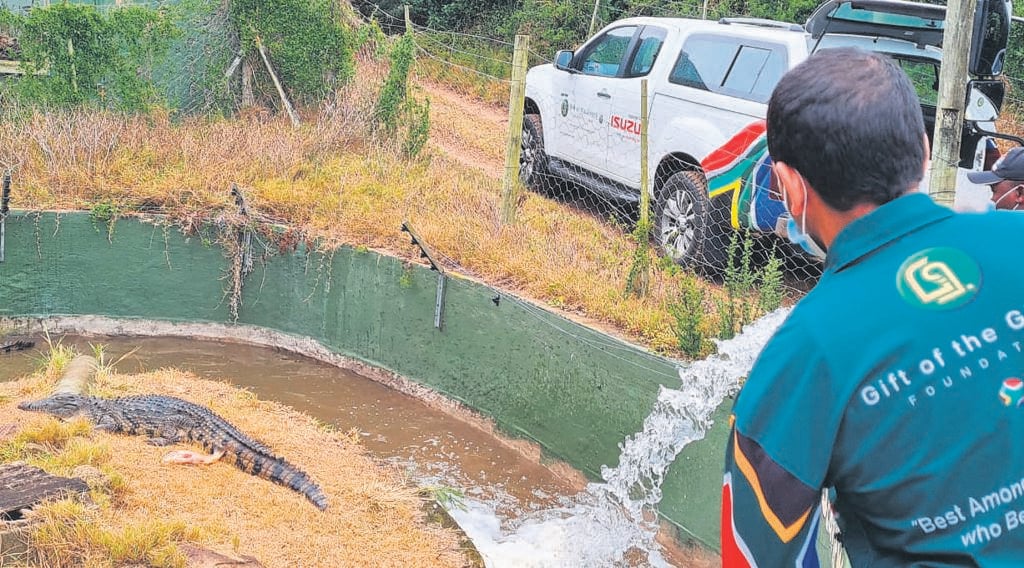
THE five animals that remained at Seaview Predator Park, after the facility closed its doors last year and relocated most of its other animals, recently received royal treatment when Gift of the Givers visited the park bearing gifts.
The country’s largest disaster response NGO arrived at the facility with truckloads of water, approximately 10 000 litres, that will be used to replace the water that the remaining three Nile crocodiles live in.
A tiger pool was also donated for the remaining two Siberian tigers, as well as 180kg of fish, freshly caught the night before, as part of the NGO’s “invasive carp” fishing project along the Garden Route.
The facility closed its doors during the height of the COVID-19 pandemic last year.
The park also suffered a tragic incident in June 2021, when a Siberian tiger, Jasper, escaped his enclosure and attacked and killed an employee, David Solomon.
The electric fencing in the enclosure housing Jasper and his sister, Jade, was in the process of being repaired when the incident occurred.
Jasper jumped on the exterior fence and got out. Solomon was in the passageway between enclosures when the tiger got out.
Although he attempted to climb the fence of a different enclosure to get to safety, Jasper pulled Solomon off the fence and broke his neck.
Shortly after the incident, the park closed its doors out of respect for the Solomon family but later said that it had closed permanently.
Relocation of the animals started a month later and to date, 38 animals have already been safely relocated.
Gift of the Givers project manager, Ali Sablay, said that when they received the call for some kind of assistance in terms of water for the park, they knew from experience the strain that the pandemic has put on many of these game reserves.
“As we know, during the COVID-19 pandemic, the hardest hit industry was the tourism industry and not only this park but we also find many parks across South Africa in the same situation.
“We can speak from first-hand experience because we deal with many of these parks around the country.
“The budget constraints for running these parks are huge and when there’s no tourism coming in, it can be devastating to the owners and with that, the taking care of the animals,” Sablay explained.
He continued by praising the park management and Aspinall Foundation that have been doing their best to assist the animals, even with limited resources.
“Whatever other support there is that we can offer to this park, we will definitely do that.
“We would just like to put it out there that there is no negativity as to how these animals are being kept because no park anywhere in the country with no budget can hold onto these animals too long and we find that many of these parks have closed down.
“For them to relocate 38 animals already is an amazing achievement. We are once again appealing to people to support foundations like these who are unselfishly ensuring that animals are being taken to a place of safety,” Sablay said.
A veterinary surgeon from Grahamstown Veterinary Clinic, which has been involved with the relocation process, Dr Annie Mears, said that the remaining animals would be relocated as soon as they had received the necessary permits but that they had reached the last stretch of this process.
She was also the one who contacted the NGO to assist the animals at the park.
“The work that is being done by the management team here to make sure that the animals are being looked after, has been exceptional.
“We have taken all the necessary precautions and put all the necessary structures in place to enable them to be safe, happy and well-fed.
“From a veterinary point, I’ve been involved the whole way in this relocation project and I’m happy to say that everything here is above board,” she said.
“We’re coming to the final stages of our relocation, where we will be moving the final animals shortly, but it all depends on the permitting.
“For now, we’re suffering with the drought so taking 10 000 litres of water from the municipal system is a bit of a stretch for anybody.
“Thankfully, Gift of the Givers jumped in and they were more than happy to take this opportunity to help us with the water and we’re really, really grateful for that.”
She added that they regularly received local donations of food but that extra food was always helpful and what they didn’t need, they could donate to other sanctuaries in the area.
Mears also said that the animals already relocated, including lions, tigers, small cats and jackals, were all happy and safe in their new homes.
Some of them had also been rewilded.