
SEEING the need for devices to assist people suffering from Covid-19 and other diseases, a multidisciplinary team of innovative young engineers based at the Propella Business Incubator have dropped all their other projects to develop a low-cost bag mask ventilator.
The device should fill the urgent need for a low-cost non-invasive ventilator for less serious Covid-19 cases, freeing up the expensive, more intricate intensive care units for those in need of advanced care.
“I was impressed by the simplicity, yet effectiveness of the design,” said Dr Hennie Smit, a Port Elizabeth general practitioner with extensive experience in anaesthesia.
“It is meant to assist respiration and not full ventilation, and therefore only needs a tight-fitting face mask, and is suitable for use in general wards where it can be monitored by non-specialist nurses.”
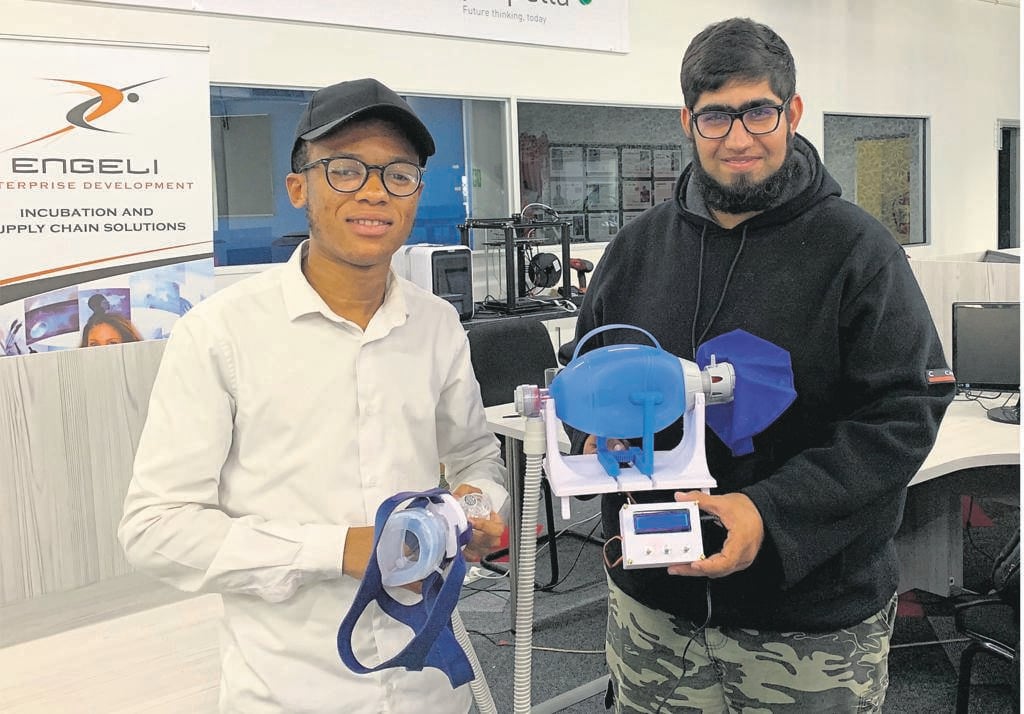
Propella incubatees and Nelson Mandela University (NMU) engineering students, Zain Imran and Neo Mabunda, teamed up with Imran’s brother, Zaahid, and Kelvin Langwani, to develop a working prototype within five days.
“In anticipation of the lockdown, we moved our 3D printer and other necessary equipment and components from Propella to Zain’s home,” explained Mabunda.
The team, who have complementary engineering skills, are now back at the Propella BusinessIncubator having been given special permission to work on their design.
At the heart of the unit is an inexpensive plastic pouch called a bag-valve resuscitator, or Ambu bag, which most hospitals already keep and, crucially, according to Imran, already has the necessary medical certification.
“We set the standards based on the World Health Organisation requirements for ventilators and ticked all the boxes, such as the volume of air delivered to the lungs, the breaths per minute, inspiration/expiration ratio and control/fail-safe capabilities,” said Imran.
“The result is a pre-intensive care ventilator that ticks many of the requirements of a high-end ventilator.”
The Salutaris (Latin for life-saving) device is powered by a servo motor that expands and contracts two arms. Rapid prototyping was possible thanks to the 3D printer.
The unit can be powered by mains or a car battery.
Durability testing is underway.
“A number of teams around the world have announced ventilators which appear to be functional, but where the Salutaris differs is that it is a highly engineered solution designed from the outset for manufacture with full production and cost optimisation in mind,” said Engeli Enterprise Development operations director, Wayne Oosthuizen.
He added that they were aiming to start production as soon as the tooling for the injection moulded parts is complete. “All that is holding us back is the finalisation of the funding needed for the tooling and initial investment in components,” said Oosthuizen.
Final pricing is not yet available as some components will have to be imported, but the group is setting its pricing benchmark at R5 000 or less.
“This isn’t about maximising profits, but getting an operational and cost-effective ventilator into hospitals,” said Oosthuizen.