
More than 20 traffic lights situated across the Nelson Mandela Bay Metro are out of order, with some of them lying completely damaged on the side of the road.
These were the observations made by the DA’s spokesperson for safety and security in the metro, Gustav Rautenbach.
According to a list that Rautenbach compiled after driving through the metro to record all the broken traffic lights, there are currently 10 traffic lights not working on the R75 (Uitenhage Road) and three on the Perseverance/Swartkops Road.
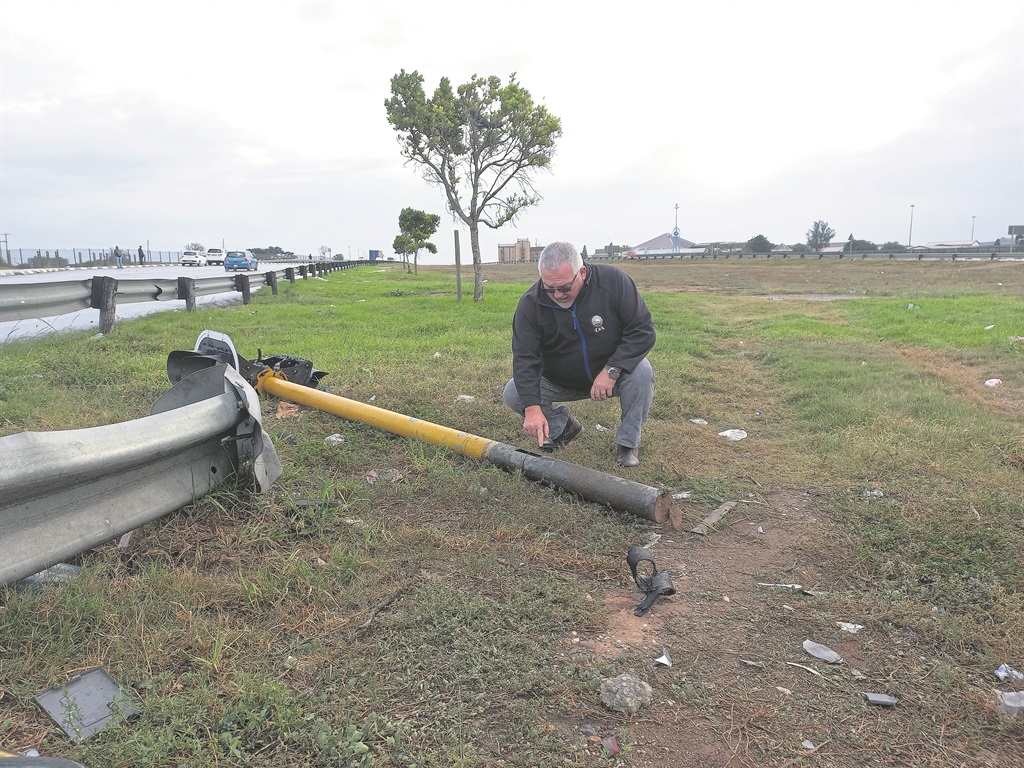
During PE Express’s visit to the intersection at Kenako Mall, multiple traffic-light poles were lying next to the road, clearly carefully dug up and then vandalised with huge stones.
Next to the poles were several holes and open manholes where the copper cables were disconnected and stolen.
DA spokesperson for roads and transport, Sandra Fillis, said that she had counted nine traffic lights out of order in the northern areas alone, specifically in Stanford Road between Gelvandale and Booysen Park.
“Five of these traffic lights that are not working are pedestrian lights [on the R75] and this is a worrying factor because many children cross this road on their way to school.
“It is a busy road, especially during peak hours,” Rautenbach said.
“We all know the impact that faulty traffic lights have on our pedestrians and motorists.
“Cable theft is on the increase and it happens all over the metro. Sadly, it is no secret that the metro has lost the battle of cable and copper theft,” he added.
PR councillor and former safety and security head, John Best, said that they had first started noticing the broken traffic lights approximately three months into the national lockdown, which was implemented in March 2020, meaning that it has been a problem for almost two years.
“It is not just a Nelson Mandela Bay problem, it is a national problem. It happens all over [the country] but we have been hit hard here in the metro,” Best said.
According to Fillis, just two weeks ago, there were three hit-and-run accidents in the northern areas, with one fatality and two serious injuries.
“These are three too many and all because of the traffic lights. We need to come up with a solution,” she said.
Ward 52 Councillor, Frans Swanepoel, added that he had received multiple complaints from residents travelling between Gqeberha, Despatch and Kariega on a daily basis for work.
“They are always struggling to get to work. They might try to leave earlier but then everyone else has the same idea, which means that everyone is still stuck in traffic at the same time.
“It is an absolute must to get the traffic lights working again.”
Rautenbach said that they have come up with a few proposals for the metro to possibly include them in budgetary considerations currently underway.
These proposals include: setting up specialised units within the metro and town laws enforcement authorities; ensuring that indelible markings are placed on electrical infrastructure; installing anti-theft bolts and fasteners to infrastructure where possible; budgeting by the electrical and infrastructure departments for the necessary security to patrol sites and improving safety and security by the SAPS increasing the patrolling of hot-spot areas.
Rautenbach added that he had contacted the director of traffic and licensing in the metro, Warren Prins, to find out whether point duties were being performed at these traffic lights and pedestrian crossings. He also requested a detailed report in respect of traffic law enforcement done regarding road accidents over the last 12 months, including how many accidents have taken place and their causes.
Prins sent a report that indicates that 207 accidents have taken place on the R75 during 2021 and 21 so far for 2022. In total, there were three fatalities, 12 serious and 116 slight injuries recorded.

On the Swartkops Road (M19) 25 accidents have taken place since last year, resulting in two fatalities, 12 serious and 32 slight injuries. Just under 40% of these accidents were caused by motorists disregarding traffic lights.
“We are currently doing VCPs (vehicle control points) on the road, patrols for visibility and deploy officers at times at intersections when traffic lights are out of order. We will continue with this. The unfortunate part is that the traffic lights are permanently damaged,” Prins said.
“I had a session with SANRAL as the road maintenance falls under them and we concluded to erect a 1.1m stop sign that is bigger than normal.
“For the erecting of stop signs, SAPS and metro police were requested to assist with the safety of the SANRAL contractor. SAPS popped around and left while the metro police indicated that they don’t have personnel and due to this the contractor felt threatened and left.
“Traffic at the time assisted with point duty at the intersection. We will continue with law enforcement,” Prins added.
MMC for safety and security in the metro, Lawrence Troon, said that he has made suggestions regarding how this problem can be addressed but that his proposals are being shot down whilst no one has alternative proposals.
Troon suggested that some of the traffic lights in the metro be converted into traffic circles, where possible.
“What is the point in constantly replacing these traffic lights and then they are just damaged and stolen again?
“This is just my suggestion and I am not saying that it needs to be done everywhere, but only where possible. We can even pilot the project.
“Initially, people won’t be used to the traffic circles but, with time, they will get accustomed to them,” he said.
“Just because we have always had traffic lights, does not mean that we should just have traffic lights. Replacing the traffic lights might even cost more than turning these intersections into traffic circles.”
Troon added that with the current instability in the council meetings, it is very difficult to get things done in the metro.
“We have not yet had a standing committee,” Troon said.
“According to the court, we have two city managers and officials don’t know who to report to.
“We first need to get stability in the metro in order to address these problems because at the moment, we can’t achieve anything.”
UPDATE: Senior consultant of strategic communications at FTI Consulting, Shanaaz Loggenberg, commented on behalf of SANRAL and said that a contractor was indeed instructed to erect stop signs at a few intersections in Nelson Mandela Bay.
These intersections are:
- Baywest – N2
- Kempston road – N2
- Joe Slovo – R75
- Chatty Dip – R75
- Johnson Road – R75
- Kenako Mall – R75
She explained that stop signs and advance signs were erected at the first three intersections listed above. Whilst erecting at Chatty Dip, the community members/SMMEs allegedly intimidated the contractor and asked them to remove the signs and poles at Chatty Dip intersection. Johnson Road and Kenako Mall intersections were then not attempted for safety reasons.
“SAPS were asked for assistance but were not able to assist. Metro Traffic (not Metro Police) were there to assist but were also asked by the SMMEs to leave site during the intimidation occurrence on the R75. Stop signs are still in place at Baywest and Kempston road intersections on the N2. The signage that was erected at Joe Slovo R75 intersection was later stolen,” Loggenberg said.