
More than R100 million has been prioritised for, and moved to, the water and sanitation capital budget to support drought mitigation and water infrastructure plans in Nelson Mandela Bay.
This was a unanimous decision made during the metro’s most recent council meeting.
According to the municipality, the funds, amounting to R120 million, have been taken from a number of non-critical – and less urgent – infrastructure projects delayed due to supply chain processes, non-availability of required material and approval of USD Grant rollovers.
“Part of the funds will be utilised to maximise the Nooitgedacht water that is received from the Gariep Dam which is 450 kilometres away and currently at full capacity.
The Water and Sanitation sub-directorate has started a number of critical civil, mechanical and electrical projects at various water treatment works, and water pump stations, in order to improve the municipal water network system,” said municipal spokesperson, Mthubanzi Mniki.
“This work will ensure full maximisation and transfer of the Nooitgedacht water, which will be a huge benefit to water consumers in the western side of the Bay.
“One of the reasons for re-prioritisation of funds is to make sure that the current projects underway are not delayed due to non-availability of funds. A number of these projects are expected to be completed by the end of March 2023,” he said.
Meanwhile, as a means of desperately trying to keep the metro’s taps from running dry, the municipality has had to advise the Department of Water and Sanitation that they would be temporarily suspending compliance to water restriction directives.
This refers specifically to restriction directives relating to the over-extraction of certain dams.
The metro had to therefore over-extract the Churchill and Loerie (Kouga) Dams by 20 megalitres each for a few days.
This was done in a bid to replenish the system that had been operating on a deficit for the past week.
Nelson Mandela Bay mayor, Retief Odendaal, said that they had done this very reluctantly as any wilful over-extraction depletes the dams even faster, and actually moves the metro closer to day zero.
“Nelson Mandela Bay residents, we are not blaming you for this crisis. We know that as a municipality we could have done better to manage this crisis in the past.
“However, if we as residents don’t reduce our demand immediately, it is a mathematical certainty that we will deplete our available dam resources before the drought is broken,” said Odendaal.
“After this immediate crisis we will keep strictly to our restriction directives and force demand down by any manner necessary. Nelson Mandela Bay, we are entering a very difficult time insofar as water supply is concerned. We as residents need to reduce our demand by at least 10% as soon as possible,” he said.
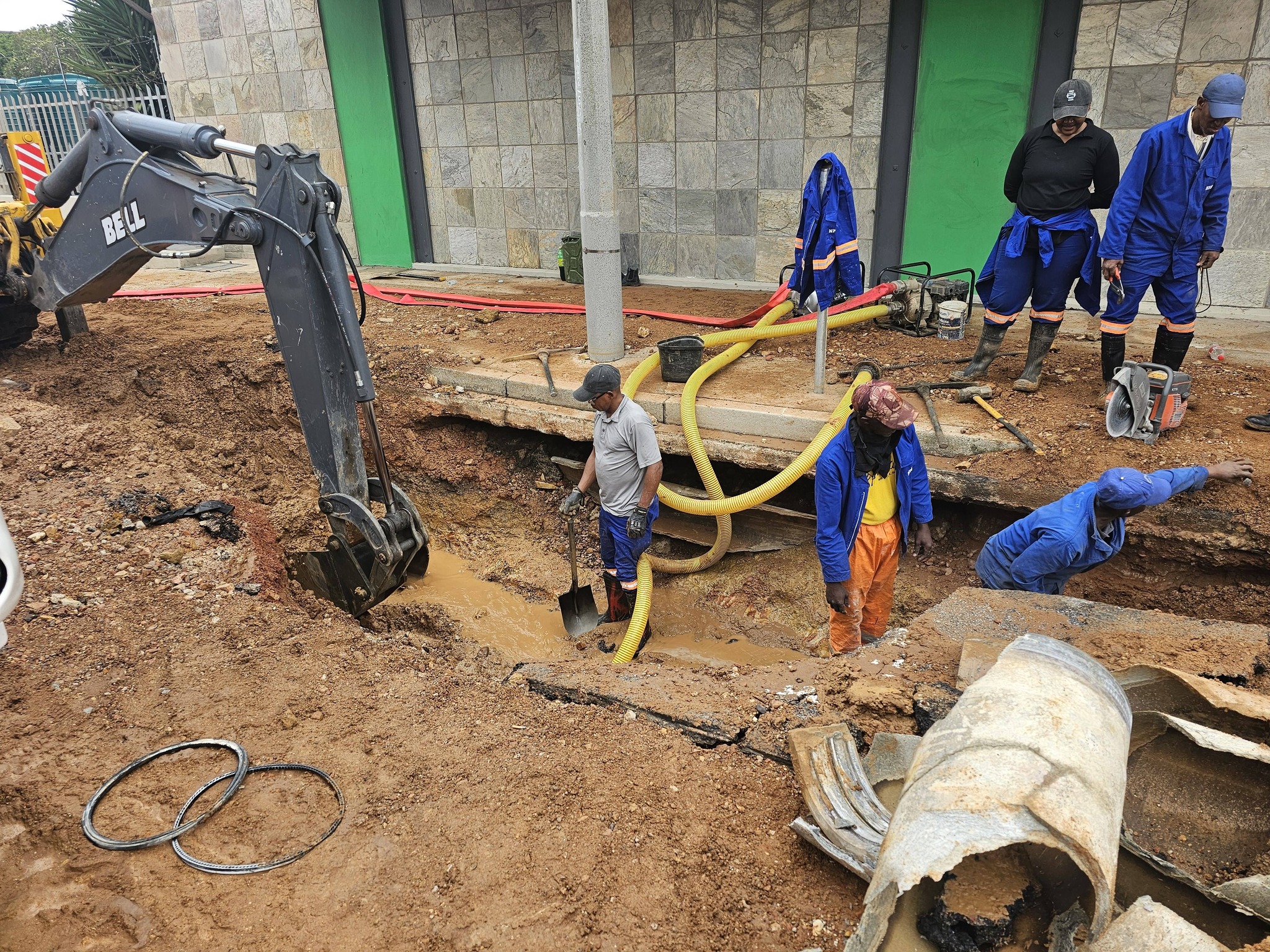
Odendaal also added that the municipality has accelerated leak repairs and he trusts that the backlog in attending to leaks will be eradicated over the next month.
The municipality has given themselves a deadline of three weeks to reduce the backlog of 5 000 water leaks – and there are now two weeks left.
MMC for Infrastructure and Engineering, Dries van der Westhuizen, said that in the week preceding this timeline, more than 1 000 reported water leaks were repaired over seven days.
He indicated that nine contractors have been allocated to attend to the backlog of leaks.
“We are monitoring progress on a daily basis. We have teams placed across the city dealing with various cases, including leaking valves, stolen meters and service leaks.
“We want to encourage our residents to report water leaks to the toll free number, 0800 20 5050 or by sending an email to waterleaks@mandelametro.gov.za,” he said.
Van der Westhuizen added that more than 70 000 leaks have been repaired from the 75 518 reported leaks at the municipality’s call centre dating back to June 2022.
Meanwhile, the Impofu Dam was recently decommissioned after its levels plummeted drastically – and it remains decommissioned due to the pumps having reached the river bed.
The Department of Water and Sanitation has increased the allocation from the Kouga Dam for the new water year; however, this dam also supplies water for agricultural purposes and to the Kouga Local Municipality.
“If all of us could take seriously the limit of 50 litres per day, per person, and stick to it, we could maximise the water that we have from all our resources.
“The situation is dire, our Chelsea Reservoir continues to struggle and as a result some of our suburbs continue to have disruptions or low pressure,” Van der Westhuizen said.
“We need to lower our water demand.”