
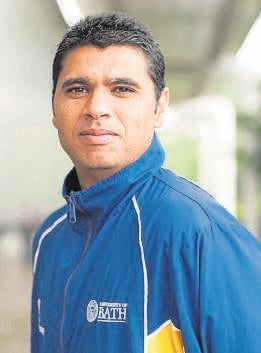
FORMER Madibaz hockey star, Jody Paul, has forged a new career in Britain, but his heart will always be with Port Elizabeth and the university that kick-started his path in the sport.
The 44-year-old ex-South African player recently shared his thoughts in a webinar with Madibaz Sport on his 14 years overseas, where he holds the position of head coach at the University of Bath.
He is also the interim head coach for the Great Britain elite women’s programme and has been used in coaching roles with the national U/18 and U/21 boys’ teams.
“I have also assisted in the senior programme in both genders, with a highlight being a bronze medal at the European Championships in 2017 with the men,” said Paul.
He fondly recalled his time at Nelson Mandela University (then known as UPE), where his game developed to a level that took him to the heights of competing in the 2004 Athens Olympic Games.
“I genuinely loved my time as a student and coach at UPE and then NMMU,” he recalled. “Those experiences shaped me as a person.
“Sharon Beckman and Brian Hibbert were the two people who got me to UPE all those years ago and I will be eternally grateful for the opportunities they provided me as a player.
“NMMU allowed me the opportunity to carry on playing international hockey by employing me in the university shop as a manager and Riaan Osman used me as head coach of the hockey programme.
“My first years of developing as a coach were at NMU where I worked with some talented athletes. That time allowed me to grow as a coach and gave me the foundation for what I am doing now.”
During the webinar, Paul spoke about some of the ideas he had developed during his coaching career.
“One of the things I have tried to introduce into my coaching philosophy is to feed information forward,” he said.
“I recall back in my playing days if I did not make a team, I was told only then what was lacking in my game and why I was not selected, which is too late for the player. The feed forward option allows the coach to tell the players in advance what they need to work on to earn selection.”
Paul added that it was important to avoid any “information overload” on the players.
Equally essential, he said, was to create open lines of communication with the players.
“There are times when you may want to put the team on edge in a training session, but you need to tell them of your plans so they understand what you are trying to achieve.”
Paul recalled that in his early days he was a demanding, verbal coach, barking out instructions to his players.
“That is the way I was able to learn, so I put that on others, but when I think if I would like my kids to be coached that way and the answer is ‘no’, then you realise you need to change,” he said.
“Society is completely different today and you have to adapt to that.
“I don’t feel I have changed my standards and values, but the way I package things is different to how I used to do it.”