

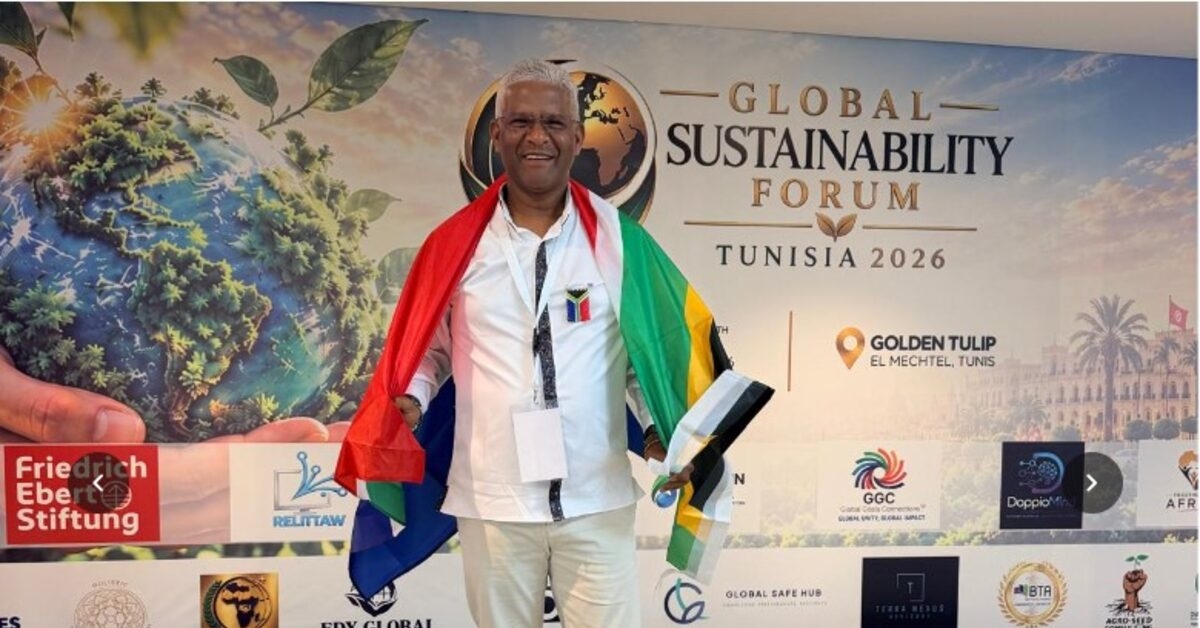
GQEBERHA – Doctor Eldrid Uithaler, a Nelson Mandela Bay environmental planner and sustainability advocate, has been honoured with an award from the World Book of Records, London, as a global leader and sustainability actor.
The recognition follows his participation in the Global Sustainability Ambassadors programme in Tunis from 24 to 27 October, which brought together delegates from over 40 countries to address global crises ranging from climate action to social equity.
Keynote sessions highlighted how alliances between organisations drive meaningful progress, spotlighting partners including Global Ethix (Canada), Friedrich Ebert Stiftung (Germany), and Relttaw (Romania), each bringing their distinct interests in sustainability, ethical leadership, and corporate responsibility to the discussions.
Dr Imed Krayem, founder of Global Goals Connection, said that Uithaler had been part of the Global Sustainability Ambassadors programme from the start, attending all online training sessions from March to October after being selected as one of the most serious candidates.

As a community coordinator and manager within the Global Goals Connections community, Uithaler took part in all daily topics and discussions, regularly sharing his own experiences and best practices related to sustainability in South Africa.
This, Krayem said, was why the community proposed his name to be awarded by the World Book of Records, London, as a global leader and sustainability actor.
During a United Nations (UN) simulation exercise at the programme, Uithaler confirmed South Africa’s stance on global hunger and food security.
“We meet at a time when the triple crises of climate disruption, economic volatility, and ongoing geopolitical conflicts continue to place unprecedented strain on global agrifood systems,” he said.
For millions across the African continent and the global South, the promise of UN Sustainable Development Goal 2 (Zero Hunger) by 2030 is severely threatened.
Championing food security and equality
South Africa reiterated that hunger was not a symptom of global food scarcity, but a direct consequence of structural inequality, price shocks, market speculation, and systemic imbalances in economics, according to the UN position on food security and hunger.
“Access to nutritious food is not an act of charity; it is a fundamental human right that we are legally and morally bound to uphold,” Uithaler stated.
Uithaler described himself as a “pracademic” — a practitioner-academic — whose work spans environmental and conservation planning and promoting safety in Nelson Mandela Bay’s urban areas.
Holder of a double PhD in Geography and in Urban Planning and Design, he previously served as chief executive officer (CEO) of the Cacadu Development Agency, where he drove the agency’s staff development programme.
Environmental and community development
He has also contributed to Corporate Social Investment (CSI) projects, assisting Non-Governmental Organisations (NGOs) and Non-Profit Organisations (NPOs) with funding for waste projects and food gardens, work that has directly benefited communities across the Nelson Mandela Bay region and beyond.
He noted that climate change was not well understood by many communities, and its impact was therefore taken lightly, with recent droughts, floods, and disasters in the region testifying to this reality.
The government had policies but remained slow in implementing them, often responding only after climate events had already caused damage, rather than acting proactively to prevent harm, he said.
Greater efforts were needed to clear invasive plant species, improve stormwater management, and manage waste more effectively, he added.
A significant challenge, he said, was pollution of water bodies and its impact on aquatic life. He called for provincial and national bodies to be more intentional in reversing ocean pollution and protecting marine ecosystems for future generations.
Addressing climate change and pollution
Uithaler said he was deeply humbled by the international recognition, noting that such acknowledgement was not always readily received at home in South Africa.
He expressed gratitude to the organisations and communities where a difference had been effected, concluding that change started with the individual — making Environmental, Social and Governance (ESG) principles a key pillar in any organisation through institutional reform and sustained community impact.
Alroy Taai, a friend of Uithaler, said he had known Eldrid since his tenure as CEO of the Cacadu Development Agency about five years ago. Holding two PhDs, he had driven the agency’s staff development programme with great success.
“He is a conscientious person who works with great integrity — a meticulous planner, very organised, results-driven, and with a deep sense of responsibility.”
ALSO READ: Janda reflects on decade leading Mbhashe Municipality


You must be logged in to post a comment.