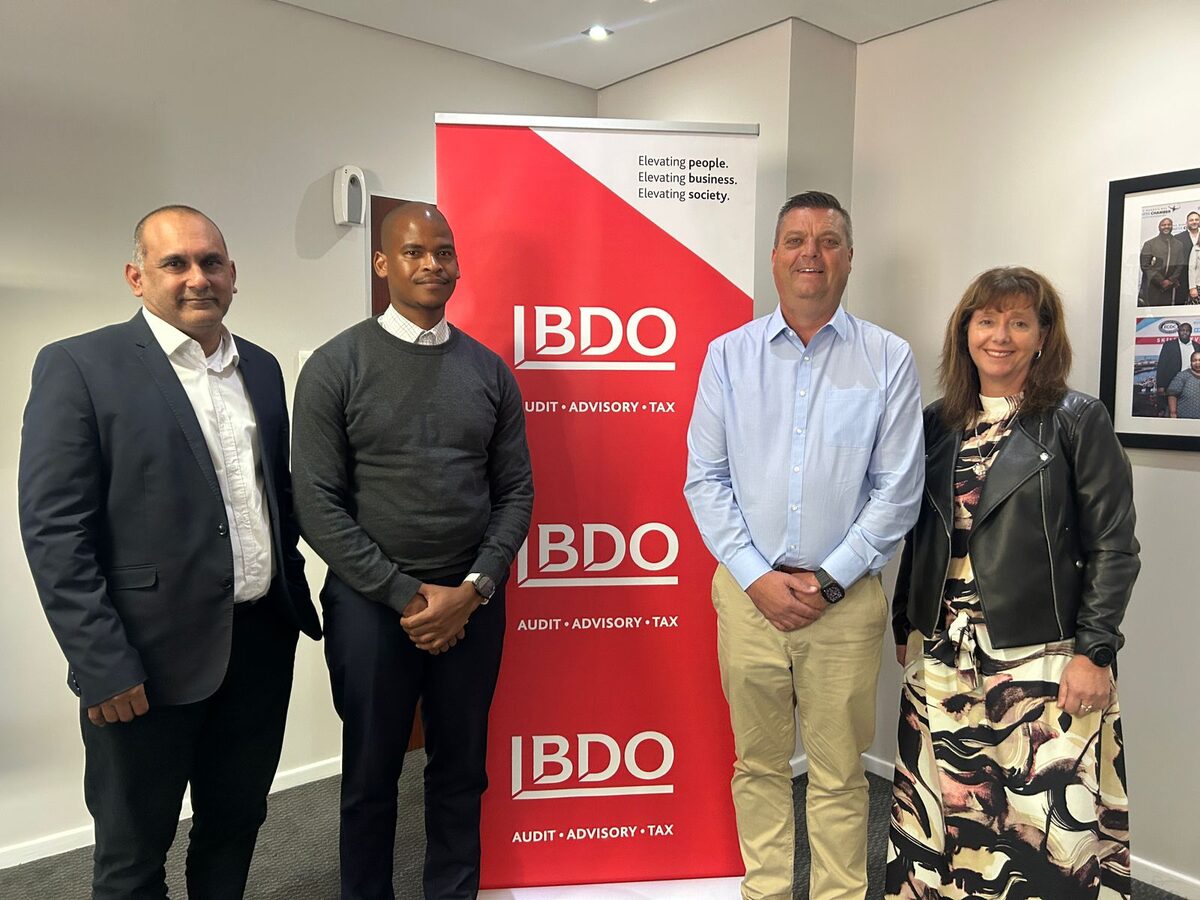

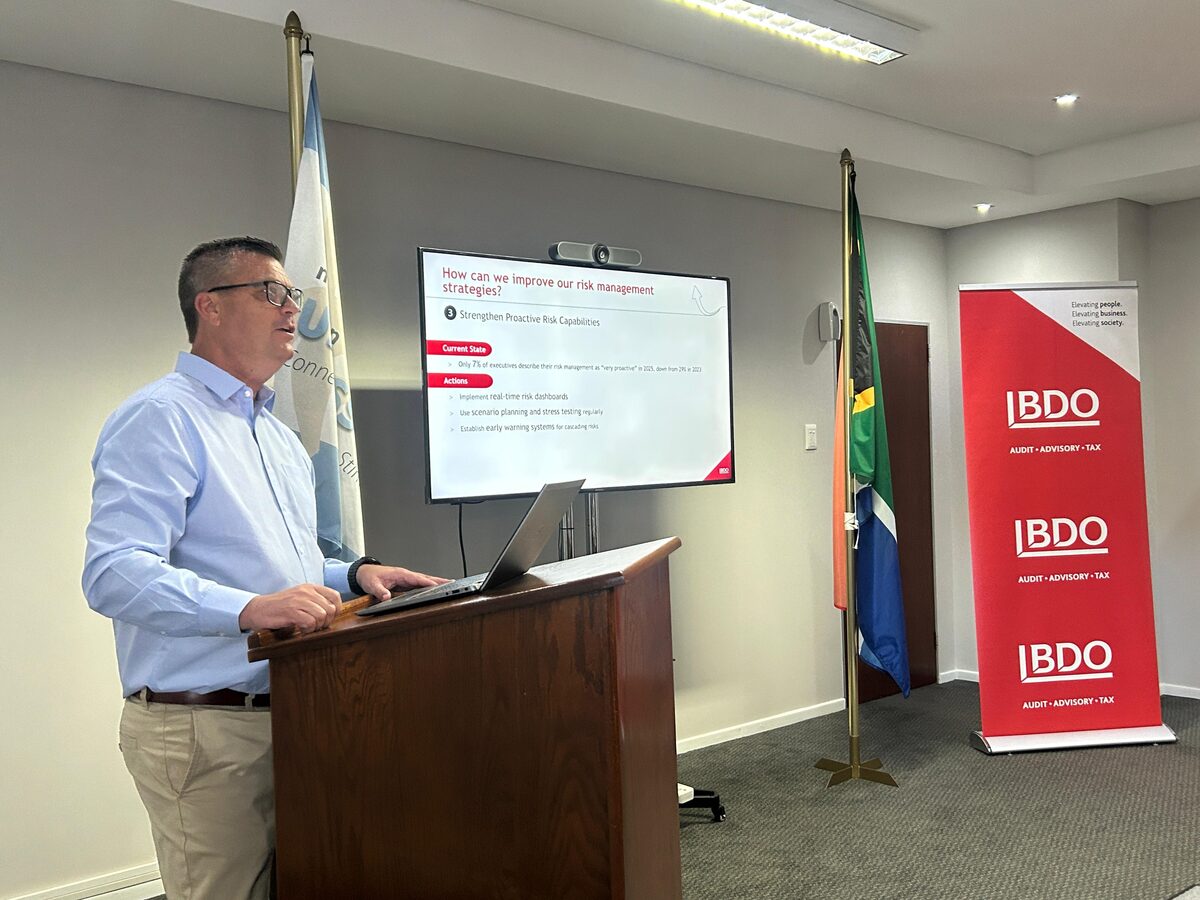
Richard Walker, Head of Risk Advisory Services at BDO South Africa, recently presented BDO’s Global Risk Landscape 2025 report to exporters and emerging businesses at a closed session hosted by the Nelson Mandela Bay Business Chamber.
The report paints a sobering picture of a global business environment where bold, proactive risk-taking is steadily giving way to caution and defensive strategies.
According to the findings, 69% of companies around the world now describe themselves as risk-averse or focused on minimising risk, up from 61% last year. Even more concerning, just 7% of business leaders say their risk management is “very proactive,” a dramatic drop from 29% in 2023.
Walker warned that this growing hesitancy could stall business growth. “Ticking boxes as our approach is going to kill us as businesses,” he said. “We’ve got to become more resilient, not just compliant. Risk management should be part of everyday operations and strategy. It must be built into company culture, not treated as a separate checklist.”
The report shows that concern over regulation, politics and economic instability is on the rise. Eighty-four percent of executives say the risk environment is more crisis-driven than ever before. As a result, many businesses are reacting to threats instead of planning ahead, leading to slower, more defensive decision-making.
Regulatory risk has now become the top concern for executives, having moved from the background in 2023 to the forefront in 2024 and 2025. Thirty-five percent of leaders feel unprepared to deal with the complexity and speed of changing regulations, particularly around data privacy, which over half of respondents cited as their top issue.
Supply chain risk ranks second, driven by ongoing geopolitical instability, climate disruptions, and cyber threats. In response, companies are increasingly adopting “flexsourcing”, a more agile, responsive supply chain strategy that allows businesses to switch suppliers, locations or logistics channels rapidly to reduce dependency and avoid disruption.
Artificial intelligence (AI) continues to be seen as both a solution and a risk. In 2023, AI was largely viewed as a threat multiplier, particularly in cyber and fraud contexts. Optimism dipped in 2024 as awareness of AI-related risks grew. In 2025, confidence has slightly rebounded; 62% now view AI as a cybersecurity tool, but the same percentage also worry about increased privacy and data risks.
Over the past three years, the report traces a shifting attitude in risk thinking. In 2023, companies started recognising how risks interconnect and amplify one another. In 2024, there was growing interest in the concept of “antifragility”, the idea that companies can grow stronger through disruption. But in 2025, that momentum has stalled, giving way to what BDO terms “risk paralysis”. While 63% of executives say risks are emerging faster than ever, many organisations remain stuck in reactive, compliance-driven modes of operation.
In South Africa, these global pressures are compounded by local challenges. Businesses are expected to comply with global regulatory standards, despite operating in environments often limited by infrastructure gaps, skills shortages, and policy uncertainty.
“We’re trying to meet first-world compliance standards in a developing environment that isn’t always equipped to support it. That’s a risk in itself,” said Walker.
Chamber President Kelvin Naidoo agreed, adding, “Due to operating in an environment of constant chaos, South African businesses are becoming too defensive, which is not good for growth and innovation. There is no doubt that local businesses have become good at operating in crisis situations, as evidenced during the Japanese Tsunami of a couple of years ago which disrupted global supply chains, as well as during the COVID-19 pandemic. This has more recently been compounded by local crisis issues such as logistics inefficiencies, reliability of power supply, lack of safety and security and municipal service delivery challenges.”
Naidoo emphasised the importance of businesses ensuring that they are not solely focused on the short-term and that they are also pursuing long-term strategies to ensure the sustainability and growth of their operations.
“At the same time, it is vital that businesses invest in their talent pipelines to ensure they have people with the required skills to support their longer-term strategies.”