
WHEN Magda Minguzzi arrived in South Africa in 2013 from Italy, she decided to make Richmond Hill her home.
“I found that Richmond Hill had many things in common with where I lived before in Venice. A unique and strong sense of community and neighbourliness exists here. When I open my windows or go out in my garden, I frequently see my neighbours. We greet each other, chat and regularly socialise together. It’s lovely to still hear children playing in the streets of one’s neighbourhood.”
For a woman like Magda, who puts great emphasis on living a life of meaning, balance and connection, this speaks volumes. She has always been actively engaged in her local, as well as her wider, community.
Magda has taught Architecture and History at the School of Architecture of the Nelson Mandela University since 2013. As a result of her previous training at the University of Architecture in Venice, her main focus and work centre on making tangible connections to lost heritage.
In line with Magda’s inquiring mind and sense of social responsiveness, she felt an urgency to understand and unearth the pre-colonial history of the First Indigenous Peoples of South Africa.
One of her various research art projects, called The Spirit of Water, has received national and international acclaim. The project encapsulates Magda’s continuous and ultimate vision and design: getting to the heart of the matter, recovering that which had been lost.
“In 2014 I started a group working with the Chiefs of the KhoiSan peoples, based in Nelson Mandela Bay and vicinity, and some of Nelson Mandela University’s colleagues and students. Through the work we do together we explore ways in which to activate cultural re-appropriation of pre-colonial indigenous sites in the Eastern Cape through which the people can re-establish a sense of belonging and memory.”
Magda is thrilled to be part of such an important journey: helping people to re-instate an unbroken storyline and filling in the gaps of the original narrative of the First Nations Peoples.
“We work together on various projects: documenting unknown indigenous sites along the coast and recording the indigenous history related to these places. In 2017 we organised a ceremony – the first of its kind after centuries – which was performed by the Chiefs of the KhoiSan. It lasted for two days and was performed in front of the ancient stonewalled fish traps, located in Cape Recife.”
This event was open to the public and not only celebrated the engineering feat of the pre-colonial fish traps, but also brought to the forefront the evidence of the earliest human manipulation of the Southern African coastline by the First Indigenous Peoples – a perfect example of the sustainable use of the coast and resources.
It takes a special kind of person with a unique skillset to bring about such an honest sense of cultural consciousness in her work.
Magda has, for many years, combined her view on the landscape and different territories and its relation to the culture and identity of its people with active research, which formed part of quite a few documentaries. And so her work became almost like a form of performance art: a beautiful balancing act between art and architecture.
“I am an architect, of course, but my art background also plays an important part in my life and my work. And I always try to keep the balance between these two disciplines.”
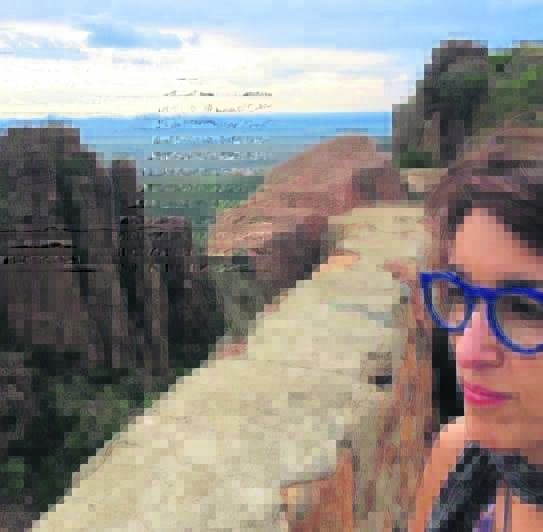
With her Italian-inspired glasses and eclectic, elegant dress sense, Magda’s appearance is a physical representation of her eye for detail. Through the clean, uninterrupted lines she constructs daily between the past and the present, she helps to guide people back to their roots.
“I absolutely love the sea. That’s another reason why Richmond Hill is the place for me. And I also respect the way in which people show concern for their fellow residents here. It should be like that in all communities. We are, after all, all connected.”
Poised between the canals of Venice and the streets of Richmond Hill, with its view over the ocean, Magda feels balanced by the continuous movement of the water. It helps her to think clearly and to bring hope in the modern world.
“If we don’t know where we come from, we struggle to move forward,” she said. “And, somehow, I can see the past and the present unfold in that simple, undeniable truth.”