
The Nelson Mandela Bay Metro’s largest dam, the Impofu Dam, has officially been decommissioned.
This means no more water can be extracted from the dam, as the water levels have dropped too low.
PE Express previously reported about this dam reaching an all-time low of 7.01% – of which 7% is dead storage. This is the lowest level that the dam has ever reached in the forty years since its construction.
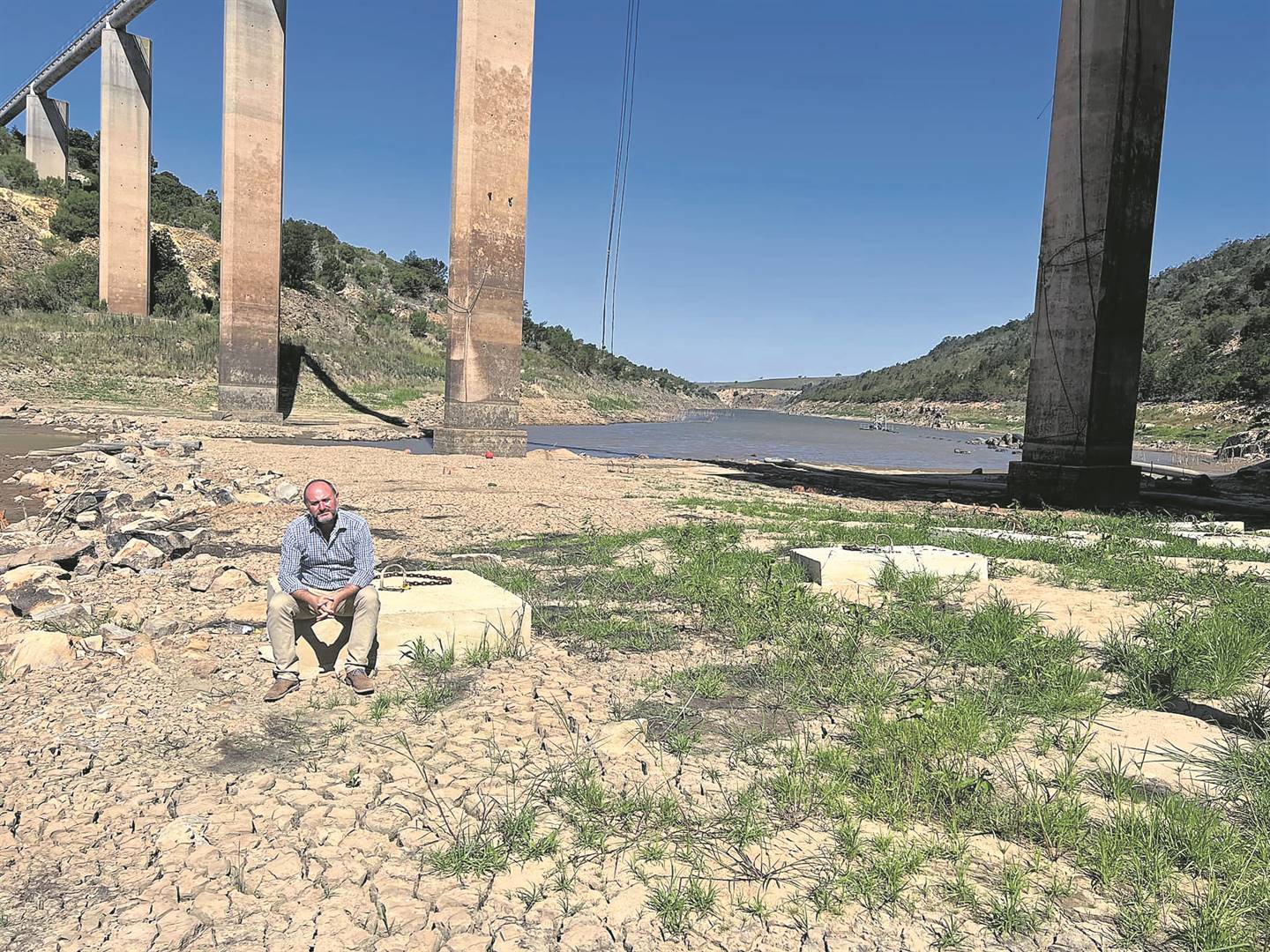
During a site visit, Nelson Mandela Bay mayor, Retief Odendaal, walked in the dam basin. In this area the water is supposed to be significantly deeper, far more than head height. Instead, the majority of the dam now consists of dry, crumbling soil, with only a little water left.
In the previous article regarding this dam, the metro’s water and sanitation director, Barry Martin, explained that the barges would no longer be able to work due to the lack of water, and would start sucking in mud. He mentioned that the barges needed to be moved downstream.
Odendaal confirmed that this would still take place.
“This dam was not built to operate below 16% of total capacity, but two years ago the municipality constructed barges, and installed mobile pumps on those barges, to be able to extract what little water was left,” he explained.
He said that the dam level was so low it had to be decommissioned as there is virtually no water left.
“We are going to construct another barge, close to the dam wall, and hopefully we will be able to extract another one or two percent from this dam within the next couple of months,” said Odendaal.
The mayor mentioned that the total combined dam levels currently stand at just over 14%, of which only about 9% can be extracted.
“We are urging all residents in Nelson Mandela Bay to use no more than 50l per person per day so that we can make it through this crisis. We believe that we will be able to prevent Day Zero if we are all responsible and heed this call to conserve water.”
He said that whilst sitting in the centre of an almost empty Impofu Dam, he was thinking about just how difficult it is to comprehend the metro’s daily water consumption.
“I was myself blown away by the cold, hard reality when I started making the calculations. If 100 000 households each had a 2 000 litre (2 Kl) water tank which fills up after a shower, collectively those 100 000 tanks would have harvested 200 000 000 litres (200 ML) – a massive quantity of water – but alas still equivalent to only 66% of our water consumption in Nelson Mandela Bay for one day.
“As a city, we simply cannot continue to guzzle the quantity of water we are currently consuming, amid the most intense drought on record. Yes, the city unfortunately still has very high real water losses. This we won’t be able to change overnight, but even when we take those water losses into account, the average resident is still using approximately 150 litres per person, per day.
“Over the next couple of weeks we are going to have to do absolutely everything in our ability to reduce this city’s consumption by at least 10%,” said Odendaal.
Meanwhile, the metro has been experiencing constant water disruptions, with loadshedding placing an even greater strain on a system ravaged by drought.
The metro’s water distribution director, Joseph Tsatsire, said that the drought had already led to an intermittent water supply to a number of areas, with the western suburbs the hardest hit.
“The crisis with loadshedding has rubbed salt into the wounds by negatively affecting the water distribution to the city’s reservoirs. As much as the city has worked out a plan to cushion the water intake into the reservoirs, as well as for storage and distribution to the consumers, the severity of loadshedding has put a strain on the system,” explained Tsatsire.
“We are working around the clock to use our existing infrastructure to re-route water to the strained areas for the reservoirs to fill up; however, the high consumption remains a challenge. We continue to interact with Eskom so that we can improve our systems to stabilise the situation.”