
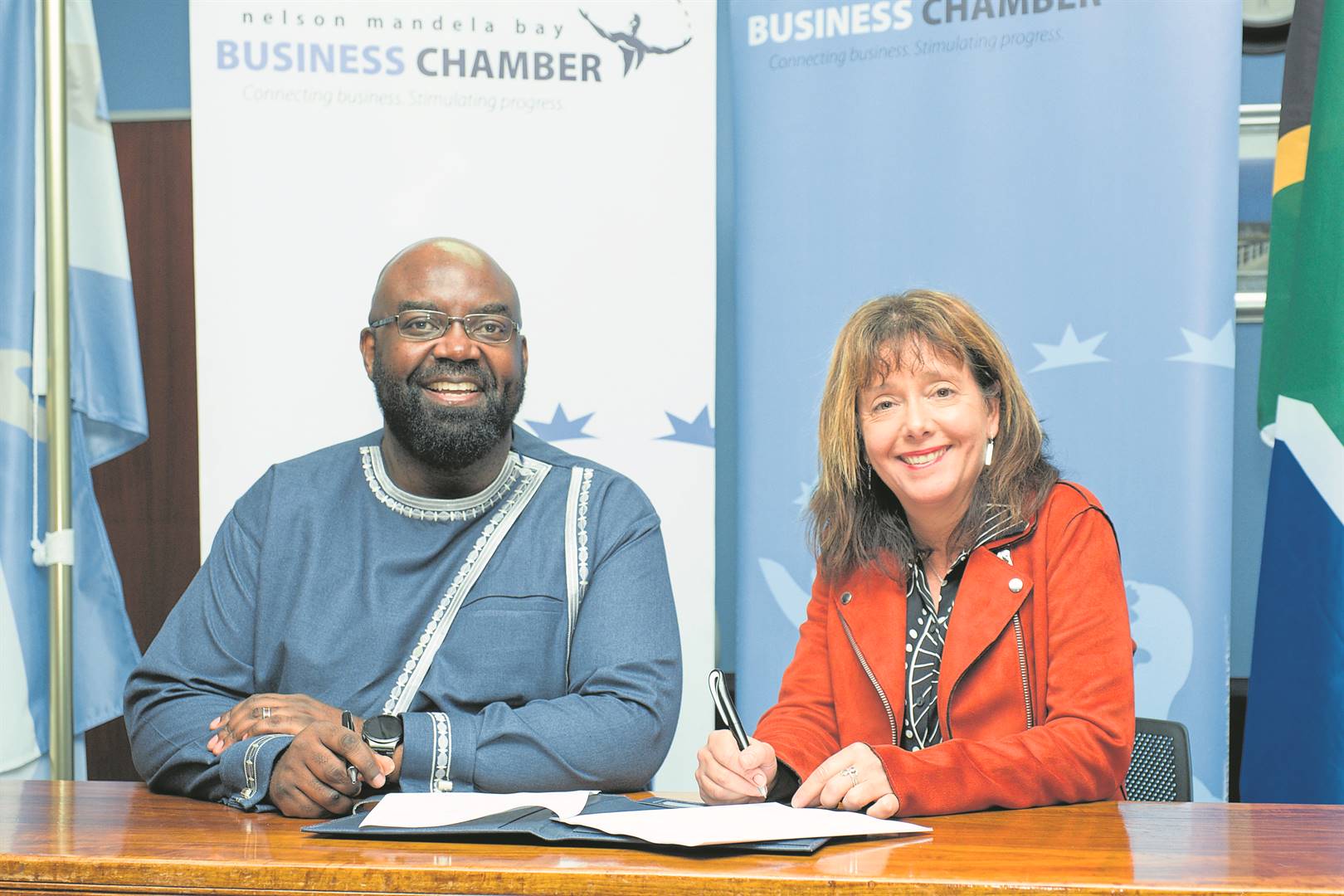
POSITIONING Nelson Mandela Bay as a logistics hub for the South African automotive sector is the shared objective of the Nelson Mandela Bay Business Chamber and the Automotive Business Council, naamsa, in a memorandum of understanding (MOU) recently signed.
The two business organisations have formed a strategic partnership to pursue their common interest in strengthening the logistics infrastructure and inter-connectivity of road, rail and ports, particularly the critical north-south corridor, to support the automotive industry and retain investments and jobs.
Together they aim at leveraging Nelson Mandela Bay’s competitive advantage of two ports, to enable the Bay to become a world-class import and export logistics hub, supporting the automotive industry as well as agriculture and other sectors.
The partnership governance structure, enabled through the signed MOU, will identify key strategic issues that would progressively drive port-rail integration as a source of greater modal integration and port competitiveness and increase the capacity of rail transport, for which investment in track and rolling stock is essential, naamsa chief executive, Mikel Mabasa, said.
“We share the vision and concerns of the Business Chamber regarding the survival of the automotive industry. This underpins our strategic partnership of organised business collaborating on an issue of strategic importance, both locally for the metro and for the country’s automotive sector as a whole. We will work with diverse teams to build new capacity among railway operators, to provide them with a logistics vision that allows them to really compete with, or complement, road transport in order to diversify the freight transport matrix,” said Mabasa.
Business Chamber chief executive, Denise van Huyssteen, pointed out that close to 45 percent of South African automotive production emanates from the Eastern Cape, and most of it is located in Nelson Mandela Bay. Most businesses in the metro, whether directly automotive-related or not, benefit directly or indirectly from the automotive sector, she said.
“We are the most manufacturing-intensive metro in the country, and logistics represent one of the highest cost areas for business. Ensuring the survival of the industry in the metro, retaining investment and protecting jobs is reliant on improving the efficiency of the two ports, getting the north-south rail corridor functioning again and shifting freight from road to rail, as well as repairing and upgrading the road network,” said Van Huyssteen.
Ensuring greater efficiency at the ports of Port Elizabeth and Ngqura will reverse the current problem of shipping lines skipping South African ports due to delays and congestion, and improve the connectivity of Eastern Cape manufacturers to foreign ports. More than 53 percent of vehicles exported out of South Africa are processed through the Eastern Cape and it makes sense to move and concentrate our attention and future investments in supporting our local ports infrastructure.
While the Port of Durban is over-congested and Cape Town has limited opportunity for expansion, a focus on making the Bay’s two ports more effective, along with the Port of East London, made sense, Van Huyssteen said. She added that collaboration between the private sector and Transnet, including clarity on potential third-party port and rail operations, would be essential in achieving more efficient and effective logistics linkages.
In addition to working jointly to strengthen industry participation in initiatives to improve logistics infrastructure and connectivity, naamsa and the Business Chamber will lobby together for the implementation of loadshedding mitigation measures. Additionally, a key area of mutual interest is the vital need for a sustainable transition to electric vehicle production through a clear, decisive and predictable policy environment in South Africa.
“The agreement with naamsa is strategically important for Nelson Mandela Bay and the Business Chamber, as it enables us to leverage the strength of a national organisation that shares our vision. It is in line with this new era of collaboration between individual businesses, organised business, state-owned enterprises and civil society, in which business aims to be part of the solution and to protect investments and jobs,” said Van Huyssteen.
Both naamsa and the Business Chamber will support and work with government institutions to review the existing institutional framework to address infrastructure-specific challenges to address the degree of fragmentation and enhance co-ordination and influence across the various levels of government (local, provincial, and national).
– ISSUED BY THE NELSON
MANDELA BAY BUSINESS CHAMBER