
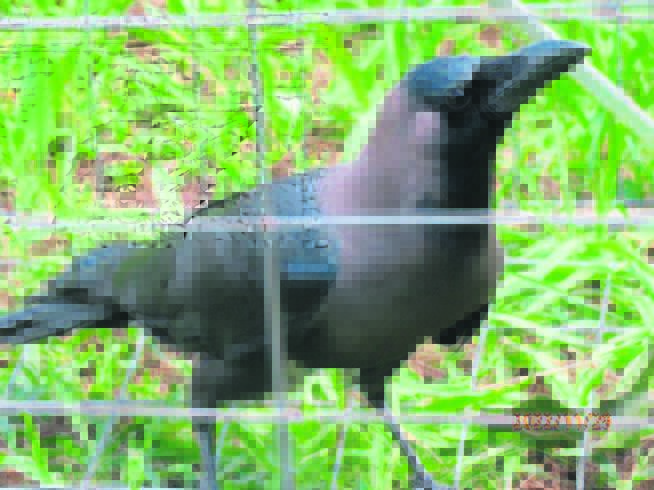
The House crow, an invasive alien bird in the Eastern Cape, originally from Southern Asia, is considered one of the most invasive birds in the world.
According to the South African National Biodiversity Institute (SANB), House crows were initially introduced to various African countries around 1897.
In South Africa it was reported to be introduced unintentionally, often through ships as hitchhikers. They are considered invasive in many parts of the world, including South Africa.
House crows (Corvus splendens) are invading parts of South Africa, mostly along the coastal areas in three provinces (Western Cape, Eastern Cape, and KwaZulu-Natal). House crows are listed as category 1a under the National Environmental Management: Biodiversity Act (NEM:BA; 2004): Alien and Invasive Species Regulations (revised in 2020), thus, requiring compulsory control and eradication if possible.
House crows reproduce sexually and usually produce three to five pale blue-green in colour and speckled with brown eggs. Incubation is rapid and this species can produce up to two clutches per year.
It has a slender body, mainly shiny black with a sooty grey breast, nape and mantle and a medium-sized bill. They are highly opportunistic birds and omnivorous in feeding, which allows them to survive in diverse environments.
Why are they a concern?
House crows pose a significant threat to native birds by out-competing them for food/habitat, and by eating their eggs.
They are also a nuisance to society and a threat to people’s livelihoods.
They are known to be aggressive and can attack people, for example street vendors, kill small native animals and poultry, damage crops and harass livestock. Their nests usually contain wire and are built on light poles, which can disrupt electricity supply and create a fire risk.
If unchecked, they will eventually colonise urban, peri-urban, and settled areas across the entire country, and eradication could become unfeasible due to the scope and associated costs.
Where are they observed in the Eastern Cape?
Currently, the House crows have been recorded in Gqeberha (Cape Recife and Summerstrand), Grahamstown – Port Alfred in Kenton-on-Sea, and East London.
Help us control this bird
The South African National Biodiversity Institute is responsible for controlling all emerging alien species.
“We must stop the House crows from further establishing more populations and spreading inland! One of the crucial steps towards managing alien species is to map their current distribution (confirmed sightings) and population sizes,” explained Menzi Nxumalo, SANBI regional co-ordinator for the Eastern Cape region.
“Should you see any birds, simply report on one of the following platforms. Download either the iNaturalist (A Community for Naturalists · iNaturalist), upload digital photos, date and locality of your observation or contact Menzi M. Nxumalo in the East London regional office, 043 726 7492 or WhatsApp any information on 078 188 7844. Email: m.nxumalo@sanbi.org.za/ Invasivespecies@sanbi.org.za”