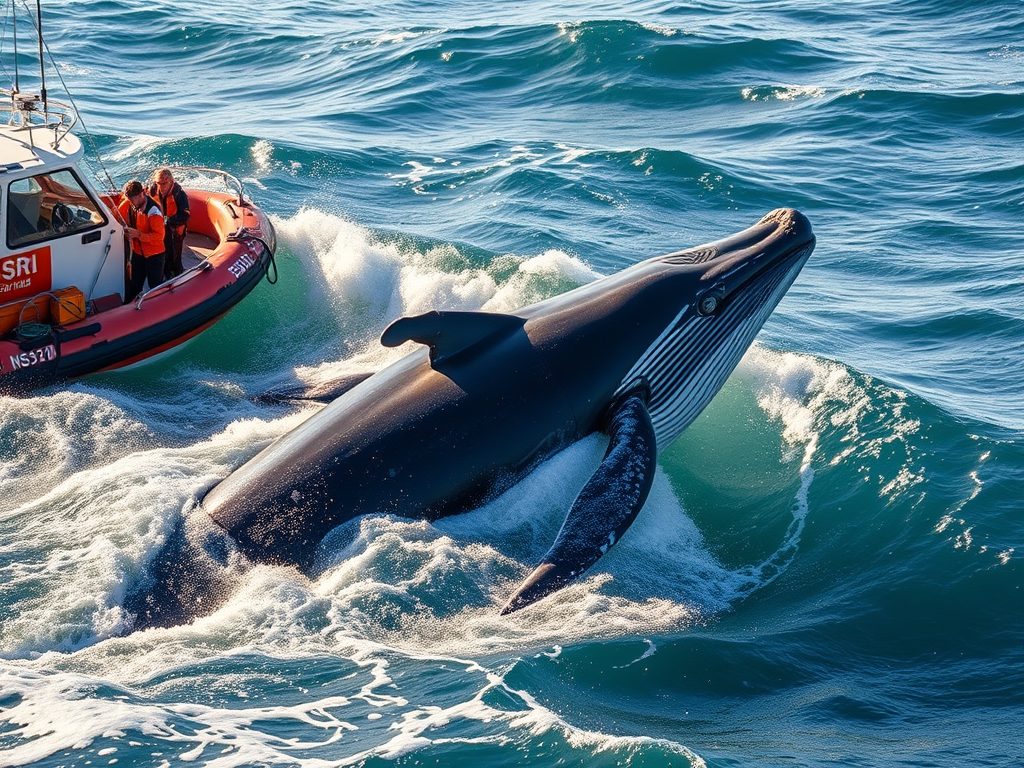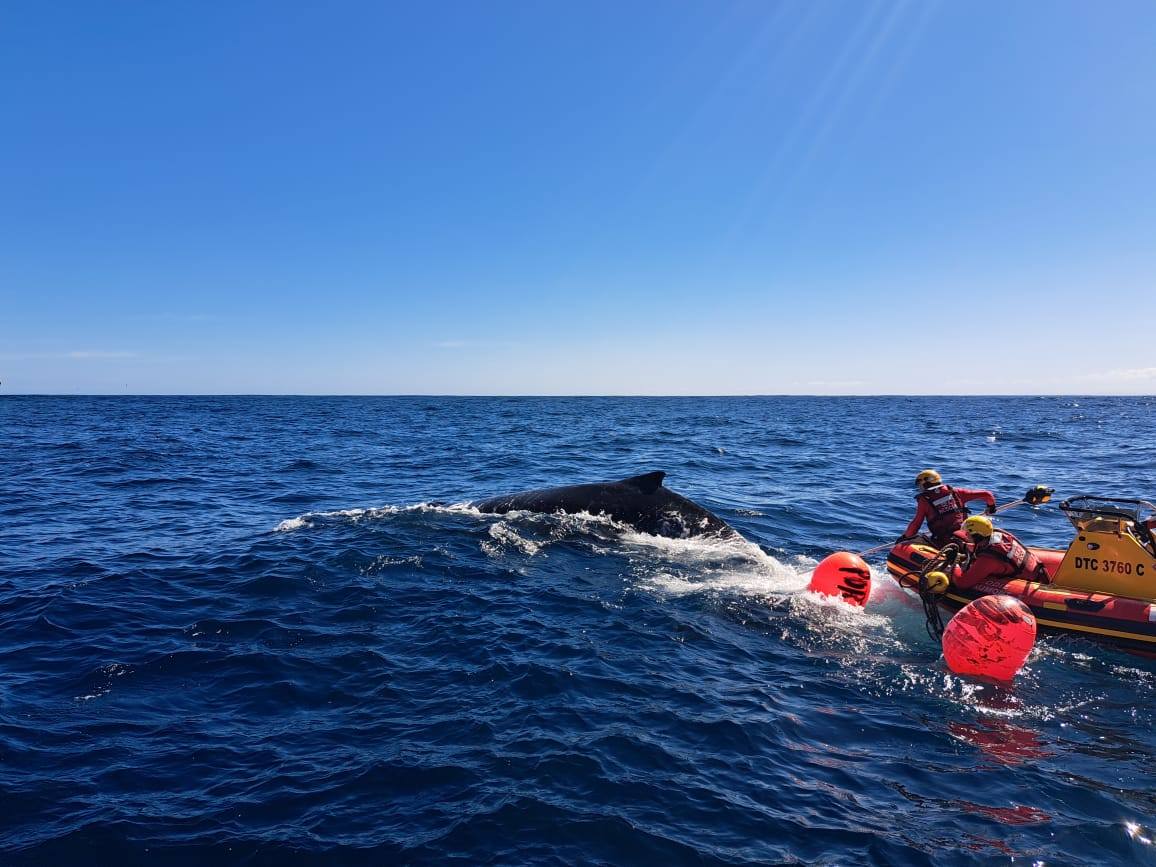

On September 21, NSRI Gqeberha Station 6, including three NSRI Gqeberha crew trained in South Africa Whale Disentanglement Network (SAWDN) whale disentanglement techniques and methods, launched two NSRI rescue craft from the NSRI rescue station at the Port of Gqeberha, Rescue 6 Alpha and Rescue 6 Bravo, following eye-witness reports of a whale entangled in fishing rope lines.
According to Craig Lambinon, spokesperson for the SAWDN, NSRI had been alerted just before 11:00 by the owner of the whale watching boat My Bru, of Raggie Charters, reporting that on a whale watching expedition with guests they had witnessed a juvenile humpback whale entangled in ropes and nets, near to St. Croix Island, Algoa Bay.
He said that they reported that the whale appeared to be tired but looked to be in a good and healthy state.
Mike Meyer, of SAWDN, was alerted and on the two NSRI rescue craft arriving in the area a search commenced.
Lambinon said that the whale watching Raggie Charters called again saying that they had again come across the whale 8 nautical miles from the Port of Gqeberha towards Koega.
“On locating the whale, about 9 meters in length, the whale was found to be tired and lethargic with a rope trailing 17 meters behind the whale, with two floatation buoys entangled in fishing rope that was entangling around parts of the whale,” said Lambinon.
“Kegging buoys, to prevent that whale from diving under water, were initially set up but the young whale appeared to be so exhausted that the kegging buoys were not necessary, and they were removed.”
Lambinon said that from the NSRI JetRib rescue craft, Rescue 6 Bravo, the SAWDN trained crew, using specialised cutting equipment, initiated cuts to a large entanglement of rope and gear on top of the whale’s fluke.
He said that there were four to five wraps around the fluke.
“The rope and fishing gear entangling the whale was thick and despite the specialised cutting equipment progress was slow – then after two good cuts and recovery of fishing gear had been achieved the operation was paused after a cutting pole broke,” said Lambinon.
He said that the two NSRI rescue craft moved away from the whale to give the whale some space and for the SAWDN and NSRI crews to re-group to discuss a way forward – with the remaining cutting pole.
Lambinon said that the 8.8 meter RHIB (Rigid Hull Inflatable Boat) NSRI rescue craft, Rescue 6 Alpha, then moved into position and was able to reach right up to the whale, which was clearly exhausted, and the crew initiated cuts to three or four loops of heavy fishing rope until all loops of rope and the buoys were removed from the animal and recovered.
He said that the whale showed signs of beginning to move freely through the water.
“From scarring it is suspected that the fishing gear, rope and floatation buoys may initially have been entangled around the head and most likely over time shifted around the fluke and Caudal Peduncle,” said Lambinon.
“Samples have been collected for research. All fishing gear and buoys recovered were brought to shore and will be examined.”
Lambinon said that the SAWDN and NSRI commend the owner of the whale watching boat My Bru, of Raggie Charters, for alerting NSRI.
“We are confident that the whale is healthy and will survive following this successful operation,” said Lambinon. The operation completed at 15:30.
ISSUED BY THE SOUTH AFRICAN WHALE DISENTANGLEMENT NETWORK (SAWDN)