

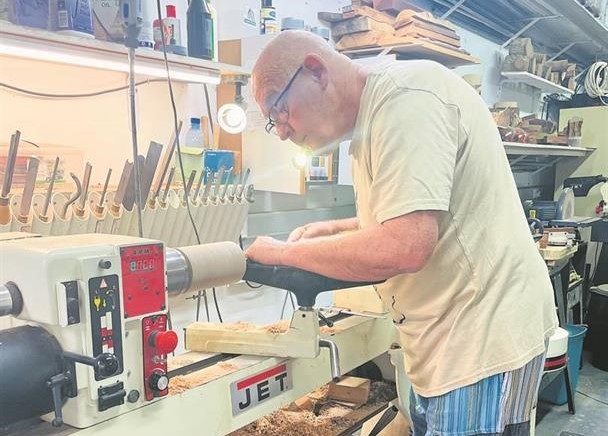
In 2017 John Atkinson, who lives in Kariega, started to do woodturning on a daily basis, and the freedom he found in the craft has turned his life around. For 40 years Atkinson worked in the motor industry, and now his engineering skills come in handy when in his workshop.
He has happily swapped his corporate attire for hippy patchwork trousers and a t-shirt, and transformed himself into a full-time imaginative woodturner.
Inside Atkinson’s workshop, he is comfortably enveloped in the warm, earthy smell of wood, present in all shapes and sizes.
Branches and logs are neatly stacked outside; off-cuts are kept beneath work tables and wood shavings surround the lathe where Atkinson is usually at work.
He doesn’t see himself as a traditional wood turner in the purest sense of the word, but it doesn’t take long to realise he is indeed the purest of purists when it comes to seeing and celebrating the supposed “flaw” in a piece of art, and nature as a thing of beauty in itself.
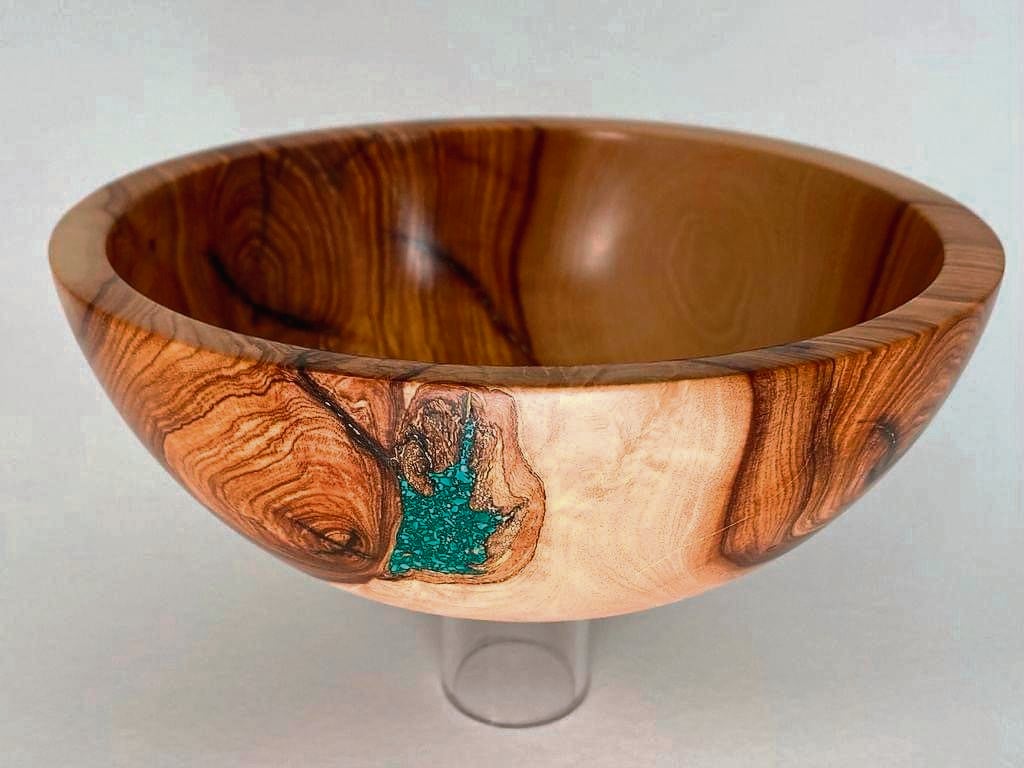
Enhancing cracks in the pieces he creates gives them their unique trademark, enhancing their overall natural quality.
“The two things that inspire me most are ceramics and nature,” he said.
The interesting shapes Atkinson’s creations take invite one to feel and hold them. In doing so, you are immediately drawn to their natural form, and the beautiful colours that adorn them, acutely reminiscent of nature and its cycles.
Atkinson loves the creative process and talks about learning through trial and error and how “something just happens in my head”, while he works and ideas naturally arise.
“I don’t do the same thing over and over,” said Atkinson. “What I really enjoy is turning something of interest that’s not the normal sort of bowl or object, and using wood that is not perfect.
“Once a piece is turned, I take great pleasure in adding colour and different textures.”
For the embellishment process, Atkinson uses a variety of techniques and resources to create different effects, like pyrography, carving, colour stains, resin, semi-precious stones, paint, glass, and natural inlays.
Without fail, he returns to, and constantly acknowledges, the natural environment in his work. His respect for natural beauty speaks for itself, as he discusses the wood he often works with.
“The curly maple, for example, has wavy patterns ingrained in it, and when you turn it, it’s magic. You don’t have to do anything to it.
“So, it just depends on the wood. Sometimes you don’t want to do anything to it. In itself, it is just a beautiful piece of magic wood.”
As Atkinson continues to perfect his art, he enjoys discovering the complexities of different processes. Keen to start burying his pieces in sheep fleece, which is full of lanolin and finishing them off in this way, he commented on the wool industry.
“I was blown away by the intricacies going into something like the wool industry.”
Being a member of the PE Woodturners Guild, as well as the Association of Woodturners of South Africa, also serves as a source of inspiration for Atkinson.
“The different, radical ideas, of youngsters and the technology that comes with it, as well as the valuable thoughts and viewpoints shared by the female members, are enlightening.”
As much as he is motivated by learning new things, he also loves sharing his knowledge and skills.
“To start woodturning, all you need is a lathe, a couple of chisels, and once the bug bites that’s it, you’re off!” he exclaimed.
Atkinson has been part of art exhibitions before, and also sells his wares at craft markets.
Before I leave, Atkinson shares his motto with me. When he attended a Woodturners Association Symposium there was a ceramicist who gave a presentation on form.
“If you can imagine it, you can create it,” he said. It is evident that this is what Atkinson now lives by.
I leave with the memory of the fruity scent of wild olive wood, the feel of wood shavings on my fingertips, and woodturning terms, like “cross grain” and “off-centre turning”, flitting through my mind. Outside the autumn leaves reflect almost exactly the colours on a bowl he created. I marvel at the creativity of individuals.
In the end, perhaps it lies in the letting go, in going back to basics, in accepting and delighting in perfect imperfections.