
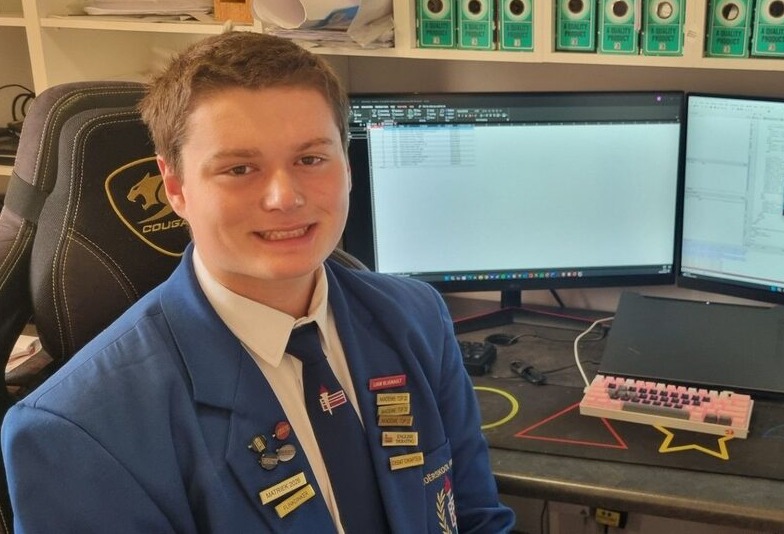
GQEBERHA – A Grade 11 learner from Hoërskool Framesby has developed an innovative offline artificial intelligence (AI) study assistant aimed at helping learners overcome barriers such as poor internet access and load shedding.
Liam Blignault designed and built the desktop application, called StudyMAX, as part of his school project — combining planning tools, progress tracking and AI support into a single platform that works without WiFi.
His father, Craig Blignault, said Liam’s interest in technology started at a young age.
“I work in the agricultural and export quality control field, but I’ve always had an interest in IT,” he shared. “I’ve been training Liam from a young age, so he has developed an appetite for computers.”
“With his IT subject at school, he is the best in his grade at Hoërskool Framesby and he is also the top learner in physics for his grade.”
Craig added that Liam recently participated in an Olympiad requiring participants to achieve over 80%.
He believes growing up in a digital era has shaped how learners approach education.
“From a young age, they are exposed to a digital environment. School assignments and presentations are no longer done on cardboard — everything relies on digital capability. I’ve been teaching him how to use technology from an early age,” he added.
Liam is still considering his future study options, with interests in engineering-related fields such as mechatronics and IT.
“At the moment, he is considering a few degrees based on his subjects, all engineering-related. He hasn’t made a final decision yet,” Craig said.
The StudyMAX project particularly impressed his father.
“His assignment was a jaw-dropper. I helped with the concept, but he did the research and built everything himself. He worked on it for the whole year and presented it at the end of the year,” he shared.
“The teacher said it was the first time they had seen an assignment that ‘talks back’. The software used at school is about 15 to 16 years old, and during that time, there was no talk of AI.”
Craig said developing an AI tool on such outdated systems made the project even more remarkable.
“To build an AI on a school computer and demonstrate it as a study tool is unique. Every parent is proud but this is the first time I felt I should reach out to the press,” the proud father shared.
Liam explained that StudyMAX integrates an academic calendar, a progress-tracking database and an AI chatbot into a single desktop application.
“It is a desktop application that integrates an academic calendar, a progress-tracking database, and an integrated artificial intelligence chatbot,” Liam shared.
He said the inspiration behind the project was the reality that many South African learners face.
“South Africa is restricted by the digital divide. AI tools require constant, high-speed internet and modern hardware. This excludes learners who experience load shedding, unreliable internet and older computers,” Liam explained.
“My goal was to build a programme that helps students with their studies, regardless of their socioeconomic background.”
To achieve this, Liam researched the most commonly used academic tools — homework helpers, planners and progress trackers — and combined them into a unified system with a graphical user interface.
He built a relational database using Microsoft Access and sourced a localised language model capable of running on minimal hardware.
“I used a model that can run on a CPU with just 4GB of RAM, without needing an expensive graphics processing unit,” he said.
However, the project came with significant technical challenges.
“The specifications required me to use Delphi 2010, which is about 15 years old and does not support modern AI models,” he explained.
To overcome this, Liam developed a custom communication system to connect the AI model to the outdated software.
“I wrote a function to launch the language model, created an output pipe and captured the data in real time. I then converted it into readable text,” he said.
He deliberately avoided using online AI services.
“I considered using an online API, but it requires an internet connection, which defeats the purpose of the programme,” he added.
The end result was a fully functional, lightweight, offline-first application designed to make AI-powered learning more accessible.
ALSO READ: State-of-the-art AI, coding & robotics centre for Astra Primary