
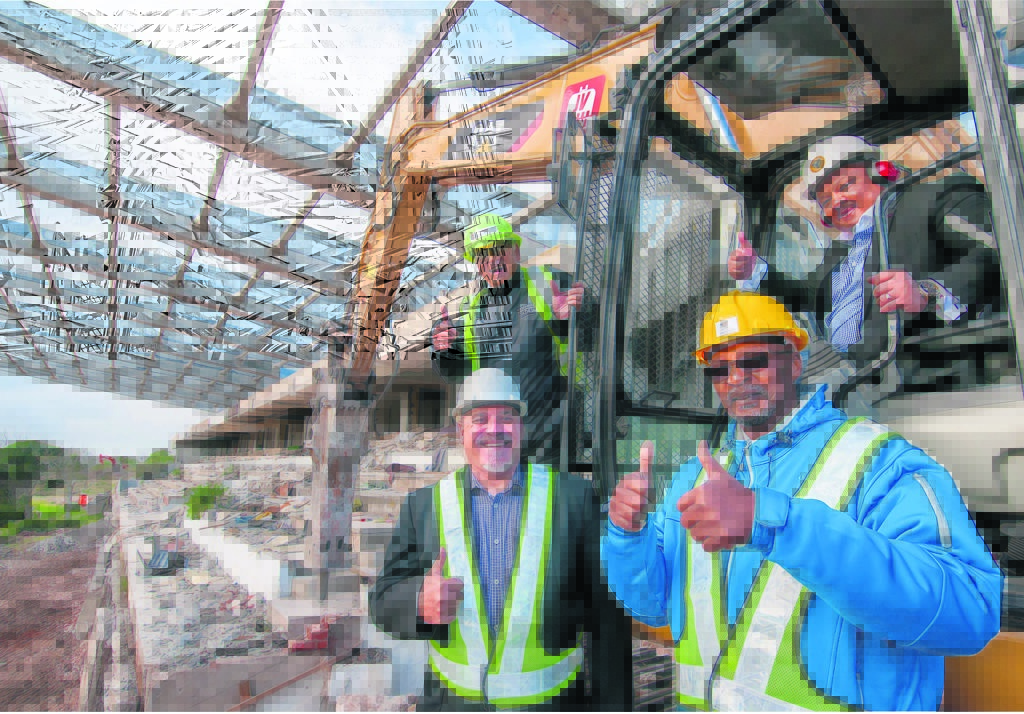
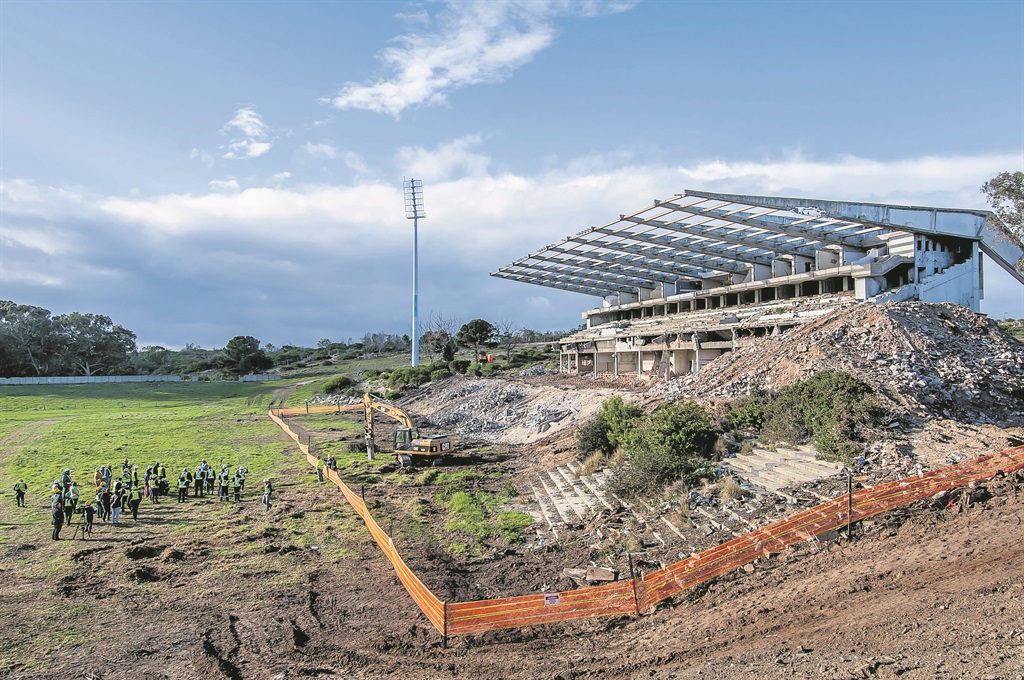
Last Friday marked the official end of the Boet Erasmus Stadium as bulldozers moved in to close the chapter on what used to be the Eastern Cape’s premier spot for rugby matches and even music concerts.
The historic site will make way for future development which could include residential, retail, entertainment, conferencing, tourism activities and even office space.
Nelson Mandela Bay Municipality’s Member of the Mayoral Committee for Economic Development, Tourism and Agriculture, Rano Kayser, Mandela Bay Development Agency (MBDA) board chairperson, Mputumi Phil Goduka, and CEO Ashraf Adam were in high spirits as they took the lead at an event held to mark the final push to demolish the old stadium.
Kayser said, “The demolition of the Boet marked the end of an era but also the beginning of a new era.
“The municipality believes the cleaning of this site will pave the way for catalytic and transformative development to take place here. Socioeconomic transformation can only be achieved through innovative spatial development which we are determined to see happen right here on what was an historic rugby ground in this country.”
The Boet Erasmus Stadium became redundant when the city built the new state-of-the-art Nelson Mandela Bay Stadium. For many years since then, the city had earmarked the site for an International Convention Centre (ICC) but due to market forces since 2008, this idea could not be realised, and the site stood idle and fell into disrepair.
The demolition followed an extensive process in obtaining a demolition license and in June the MBDA was finally able to proceed, clearing the way to leveraging this prime piece of land for future catalytic developments.
Tamlynn Jackson, project leader at the MBDA, explained, “The process to demolish a structure of this size is complex and drawn out due to the nature of approvals involved, each with a set of criteria to be met.”
She added, “One such approval is that of the Provincial Department of Environmental Affairs, necessary to safeguard sensitive environmental considerations, such as the protection of the flood line. A mandatory 20-day period for possible public objections to the demolition was also required before the demolition process could be initiated.”
Adam said, “The agency does not want to simply appoint professionals to advise us on what to do, we want the public to have a say.
“Govan Mbeki Avenue, the Boet Erasmus site and Bayworld are all public assets – they’re in the public imagination and the public psyche.
“The public has vested interests in these areas over the years and the MBDA wants them to have a say in the way forward. We want to use this opportunity as part of nation-building and what it means to live in Nelson Mandela Bay.”