
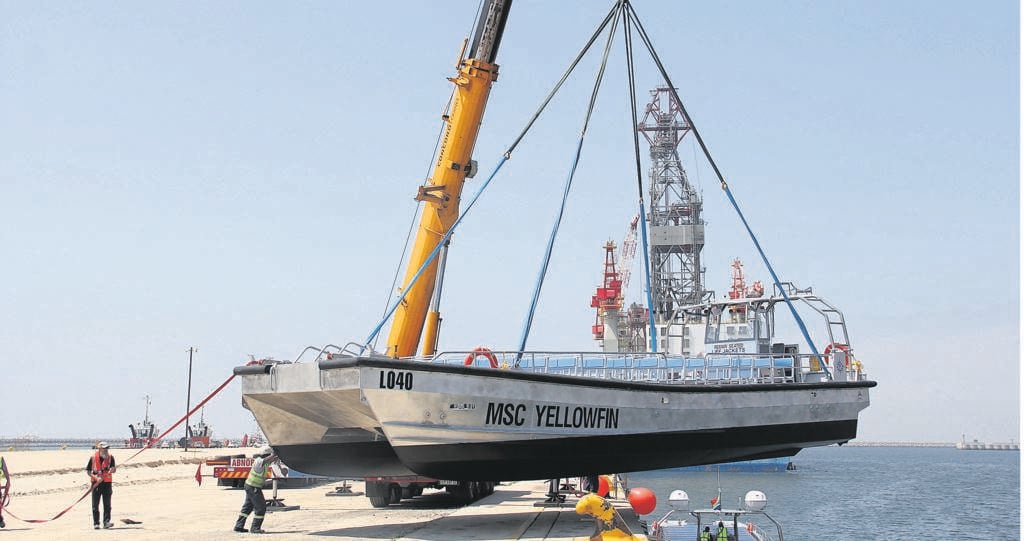
TRANSNET National Ports Authority’s (TNPA) Port of Ngqura hosted the testing and launch of the first ever locally manufactured aluminium vessels by PE-based boat builder, Legacy Marine.
According to a TNPA media statement, as Legacy Marine’s shipyard is based in Perseverance, low bridges blocked the route to the Port of PE in the past, restricting the building of larger vessels.
“When the new Port of Ngqura stepped up as an alternative port, it contributed to the expansion of boat building in the Eastern Cape,” the statement read.
General manager of sales at Legacy Marine, Gary Tait, said, “Now that the port is available for new vessel launches, we can build larger vessels, providing a boost to the boat building sector in the region.”
He said when they approached the port in 2017 as an alternative port from which to launch newly built vessels, they were very willing to assist.
“Since then Legacy Marine has launched four new vessels at the port, with the last vessel being shipped to Angola in February.
“We conducted all the vessels’ commissioning and sea trials with our international clients in the port. The Ngqura team has been extremely professional and provided immense support to us,” said Tait.
Acting deputy harbour master of the Port of Ngqura, Vuyani Ntsimango, said they were open to new activities that made business sense.
“This way we have shown that we are not only focusing on big vessels and revenue, but also on smaller upcoming businesses.
“The activities included the vessel launching, ship stability testing, seaworthiness testing, testing of navigational equipment, a survey according to local authority standards and the mooring arrangements, using ropes to keep the vessels alongside the berth,” Ntsimango explained.
The four vessels consisted of two passenger transfer vessels for an international cruise liner and two customised dive support vessels for Stapem Offshore, based in France. The two passenger transfer vessels operate in Mozambique, while the dive support vessels were designed to operate in the oil and gas production sector off the Angolan coastline.
These vessels are equipped with a three-man air dive system, remotely operated underwater vehicle (ROV), a subsea HP (high pressure) washer and subsea welding capabilities.
Owing to their size and efficient use of space, the vessels are extremely cost-effective and high-tech work platforms.