
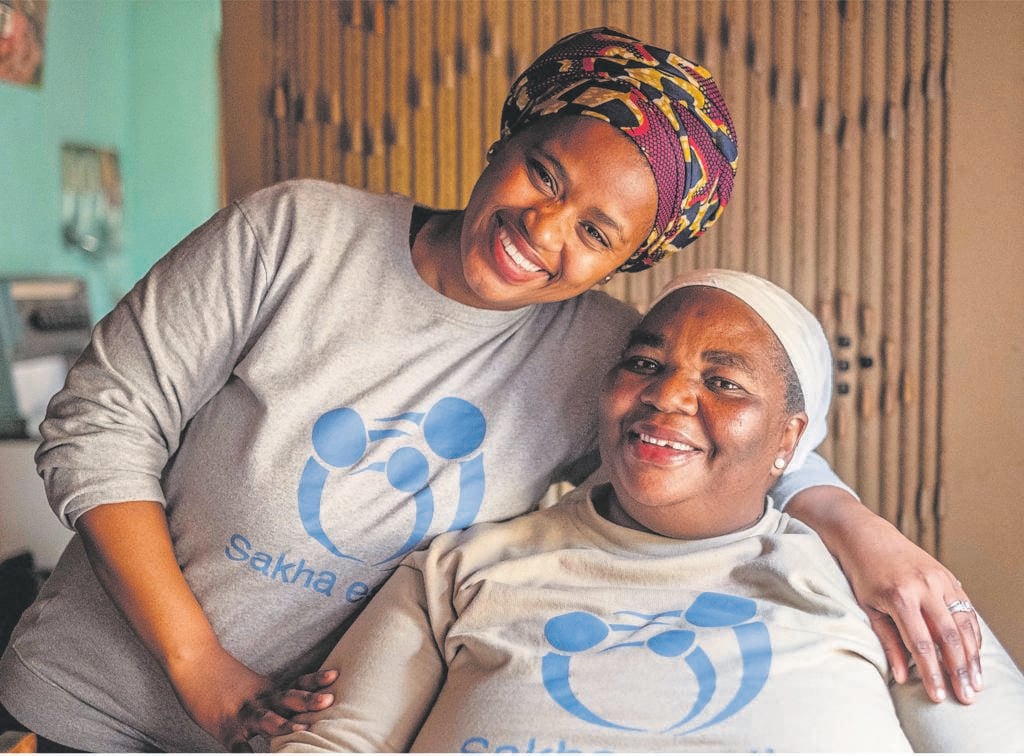
A COLLABORATIVE project between UNICEF, Nelson Mandela University, the Department of Health and Early Inspiration has given rise to a parent support group across the city under the name Sakha Esethu.
This community-based initiative is a gathering that provides mutual support for caregivers and parents on burning health issues and parent support through dialogue and conversation.
Sakha Esethu means “It starts with us, we’re building our own”. This active phrase emphasises the active role that community members, mothers, fathers, teachers or grandparents – anyone interacting with children can assist in the development of a child.
Sakha Esethu seeks to promote community participation by utilising the energy of trained community mentors and caregivers.
A mentor who naturally gathers community members
Nontsikelelo Mabangula (54), a Sakha Esethu mentor mother from New Brighton, received training in 2018 to be deemed competent as a mentor mother and began to showcase particular leadership and an ability to gather caregivers.
Even without prior qualifications, she has recruited and is running two Sakha Esethu parent groups: one with caregivers and another with grannies from her community.
Nontsikelelo is a mother in her own right, volunteering as an ECD practitioner at Little Rose, an ECD centre in Kwazakhele.
“I dream of opening my own centre one day,” Nontsikelelo said.
Most of the parents in her support groups are unemployed and this has provided Nontsikelelo and her group members with an opportunity to actively participate in community matters related to child health and wellness.
Seeing a window of opportunity, this innovative Sakha Esethu mentor mother mobilised the grandmother group through a monthly stockvel gathering, which was already in operation.
“Grandmothers are influential when it comes to raising children and are the ones who end up staying with their grandchildren when mothers go back to work or back to school,” she said.
Nontsikelelo’s vision for her parent support groups is fuelled by the success of her first two groups and she has great plans for initiating a third group. She was named one of the Early Inspiration Practitioners of the Year in 2018. Topics she covered included among others the role of a parent, HIV, breastfeeding myths and monitoring of children’s growth.
The power of training and mentorship is strongly seen as a catalyst opportunity for women, just like Nontsikelelo, to mobilise their communities, too.
Tsepiso – entrepreneur and Sakha Esethu mentor mother
Great value lies in the collective power that communities have when supporting each other. In a community where individuals, mothers, fathers, grandparents, family members and neighbours, choose to share a vision, offer a heart of empathy and pursue an empowerment mindset – there is great potential for change. Despite the hardships of living in an underprivileged community, like the outskirts of Motherwell, there are stories of great impact to be told.
One of these stories is of Tsepiso Mokhoelehe, a 42-year-old mother with two children. She is also the principal and owner of her own ECD Centre, Tsepies Educare, which she started a year ago.
Her centre has grown from strength to strength, starting with just three children and there are now more than 15 regularly attending.
Tsepiso, graduated with her ECD Level 4 qualification, and attended training to be a Sakha Esethu mentor mother in 2018.
In just six months of running her Sakha Esethu mentor mother group, she had outgrown her living room and was hosting meetings in her garden.
“I was not involved in the community before. I was only busy with my ECD Centre…
“I have learnt participatory approaches when working with families and communities. We are now planning a community project which is a soup kitchen and this is a huge community development,” she said.
Tsepiso felt that her new title of mentor mom benefited not only her centre, but the wider community.
An entrepreneur, Tsepiso began to see many additional needs in her community that would be possible obstacles to people coming and seeking help from the support group. She commented, “Poverty causes people to keep to themselves most of the time. They become isolated.”
The Sakha Esethu support group decided to open up a community-based soup kitchen, where people gather in Tsepiso’s ECD centre to have some food, and that is where she gets an opportunity to discuss parenting issues with them, and tell them about the support group.
She has begun to approach sponsors for donations of food towards the initiative. This is ubuntu in action.
There is a genuine desire to be more than just a group of gathering parents but also a group of change makers in Motherwell.
“I don’t yet have children – but I can support parents”
Ntombekhaya Mbodla heard about the Sakha Esethu parent support training through a friend of hers.
She mentioned that these types of opportunities seldom come to her area in Wells Estate.
Although Ntombekhaya does not have any children of her own, she has been taking care of her sisters’ children for as long as she can remember and has grown up with a passion for children in her area.
Ntombekhaya started going to nearby clinics to introduce herself to the nurses and the clinic staff to market her support group and encourage nurses to refer community members to join her.
She hopes her group will be accessible particularly to parents who are struggling with raising their children.
She has two fellow mentors in her area who assist her in recruitment and referrals. One of Ntombekhayas’ goals is to open her own ECD centre in the near future.
For more info on the project, visit www.sakhaesethu.com.