
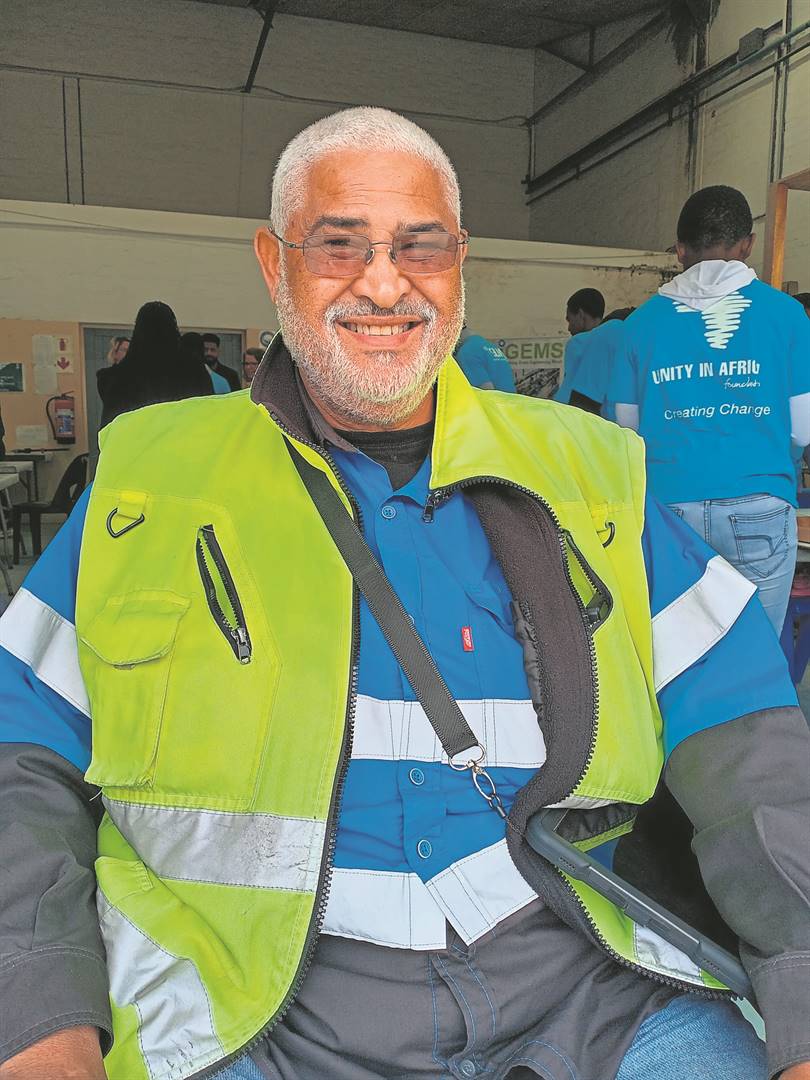
Galilodien Waggiet may only have been at the Labco-MCI-IT (TEA) Laboratory in Gqeberha for nine months, but his 40 years’ experience in road material testing is already contributing significantly to the development of South Africa’s young engineers.
Twenty South African National Roads Agency SOC Limited (SANRAL) students, as well as a dozen more who are learning skills through various NGOs, are currently undergoing training at the centre.
Waggiet guides them in testing methods and how these relate to road construction, while teaching them how materials are used in the concrete design process and how to determine the quality of materials.
“I take them from A to Z, so they have the full scope of how the materials fit together,” he explained.
Waggiet was born in Cape Town but grew up in Vryburg – often referred to as the ‘Texas of South Africa’ – in the North West. After being awarded a diploma in civil engineering from the former Peninsula Technikon (now the Cape Peninsula University of Technology), he enrolled in other industry-relevant courses through the University of Stellenbosch.
He also holds SETA certificates in training, facilitating and moderating, and is a registered engineering technician.
Waggiet enjoys mentoring young people and helping them understand how to resolve the kind of problems that inevitably arise in road construction.
“I’ve taken my chance to transfer my skills and experience. As we all know, you can’t buy experience off the shelf,” he said.
“Before you start any construction, SANRAL needs to know the quality of the materials. It needs to look at all the reports, while consulting engineers must outline the properties of materials and make approvals on that basis. It’s a very time-consuming process,” he said.
Part of Waggiet’s mandate at Labco is to visit SANRAL sites throughout the Eastern Cape to collect material samples to verify reports submitted to the roads agency. Thoroughness is key, given the scale of the construction projects.
During his time with the infrastructure engineering firm, Van Wyk & Louw (today known as Zutari), the father of four worked on numerous SANRAL projects, as well as roadwork programmes in Malawi, Botswana and Lesotho. Among the agency’s projects were the rehabilitation of the Britstown to De Aar road in the Northern Cape, the widening of the Witbank road and, most recently, laboratory work for SANRAL’s ongoing N3 national road project.
“A project I am especially proud of is a road-build in Colesberg in the Northern Cape. I was part of the concrete design team for all those bridges you see there,” he recalled. “I have taken my son there and explained to him how we had to work 48 hours casting 1500 cubic metres of concrete. We worked in 12-hour shifts, planning and making sure everything was accurate and safe. At the same time, we had to make sure we kept the public happy.”
Waggiet has also tested the concrete for most of the bridges at the Coega industrial development zone outside Gqeberha.
He is the first to acknowledge that advancements in technology have greatly benefited young and aspirant engineers and that any young person who fails to take advantage of the opportunities SANRAL offers will be doing themselves a huge disservice.
At the same time, he believes there is still tremendous value in teaching students the “old way” of doing things.
“You need to understand how to calculate something yourself so you can understand how everything works,” he said. “Here at the lab, we teach testers and students how to use a calculator properly. The fact is that technology-based systems do go down, or your network might be slow. That’s where manual calculations come in, so you don’t delay the reporting process.”
What makes him feel he has made an impact is that former students – many of whom have gone on to become managers in the field – still call him for advice when they struggle to come up with solutions themselves.
“Sometimes it’s not education that makes you what you are – it’s the experience,” he proudly concluded.