

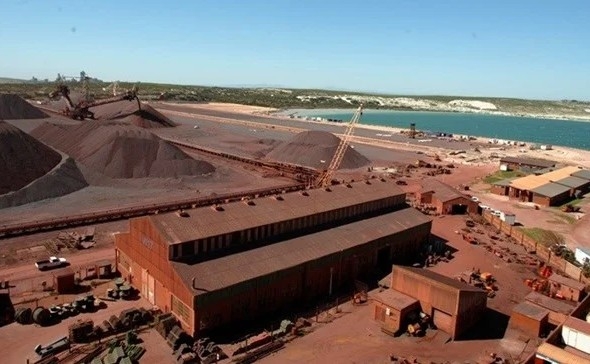
The West Coast District Municipality has rejected Transnet Port Terminals’ application to renew an Atmospheric Emission Licence for the Saldanha Iron Ore Terminal, following concerns raised by local communities about dust pollution and procedural irregularities.
The decision, welcomed by environmental organisation The Green Connection and the Red Dust Action Group (RDAG), centres on what community groups describe as fundamental failures in transparency and environmental assessment.
Shahil Singh, legal advisor for The Green Connection, said the decision demonstrates that regulatory oversight can function as intended when communities demand accountability.
“This sends a clear message that environmental accountability cannot happen behind closed doors and that communities have a right to transparency,” Singh said.
Local community groups raised concerns about the integrity of the application process, including alleged failures to uphold transparency and procedural fairness as required under the Promotion of Administrative Justice Act and the National Environmental Management: Air Quality Act.
For much of the process, the licence was not made available to interested parties, who were instead directed toward the lengthy Promotion of Access to Information Act process, potentially undermining meaningful public participation.
Singh said key concerns included the application’s failure to properly assess cumulative environmental impacts, treating terminal operations in isolation despite a significant increase in throughput volumes without corresponding upgrades to infrastructure, monitoring or mitigation.
The absence of an updated baseline environmental assessment, dust dispersion modelling and specialist studies left serious uncertainty about the true environmental impact under west coast conditions, including high-wind events.
The application failed to adequately describe the handling and frequency of ore spillages and associated dust generation, and lacked clarity on potential chemical dust suppression methods and environmental risks to soil health and the sensitive marine environment.
The decision carries particular significance for small-scale fishing communities in Saldanha, whose livelihoods depend on a healthy marine ecosystem. Evidence suggests pollution may have already compromised their catch and value-added products, threatening food security and income.
Christie Links, a small-scale fisher from the west coast and chairperson of Saldiaz Cooperative, said the dust and pollution affect daily lives, health and the ability to earn a living.
“This is about our dignity and our survival. The health of the ocean directly determines the wellbeing of our communities,” Links said.
The terminal’s proximity to the Langebaan Lagoon, a wetland of international importance, means continued dust deposition poses a serious risk to biodiversity and coastal livelihoods.
Transnet Port Terminals has until 9 July to appeal the decision.
The Green Connection has called on the company to submit a revised application that is transparent, scientifically robust and aligned with a zero-fallout operational model that protects both people and the environment.
Singh said the rejection underscores the urgent need for stronger regulatory oversight, including stricter licence conditions, transparent reporting of pollution incidents, enforceable penalties for non-compliance and improved operational controls.
“These are not unreasonable demands. They are the minimum safeguards needed to ensure that industrial activity does not come at the cost of people’s health, environmental integrity and long-term sustainability,” Singh said.
ALSO READ: Transnet loses atmospheric emission licence for bulk terminal in Saldanha


You must be logged in to post a comment.