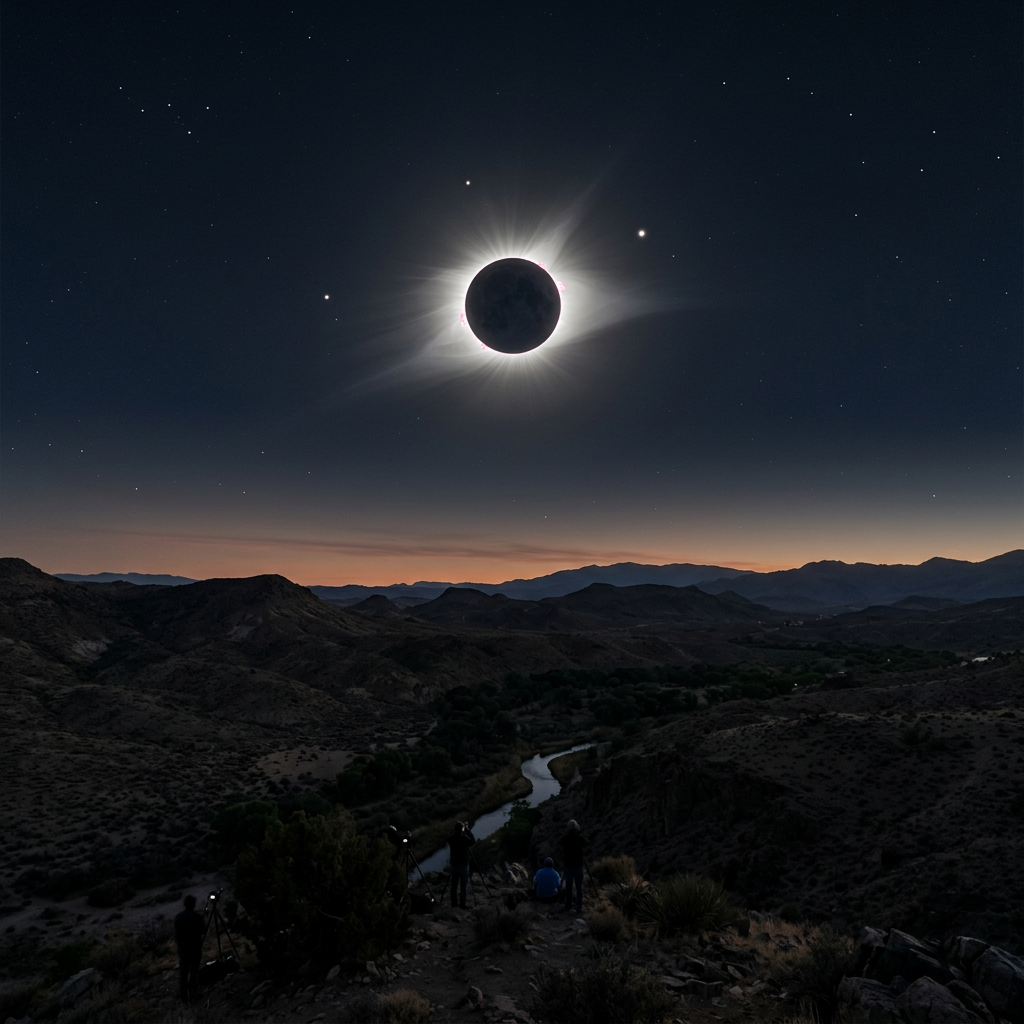
As the Moon passed between Earth and Sun on Wednesday, the world briefly plunged into violet darkness. The temperature dropped. Birds and animals, confused by the sudden nightfall, began behaving unusually. Stars and planets appeared in the sky next to the covered Sun.
This rare sight drew people from across the globe to northern Spain to witness a total solar eclipse.
“People do get addicted to it because it is such a moving experience,” said Lucie Green, one of four self-described “eclipse chasers” who spoke to AFP before the event.
Viewing the Sun is particularly significant for Green, a solar physicist at University College London who watched the eclipse from a boat off the Spanish island of Mallorca.
She is part of a growing community who plan holidays around total solar eclipses, which occur in different locations around the world every year or two.
Journey cancelled due to wildfires
Elizabeth Warning (51), a TV researcher in Australia, said seeing a total eclipse “feels like it’s the end of the world… you’re changed forever.”
Warning had planned to travel from Sydney to Spain for Wednesday’s eclipse but cancelled at the last minute due to concerns about fires ravaging the country.
An extreme wildfire risk was issued for most of Spain on Wednesday, with temperatures forecast to reach 40 degrees Celsius in parts of the northeast.
While a partial eclipse was visible in most of Europe, North America and northwest Africa on Wednesday, eclipse chasers pursue “totality” – when the Moon completely covers the Sun.
Totality is only visible in a narrow band of Earth, which usually requires detailed and expensive travel plans. However, Wednesday’s event – the first total eclipse visible in mainland Europe this century – proved an easier trip for many.
Chasing the perfect view
Ryan Milligan, a solar physicist at Queen’s University Belfast in Northern Ireland, has travelled for 12 different eclipses to places including Siberia, Chile and the Faroe Islands.
On Tuesday, Milligan was in the Spanish city of San Sebastian, where 99.7% of the Sun was obscured.
“Not close enough!” said Milligan, who headed for the Spanish city of Burgos, where totality lasted one minute and 43 seconds.
“A total eclipse is not something you see, it’s something you experience,” he told AFP.
“The temperature drops, the light and shadows are all in the wrong place, the colours are muted, there’s a 360-degree sunset, the animals go to sleep – these things you cannot convey to people through a picture or a video or a news article,” Milligan said.
“It’s that adrenaline rush of trying to experience all that within a few minutes that pushes us literally to go to the ends of the Earth.”
Once the brief event ends, the chasers start planning their next trip.
“It’s a very expensive, very odd addiction,” Warning said.
Green travelled to Antarctica in 2021, only to be blocked by clouds – a common problem for eclipse chasers.
“I’ve got about a two-thirds success rate,” she said.
Sometimes conditions align perfectly. Warning described how “the clouds parted” at the last second in the Faroe Islands in 2015, allowing her to see an eclipse that people just hundreds of metres away missed.
Milligan was one of those in the Faroe Islands who saw only clouds.
“I was distraught… not least because they told me I would have seen it if I’d stayed in my hotel,” he said.
Planning the next adventure
Jenny Winker (60), a retiree from St Paul, Minnesota, arrived in the northern Spanish city of Logrono on Saturday with nine family members.
“Enjoying all the wine and pintxos!” she told AFP hours before the event.
“If you’ve never seen a total eclipse, it is breathtaking.”
Some chasers are already planning for a total eclipse on 2 August next year.
Near Luxor, home to the Valley of the Kings in Egypt, totality will last six minutes and 22 seconds – the longest eclipse humans will be able to see until 2114.
Experts warn that anyone viewing solar eclipses must wear special glasses to avoid damaging their eyes.
ALSO READ: Spectacular total lunar eclipse to grace South African skies tonight