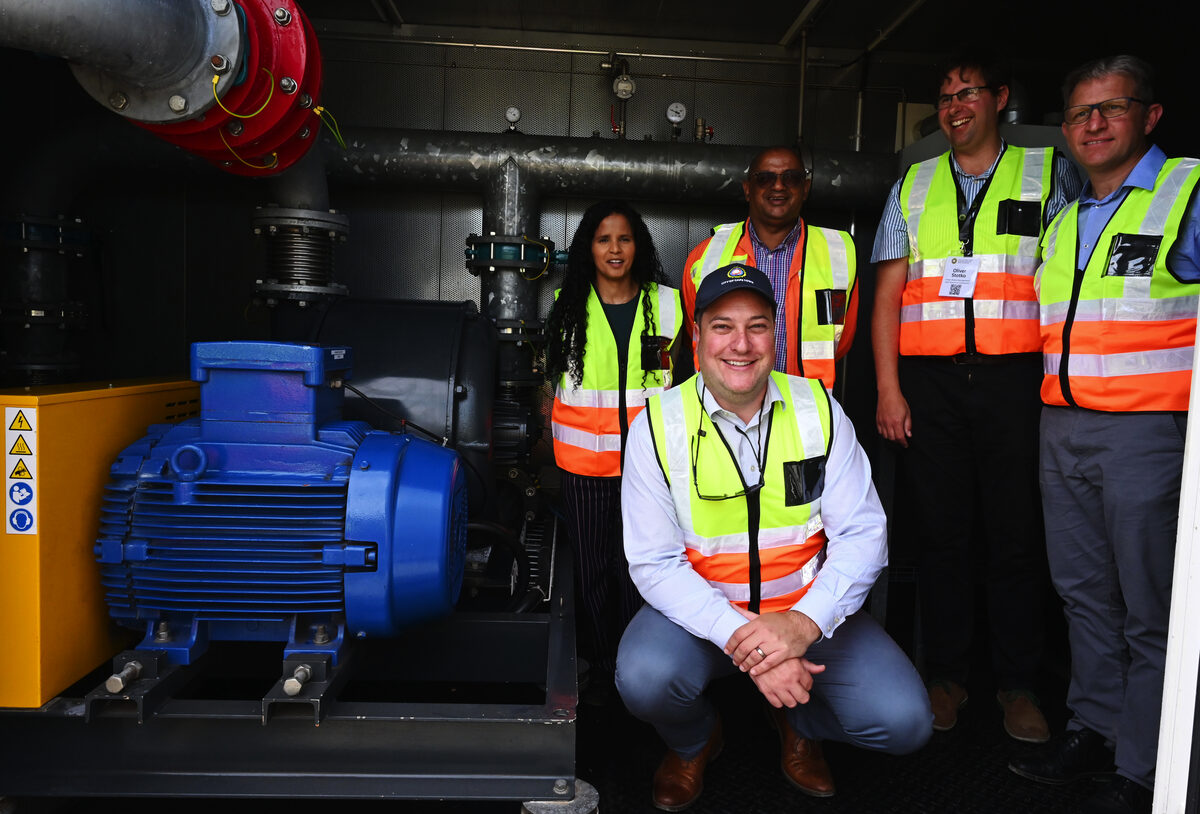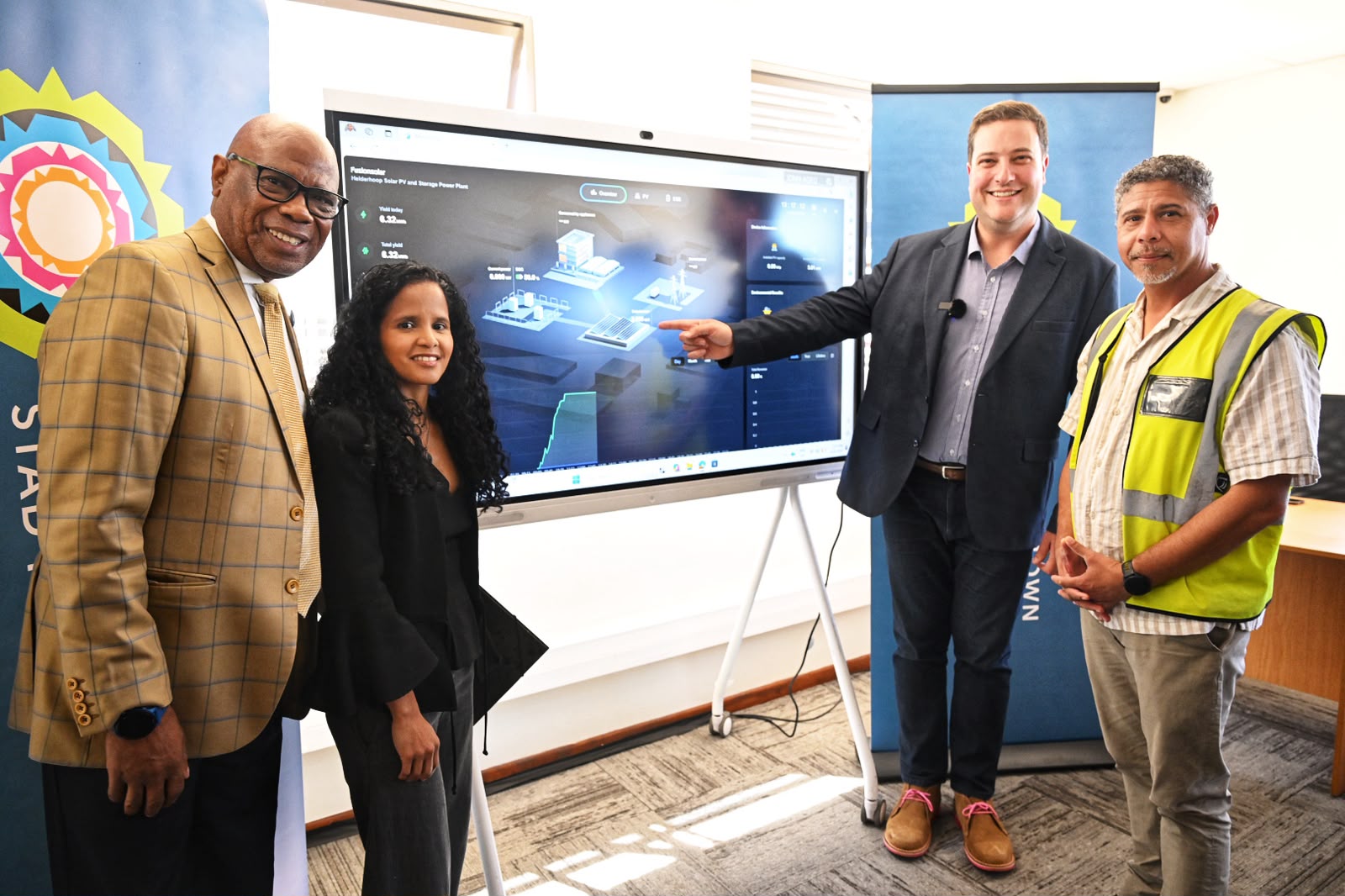
Cape Town has launched South Africa’s first metro-built hybrid power plant, with the City projecting that the R220 million Helderhoop Solar and Storage Power Plant in Atlantis will save residents at least R400 million over the next 20 years compared with electricity purchased from Eskom.
Cape Town Mayor Geordin Hill-Lewis officially launched the facility on Thursday, alongside Mayoral Committee Member for Energy Alderman Xanthea Limberg. The plant’s name, meaning “Bright Hope”, was proposed by Atlantis matric learner Vinolio Cloete.
“The key benefit of this new power plant is that the power it generates is much cheaper than Eskom’s, saving Cape Town residents at least R400 million over the coming 20 years,” Hill-Lewis said.
“Our firm intention is to reduce our reliance on Eskom’s expensive power and large annual increases so that we can pass these savings on to Capetonians over time.”
The facility comprises 12,850 solar panels and two utility-scale battery storage systems. Covering 15 hectares, the site is roughly the size of 21 rugby fields.
“With this new power plant right here in Atlantis, we are demonstrating that municipalities can play a leading role in building their own energy future and reducing dependence on Eskom’s expensive and unreliable electricity,” Hill-Lewis said.
He said the launch followed the City’s move to become the first municipality to procure electricity on the open market at rates up to 20% below Eskom’s, as part of an initial 200MW independent power procurement programme.
Plant marks milestone for Atlantis
Hill-Lewis said the name Helderhoop, meaning “Bright Hope”, reflected the promise of a better future for the community, which is marking its 50th anniversary.
The mayor also highlighted other developments in Atlantis, including the City’s completed R31 million upgrade of Wesfleur Stadium, ongoing improvements to MyCiTi bus stops and continued commercial investment in the Atlantis Special Economic Zone (SEZ). The City contributed 96 hectares of municipal land to the SEZ.
Limberg said construction of the plant had been completed and that it was operating under controlled test conditions as part of the commissioning process.
“We thank our City officials, project teams, contractors, local businesses and, most of all, the community of Atlantis, who have helped bring Helderhoop to this point,” she said.
About 305 jobs were created during construction, Limberg said, alongside opportunities to gain skills, training and experience in renewable energy infrastructure.
Cloete, who was attending Saxonsea High School at the time of the naming competition, submitted the winning name.
“This name combines the idea of light and energy with hope for a better future for Atlantis. Solar power brings clean energy, jobs, opportunities and progress for Atlantis,” her motivation read.
Cape Town’s energy security drive
The City says the Atlantis facility forms part of a broader programme to strengthen energy security and reduce reliance on Eskom.
Other initiatives and milestones highlighted by the City include:
- Independent power procurement: The City has signed two power purchase agreements with independent power producers, securing electricity at rates up to 21% below Eskom’s tariffs as part of an initial procurement programme of up to 200MW. It plans to procure up to 500MW from energy traders and aggregators, as well as additional electricity from waste-to-energy producers.
- Energy efficiency: The Municipal Energy Efficiency Programme, which includes streetlight and building retrofits and rooftop solar photovoltaic (PV) installations, has saved more than 427GWh of electricity and approximately R625 million to date.
- Municipal solar generation: The City’s small-scale embedded generation (SSEG) programme has installed 2.2MW of solar capacity across municipal sites towards a target of 25MW within the next two years.
- Payments for excess solar power: Since June 2024, residents and businesses have earned R67 million by selling 150GWh of surplus solar electricity to the City in exchange for municipal bill credits and cash. More than 250MVA of rooftop solar PV capacity has also been installed across Cape Town, helping to ease pressure on the electricity grid and improve energy resilience.
- Energy wheeling: The City has introduced a system that allows electricity to be traded between producers and consumers across its electricity network. More than 1,700MWh of electricity has been traded through this system since 2024.
- Planned Paardevlei facility: The City has completed feasibility studies and is preparing to approach the market for the development of a City-owned 70MW hybrid solar PV and battery storage plant in Paardevlei by 2029.
- Load-shedding mitigation: The City says it successfully mitigated 24% of load-shedding during an extended Eskom generation crisis, making it the only city to achieve this.
The City says the Helderhoop plant is another step towards diversifying Cape Town’s electricity supply, improving energy security and limiting the impact of rising electricity costs on residents.
ALSO READ: Government and parastatals told to settle R1.4bn Johannesburg debt