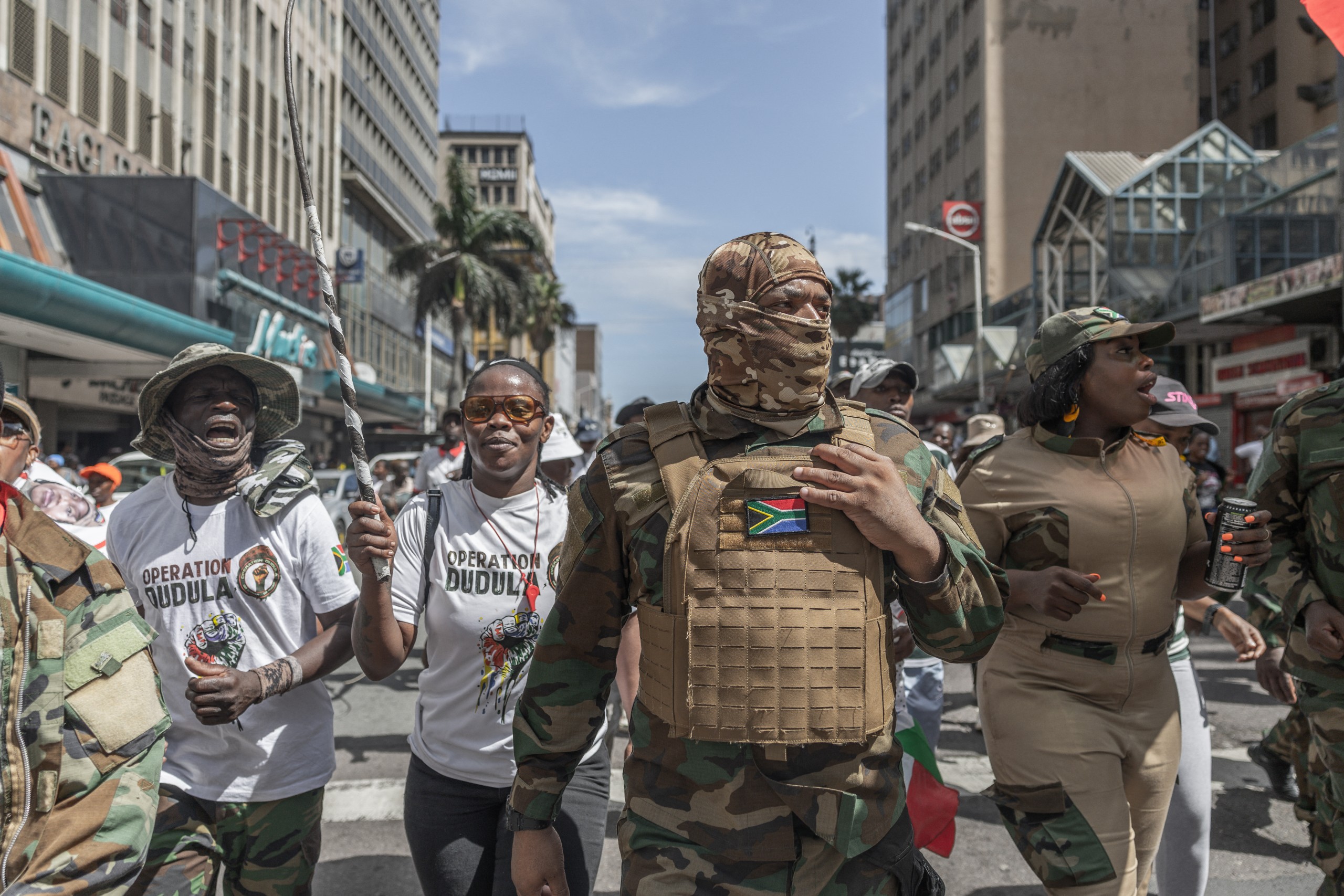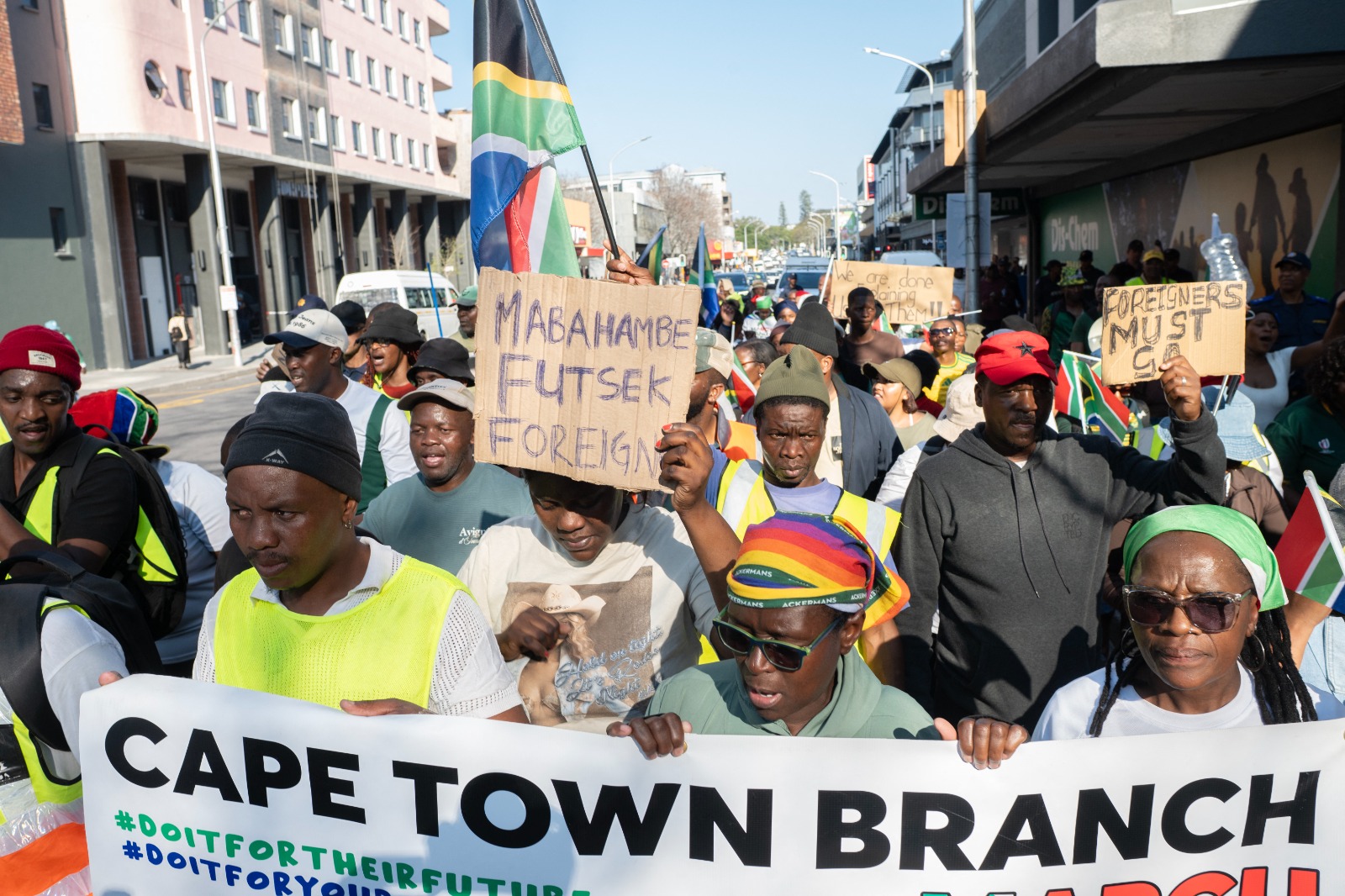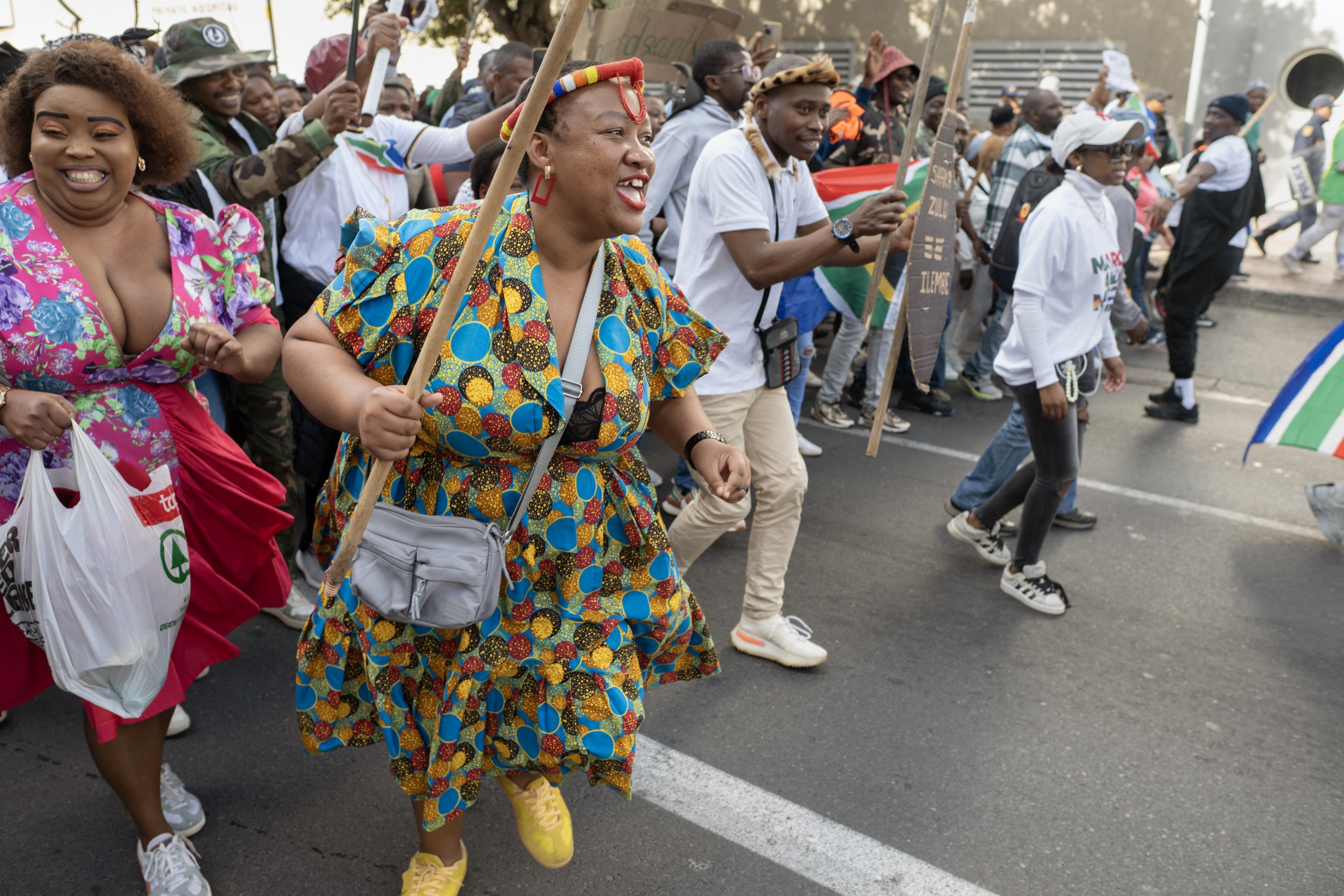
The surge in anti-immigrant demonstrations across South Africa is raising concerns about potential violence ahead of local government elections in November, with protest leaders setting an unofficial deadline of 30 June for undocumented foreigners to leave the country.
Phakela Ndabandaba, a Zulu activist emerging as the face of the movement, led several hundred bare-chested men in traditional headgear through Kwa-Thema near Johannesburg on Monday, many carrying sticks, whips and shields.
“We are ready to act,” they chanted in a Zulu war cry directed at undocumented immigrants.
The protests, spearheaded by various citizen-led groups including Ndabandaba’s unnamed organisation and another called March and March, centre on a common grievance: foreign nationals are taking scarce jobs and resources in a country where official unemployment exceeds 30%.
“That so many attended the latest protest during the work week should be a worry for the authorities. This means they are not working,” Ndabandaba told journalists.
Violence and repatriations
The growing tensions, fuelled by online hate speech, are blamed for the killings of two Mozambicans more than a week ago. Foreign nationals report intimidation and beatings by mobs going door-to-door demanding they leave by 30 June, a deadline that has no official backing but is being widely broadcast across social media.
Uledi Folloma (31), a Malawian national, described his experience in Gansbaai, Western Cape province: “I was sleeping early in the morning and people just came and broke in the door. They started to take our stuff and chased us.”
Ghana, Mozambique and Malawi are among countries that have repatriated hundreds of their nationals this month. South African authorities say most did not have correct documentation to be in the country.
Political dimensions
The protests come as campaigning begins for local elections where President Cyril Ramaphosa’s African National Congress is expected to face another electoral setback after losing its national majority in 2024.
Ndabandaba, whose full name is Nkosikhona Phakel’umthakathi Ndabandaba and is reportedly in his mid-40s, insists the movement has no political agenda.
“We have no political aspirations. We just want to awaken our leaders,” he said, claiming his group has organised protests for a year and six months without violence. “We have never killed or hit anyone.”
He hails from KwaZulu-Natal, the only province where Zulu-based parties swept the 2024 elections and the heartland of former president Jacob Zuma, who was expelled from the ANC for leading rival party MK into the elections.
ALSO READ: Three hundred Ghanaians repatriated as xenophobic tensions grip South Africa
Ndabandaba’s group will not divulge its financial backers. Organiser Zandisile Thukwane said traditional chiefs at workers’ hostels and ordinary people contributed to the Kwa-Thema rally.
“You don’t need any funding to stand for your rights,” said Ngizwe Nchunu, another group leader.
Questions over funding and influence
Jacinta Ngobese-Zuma (39), founder of March and March, which gained prominence last year when it blocked foreign nationals from accessing hospitals, also claims to have no political ambitions.
“I have no desire to be in politics,” the former radio presenter told the South African Broadcasting Corporation this week.
However, ActionSA, which took just over 1% of votes in 2024, has said it would welcome Ngobese-Zuma, who is not related to the former president.
ALSO READ: Two Mozambicans killed as xenophobic violence resurfaces in South Africa
Loren Landau from the African Centre for Migration and Society said local-level protests are evolving into “a national movement that clearly has financing, a significant social media presence and a set of strong leaders fighting for political influence”.
“It is funded by internal political powers or aspirants who want to make the ANC look bad or want to support their own anti-immigration agenda so that they can access political office. Every day closer to the election, it’s more dangerous,” he said.
Governance expert Tendai Mbanje from the Centre for Human Rights described it as an “unforgiving environment” that “mixes genuine socio-economic grievances with populist rhetoric”.
Analyst Kingsley Makhubela suggested the citizen-led protest groups may see themselves as kingmakers in the election.
“But who’s funding their activities and moving around the country? It’s something that we all don’t know,” he said.
ALSO READ: Ramaphosa unveils five-point plan to tackle illegal immigration