The dream died at Ellis Park, and by the end it wasn’t even close.
New Zealand claimed a comprehensive 33-16 victory over the Springboks in the opening Test of Rugby’s Greatest Rivalry series on Saturday, turning a tight first-half contest into a second-half demolition job that left the home crowd stunned and South African rugby searching for answers.
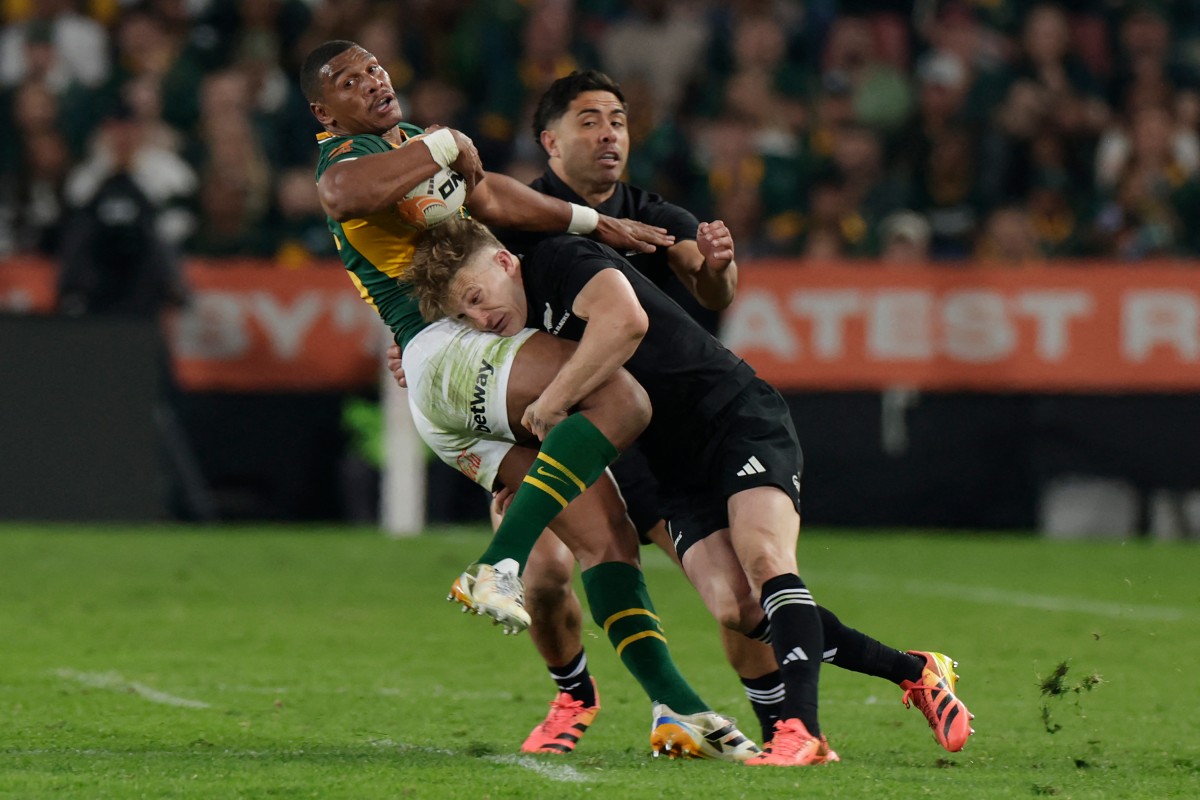
What began as a tense, physical arm-wrestle befitting these two proud rugby nations descended into chaos for the Boks as discipline evaporated, yellow cards flew, and the All Blacks ruthlessly exploited their numerical advantage to run in tries and shatter South African resistance.
By the final whistle, the Springboks were down to 13 men, their hopes in tatters, and the altitude advantage at Ellis Park rendered utterly meaningless by a New Zealand side that demonstrated exactly why they’re considered one of world rugby’s most dangerous outfits.
The opening exchanges
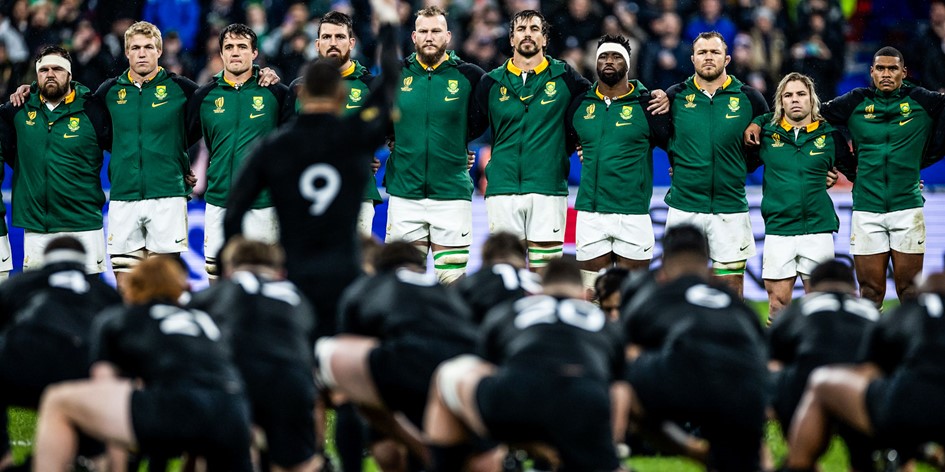
After the formalities and anthems that send shivers down spines, Rugby’s Greatest Rivalry began at 17:10 with the kind of intensity these occasions demand.
Cheslin Kolbe opened the scoring in the fifth minute, slotting a penalty to give the Boks an early 3-0 lead. The Ellis Park crowd roared approval, sensing the possibility of something special unfolding.
But New Zealand responded with clinical precision four minutes later. After building through patient phases, scrumhalf Cam Roigard delivered a bullet pass that put Will Jordan away for the opening try. 5-3 to the visitors, and suddenly the complexion had shifted entirely.
The Springboks hit back immediately. André Esterhuizen, that powerful centre who makes defenders look like children when he gets a head of steam, barged over in the 14th minute, leaving All Black tacklers scattered in his wake. 10-5 to South Africa, and Ellis Park was absolutely bouncing.
The tight first half
For 40 minutes, this lived up to every ounce of hype. New Zealand struck back through Josh Moorby in the 24th minute, the winger finishing brilliantly after some exceptional offloads in contact kept the ball alive when it looked dead. 12-10 to the All Blacks.
Kolbe restored the lead three minutes later with another penalty – 13-12 – and that’s how the sides went to the sheds at half-time.
One point separated them. Everything still to play for. The second half would determine who drew first blood in this four-Test series.
What followed was a masterclass from New Zealand and a nightmare for the Springboks.
The second-half collapse
Kolbe extended the lead to 16-12 just two minutes after the restart with another penalty, suggesting South Africa might build on their slender advantage and grind out a famous victory.
Instead, disaster struck immediately. In the 48th minute, Fabian Holland charged down a Grant Williams kick attempt and fell on the ball for a try that shifted momentum decisively. 19-16 to New Zealand, and you could feel the anxiety rippling through the Ellis Park stands.
The All Blacks sensed blood. In the 60th minute, following a dominant scrum that showcased their pack’s power, they worked the ball wide and crashed over to extend the lead to 26-16. Suddenly, what looked like a tight contest was threatening to become a rout.
Discipline disaster
The 70th minute brought the moment that effectively ended the contest as a competitive spectacle. Marco van Staden received a yellow card, reducing the Springboks to 14 men at precisely the wrong time.
Two minutes later, it got worse. Cobus Reinach followed him to the sin bin, leaving South Africa down to 13 men with eight minutes remaining and the All Blacks smelling opportunity.
What followed was inevitable. Will Jordan crossed for his second try in the 75th minute after New Zealand’s scrum demolished the undermanned Springbok pack and created the space wide for Jordan to finish. 33-16, and the result was beyond doubt.
The brutal reality
The final score – 33-16 – represents New Zealand’s most emphatic victory at Ellis Park in years and raises serious questions about South Africa’s discipline, game management, and ability to maintain composure when pressure mounts.
The first half suggested this would be a classic encounter decided by fine margins. The second half revealed a South African side that imploded when the heat intensified, gifting New Zealand numerical advantages through poor discipline and watching helplessly as the visitors ruthlessly exploited those advantages.
Rassie Erasmus’s decision to start Sacha Feinberg-Mngomezulu at flyhalf didn’t cost the Boks this match – indiscipline did. But questions will inevitably be asked about selections, tactical approach, and how South Africa responds when the series moves to Cape Town next weekend.
For Dave Rennie and the All Blacks, this represents the perfect start to the Greatest Rivalry series. They weathered an early storm, stayed composed when the first half remained tight, then turned the screws in the second half with clinical precision.
Will Jordan’s double, the dominant scrum, and the ability to capitalise ruthlessly on South African mistakes – this is exactly the blueprint New Zealand wanted to execute.
What comes next
The series is 1-0 to New Zealand with three Tests remaining. South Africa must regroup, address the discipline issues that proved so costly, and find a way to match the All Blacks’ intensity for the full 80 minutes.
Playing with 13 men for the final eight minutes at altitude should be physically impossible. That the All Blacks made it look routine tells you everything about the gulf that opened up as this match progressed.
Ellis Park was supposed to be the fortress. The altitude was meant to be the advantage. The passionate home crowd should have been the difference.
Instead, New Zealand delivered a performance that announced their intentions for this series loud and clear: they’re here to win, they’re here to dominate, and they won’t be intimidated by history, altitude or occasion.
The Springboks have seven days to find answers. Because if this performance repeats in Cape Town, the series could be over before it really begins.
Rugby’s Greatest Rivalry delivered a statement opener. Unfortunately for South African fans, New Zealand wrote it in All Black ink.