

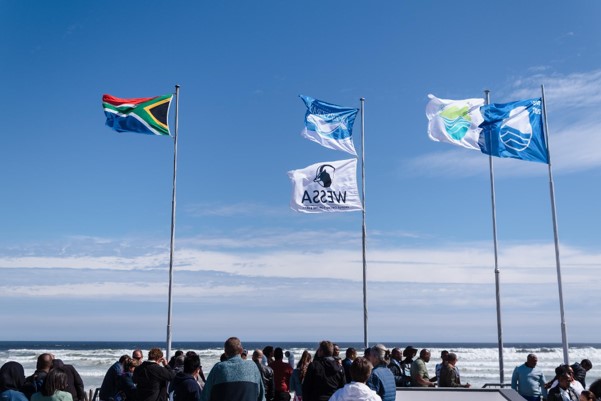
HERMANUS — South Africa’s Blue Flag and Green Coast programmes are entering their next chapter with a renewed focus on environmental stewardship, inclusion, community participation and long-term coastal resilience, as the Wildlife and Environment Society of South Africa (Wessa) celebrates 25 years of Blue Flag in South Africa and its centenary.
Blue Flag is an international environmental award programme recognising beaches, marinas and tourism boats that meet high standards for environmental management, water quality, safety, accessibility and environmental education.
Wessa’s national Green Coast programme recognises coastal sites that demonstrate effective conservation management, community participation, environmental education and responsible tourism.
“We’re proud of that history, and we are conscious that history comes with a huge responsibility to keep earning people’s trust and to respond to the challenges of our time. And to enable more people to care for our natural heritage,” said Wessa CEO Cindy-Lee Cloete.
The milestone was marked at Grotto Beach in Hermanus, co-hosted by Overstrand Municipality, which has maintained Blue Flag status for 25 consecutive years. Humewood Beach, in Nelson Mandela Bay Metropolitan Municipality and Marina Beach, in Ray Nkonyeni Municipality, were also recognised for their 25 years of sustained commitment to environmental sustainability, environmental education and information, accessibility, high-quality management and visitor safety.
A national network of coastal destinations
A total of 50 full Blue Flag beaches, 20 pilot beach sites, seven tourism boats and five marinas received their certificates alongside 19 Wessa Green Coast sites, reflecting the scale of a programme that has grown from South Africa’s pioneering adoption into a national network of coastal destinations committed to environmental management, education, safety, accessibility and continuous improvement.
ALSO READ: Nature’s 2.76-million-hectare win
Blue Flag International’s Kathy Young, a board member of Foundation for Environmental Education, reinforced the significance of South Africa’s contribution to the programme, noting that South Africa was the first country outside Europe to implement Blue Flag, with Wessa becoming its first non-European member organisation.
“You are not simply implementing an international programme; you are helping to internationalise it,” Young said. She emphasised that Blue Flag is about far more than a tourism label.
“At its heart, Blue Flag is an environmental programme. The flag is the visible part. Behind it is a much deeper commitment to continuous improvement. Programmes succeed because people make them work.”
National Department of Tourism representative Dr Shamilla Chettiar connected this environmental stewardship directly to sustainable tourism, describing Blue Flag beaches, Green Coast and pilot sites as pillars of responsible tourism. “What they are also is proof that ecological stewardship stand side by side with economic development.”
She also reaffirmed the Department’s commitment to finding a way to renew its partnership with Wessa while highlighting the need for continued collaboration in the face of climate change and pollution. “No one gets anywhere by themselves. They say if you want to go fast, go alone; if you want to go far, go together. And we certainly want to go far.”
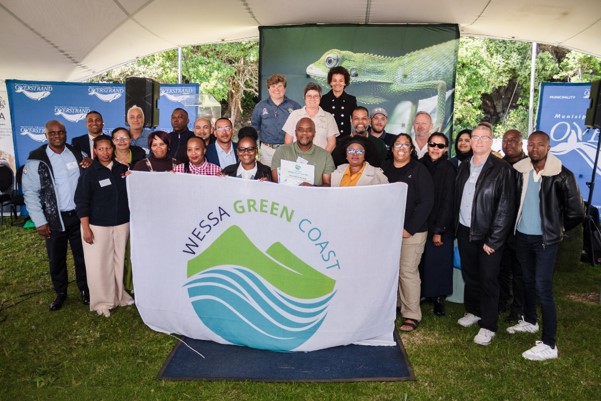
That collaborative approach was echoed by CapeNature’s Pierre de Villiers. He highlighted the role of the Green Coast programme in demonstrating how integrated ecosystem management can build coastal resilience by using the Klein Estuary as an example, and showed how catchments, estuaries, beaches, dunes and oceans are interconnected. “By managing an estuary successfully, you’re actually creating resilience for your coastline,” he said. “Partnerships are everything nowadays. We can’t work alone. We can’t work in silos.”
Inclusion is also becoming central to what coastal stewardship looks like.
The awards gathering followed the launch of the Living Coast Prototype Signage, the first inclusive interpretive coastal signs at Grotto East beach, developed with partners including Wessa, the Department of Forestry, Fisheries and the Environment (DFFE), Blind SA and the National Council of and for Persons with Disabilities. The signs incorporate Braille, while digital guides provide audio, subtitles, environmental information and citizen science content in English, Afrikaans and isiXhosa.
Ryan Peter of DFFE said, “A sign should not only be seen; it should be heard, felt, and understood. In your own senses, in your own words, and that is what inclusive environmental education looks like.” The intention is to extend this access-first approach to Blue Flag and Green Coast sites nationally.
ALSO READ: New Grasslands National Park declared in Eastern Cape highlands
For Overstrand Municipality, the work behind the flag remains a year-round commitment. De Wet Nel described maintaining Blue Flag status for 25 years as “no small feat”, requiring sustained attention to water quality, environmental management, safety and inclusivity. Overstrand Mayor Alderman Archie Klaas said the investment was ultimately about people and place: “Our beaches should be enjoyed by everyone, including persons with disabilities.”
As South Africa looks ahead, Wessa is setting a goal of 100 Blue Flag beaches by 2030, an ambition to be built “beach by beach through investment, readiness and sustained care”.
The next chapter, according to Cloete, is not simply about raising more flags. It is about raising the level of ambition behind them: protecting living ecosystems, bringing more people into conservation, strengthening partnerships and ensuring that South Africa’s coast remains clean, safe, resilient and accessible for generations to come.
As Young put it, “Our ambition must go beyond recognition to impact.”




You must be logged in to post a comment.