


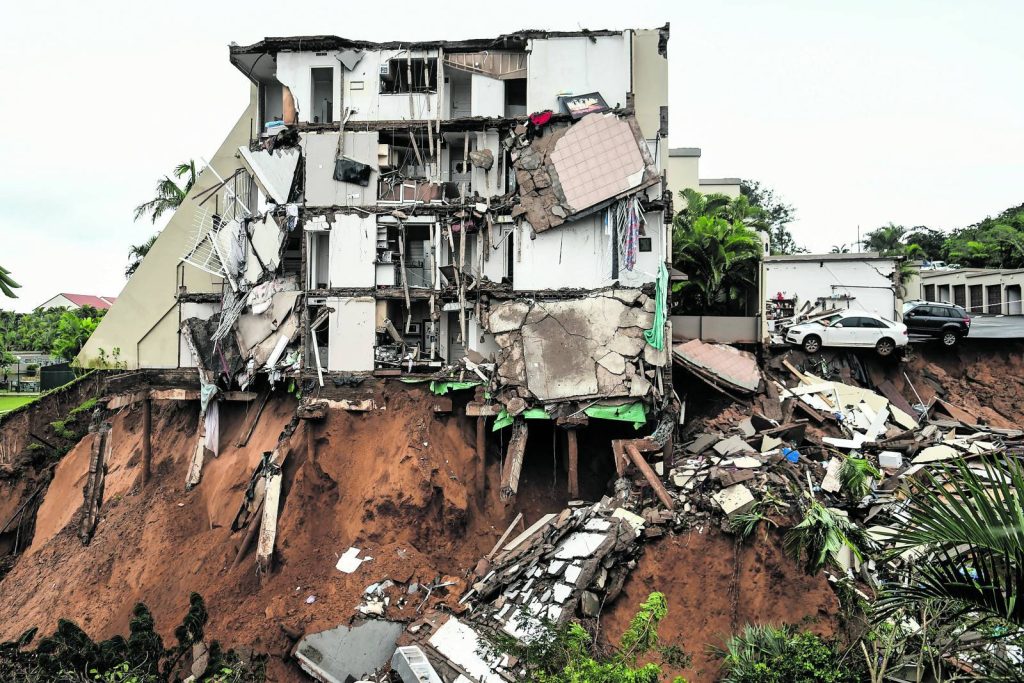
The catastrophic Durban floods of April 2022, which claimed 544 lives and displaced tens of thousands, were made significantly worse by climate change, a new study led by Wits University has confirmed.
The research, published in the journal Communications Earth & Environment, is a formal scientific attribution of the event. It shows that rainfall during the storm of 11–12 April 2022 was between 40% and 107% heavier than it would have been in a cooler, pre-industrial climate.
Using cutting-edge climate modelling developed by Professor Francois Engelbrecht, Director of the Global Change Institute at the University of the Witwatersrand (Wits), in collaboration with national and international partners, the study represents a major leap forward in the continent’s ability to analyse how global warming is driving extreme weather.
The research identified three key drivers behind the intensified rainfall:
• A warmer atmosphere, fuelled by greenhouse gases, holds more moisture;
• The Agulhas Current has warmed in recent decades, increasing ocean evaporation and feeding moisture into coastal storms;
• Changes in wind patterns are funnelling more moist air into KwaZulu-Natal.
The team also modelled future scenarios, warning that storms in eastern South Africa will likely become even more intense as the planet continues to warm.
Building resilience in a warming world
The climate attribution model used in the study took nearly three years to develop after President Ramaphosa’s initial comments. “We need to move from academic modelling to near-operational capability — where we can confirm within days, not years, whether climate change intensified a disaster. With even faster next generation computers being installed at the CHPC and our newly established modelling system, this is absolutely achievable,” says Engelbrecht.
“In the short term, we need robust Disaster Risk Reduction plans that can evacuate people from high-risk areas with just a few days’ notice,” said Engelbrecht. “This demands advanced Early Warning Systems and, importantly, trust in those systems at community level. In the long term, we must help people to relocate to safer locations — above the flood line. But this is a difficult and costly process in cities that are growing rapidly and informally.”
Local leadership rising to the challenge
Mayor Cyril Xaba of eThekwini has welcomed the research findings. In eThekwini, local government is already taking action. Working with the University of KwaZulu-Natal, the municipality has developed a Community-Based Flood Early Warning System (CBFEWS) in Quarry Road West Informal Settlement. During the April 2022 floods, the system was activated, and no lives were lost, despite over 120 dwellings being washed away.
“We’ve seen time and again the value of working with communities to create very local flood warnings,” says Dr Sean O’Donoghue, Senior Manager: Climate Change Adaptation at eThekwini Municipality. “This climate attribution study marks a watershed moment — we now have definitive, scientific evidence of how climate change is impacting us, and more importantly, what we need to plan for”.
Through the INACCT Resilience project, funded by CLARE and in partnership with ICLEI Africa, the City is expanding localised warning systems across vulnerable areas. It is also growing the Transformative Riverine Management Programme, which employs local residents to clear debris from waterways — a key step in managing future floods.
At the provincial level, the Department of Water and Sanitation, uMngeni-Thukela Water, and research partnerships are collaborating through international programmes such as WaRisCo (under the WASA programme) and REPRESA (CLARE programme) to reduce both flood and drought risks.
“The silver lining to the dark storm clouds threatening South Africa’s east coast is that government at all levels is embracing climate science to protect lives. But efforts must now expand rapidly — especially into the Eastern Cape, where risks are rising,” says Engelbrecht.


You must be logged in to post a comment.