


The US House of Representatives has backed a resolution seeking to halt American military action in Iran, dealing a political blow to President Donald Trump as efforts to reach a deal with Tehran stagnate.
Four lawmakers from Trump’s Republican party joined Democrats on Wednesday to vote 215-208 in favour of the public rebuke, though the resolution remains largely symbolic as the president can veto the measure if it gains Senate approval.
“This is a loud and unambiguous message to Donald Trump on behalf of the American people: it’s time to end his deeply unpopular and illegal war of choice in Iran,” Democrats posted on X.
The vote came as weeks of complicated talks marked by sharp rhetoric and flare-ups of violence have failed to reach a deal to end the war and reopen the Strait of Hormuz, which is essential to oil supplies.
Divergent messages on progress
Washington and Tehran have sent conflicting signals in recent days. Iran said Wednesday “no tangible progress” was made, whilst Trump voiced optimism, telling reporters at the White House “it could happen over the weekend.”
Iranian Foreign Minister Abbas Araghchi said lines of communication with the United States remained open but warned that any Israeli attack on the Lebanese capital Beirut would trigger a “full-scale resumption” of the conflict.
“Communications with the Americans have not been cut off, and messages have been exchanged regarding the need to stop aggression against Beirut, but no tangible progress has been made in the negotiation process,” Tasnim news agency quoted Araghchi as telling Lebanon’s Al Mayadeen TV.
“Any attack on Beirut will have grave consequences and will lead to a full-scale resumption of the war,” he said. “Our armed forces are ready to strike Israel if it attacks Beirut.”
Drone strike kills one at Kuwait airport
In the latest episode of violence, Kuwaiti officials said renewed hostilities on Wednesday included an Iranian drone strike on a passenger terminal at Kuwait international airport that killed one person and wounded 63.
Kuwait’s military condemned the attack as an act of “criminal Iranian aggression.” India’s foreign ministry confirmed the fatality was an Indian national.
Iran’s Revolutionary Guards denied attacking the airport, claiming it was “an error in the American Patriot systems, which landed on the terminal after failing to intercept Iranian missiles.”
The Revolutionary Guards also accused US forces of provoking a response by targeting a tanker and a communications tower on the country’s Qeshm Island.
Kuwait suspended air traffic and diverted arriving planes to other destinations following the attack, but later restarted Kuwait Airways flights. The international airport has been targeted several times during the war and had only fully resumed operations on Monday.
Hassan Sheikh (40), a Pakistani resident of Kuwait who lives near the airport, said he heard explosions throughout the night, adding: “For the first time, my children felt how serious the situation was.”
Nuclear stockpiles at centre of talks
At a congressional hearing, US Secretary of State Marco Rubio said Iran’s highly enriched uranium stockpiles were at the centre of discussions with Tehran.
Washington insists Tehran must turn over its near-weapons-grade enriched uranium, agree to curb its nuclear activities and reopen the Strait of Hormuz, the key shipping channel for Gulf oil and gas, for any peace agreement to take hold.
The fresh attacks constitute one of the more severe tests yet of the 8 April ceasefire that paused more than a month of war sparked by the US-Israeli bombing of Iran, and has largely held despite sporadic exchanges of fire.
Trump played down the renewed hostilities, saying “in that part of the world ceasefire is when you’re shooting in a more moderate manner.”
Israeli Prime Minister Benjamin Netanyahu accused Iran of “playing with fire.”
“Iran surely knows what the president has said, that if necessary, there’ll be a full-scale return to military action,” Netanyahu said in an interview with US channel CNBC.
Israel, Lebanon agree ceasefire
In Washington, Israel and Lebanon agreed to a ceasefire after two days of direct talks. Notably, the agreement requires a “complete cessation” of fire by Hezbollah.
They further agreed “with the guidance of the United States” to create “pilot zones” in which Lebanese armed forces, which have struggled to contain Hezbollah, “will take exclusive control of the territory to the exclusion of all non-state actors,” a joint statement said.
Further talks were planned in the week of 22 June, with a view toward reaching a “comprehensive agreement.”
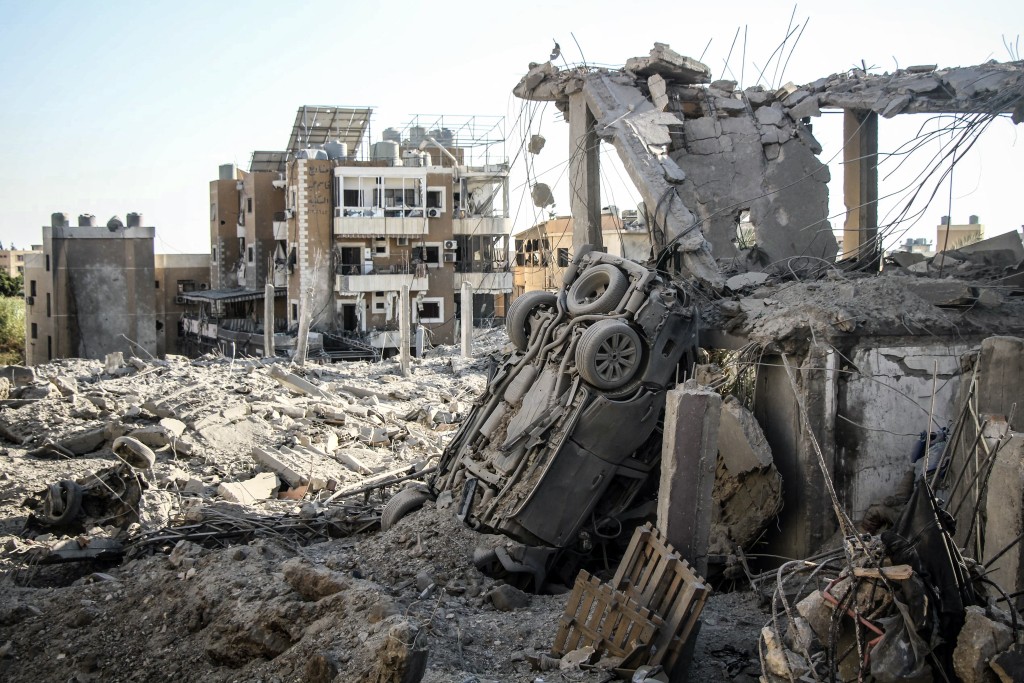
Israel and Hezbollah, however, have continued to trade fire, with Hezbollah claiming missile attacks on northern Israel Wednesday and Lebanon saying Israeli strikes in the south killed at least nine people, including two paramedics.
Israeli troops are staging their deepest ground offensive into Lebanon in two decades.
A truce to halt the fighting in Lebanon was meant to take hold on 17 April but has never been observed.
ALSO READ: Drone strikes close Kuwait airport as Iran and US clash in Gulf


You must be logged in to post a comment.