The United States has imposed targeted visa restrictions on South African officials involved in race-based discrimination and land seizures, escalating tensions between the two nations.
Secretary of State Marco Rubio announced the new policy this week stating it targets foreign nationals who enact or enable policies promoting race-based discrimination, inciting violence, or enabling land confiscation without compensation.
“The South African people are being failed by a government that is destroying its economy through an obsessive pursuit of racial grievance against the Afrikaner minority,” Rubio said in a statement posted on social media.
The restrictions, implemented under Section 212(a)(3)(C) of the Immigration and Nationality Act, do not constitute a blanket visa ban on all South Africans. Instead, they specifically target individuals the US deems responsible for implementing discriminatory policies, along with certain family members.
Rubio said the South African government has failed to address rural crime, violent rhetoric, and race-based discriminatory policies against Afrikaners and other minority groups.
“Those responsible for these injustices have no place in the United States,” he added.
US State Department officials described the visa restrictions as the “first step in a series of escalatory measures” to pressure South Africa on these issues. No specific individuals have been publicly named under the policy.
DA acknowledges policy failures
The Democratic Alliance (DA), South Africa’s main opposition party, responded to the announcement through its spokesperson on international relations, Ryan Smith.
While the DA said it respects the sovereignty of nations and the right of democratic countries to determine their own laws, Smith acknowledged that many policies passed by the African National Congress (ANC) have not served South Africans.
“South Africans of all races know and understand that South Africa’s current policy suite under the ANC does not, and has not served the majority of our country for decades,” Smith said.
The DA pointed to recent economic data showing South Africa’s gross domestic product (GDP) shrank by 0,2% in the second quarter of 2026, following a 0,4% increase in the first quarter. The contraction resulted from declines in mining, manufacturing and trade sectors.
In response to the economic downturn, DA Federal Leader Geordin Hill-Lewis has made written requests to President Cyril Ramaphosa demanding urgent policy reform.
ALSO READ: South Africa accepts controversial US ambassador amid strained relations
Legal challenge to land reform law
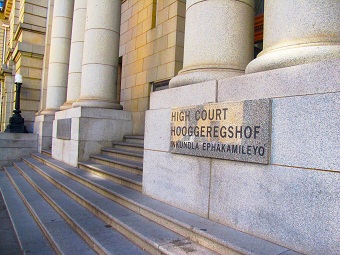
The DA has also challenged the Expropriation Act in the Western Cape High Court, arguing it is procedurally flawed and incompatible with property rights outlined in Section 25 of the constitution. The case was heard in August 2026 and remains before the court.
The Expropriation Act, signed into law in December 2024, has not yet come into force. Critics say it undermines property rights by enabling expropriation with nil compensation, while the government argues it gives effect to the constitutional requirement for “just and equitable” compensation.
In May, the DA introduced the Economic Inclusion for All Bill to parliament as an alternative to the ANC’s Broad-Based Black Economic Empowerment (B-BBEE) Act. The party believes economic justice can be achieved without race-based criteria for access to opportunity.
Crime and policing concerns
Smith also highlighted the DA’s repeated calls for reform to the South African Police Service (SAPS), including devolving policing powers for stronger local competence and greater investment in resources and investigative capacity.
Recent violent feminicide cases in Ekurhuleni demonstrate these reforms are long overdue despite Ramaphosa’s pledges to address the problem, Smith said.
The DA maintained that South Africa does not need other countries to highlight its policy failures.
“The ANC does not need to be told by the USA that its policies are failing, it only needs to look at its plummeting electoral support as more and more South Africans reject its policies and governance that have repeatedly failed us all,” Smith said.
He added that the ANC will face consequences at the South African ballot box later this year, where voters will deliver their verdict on the government’s performance.
Historical context
The visa restrictions follow earlier actions by the Trump administration related to South Africa, including prioritising Afrikaner refugees for resettlement in the United States and cuts to foreign aid.
The South African government has denied allegations of mistreatment against white South Africans, maintaining that land reform policies are necessary to address the historical legacy of apartheid.