

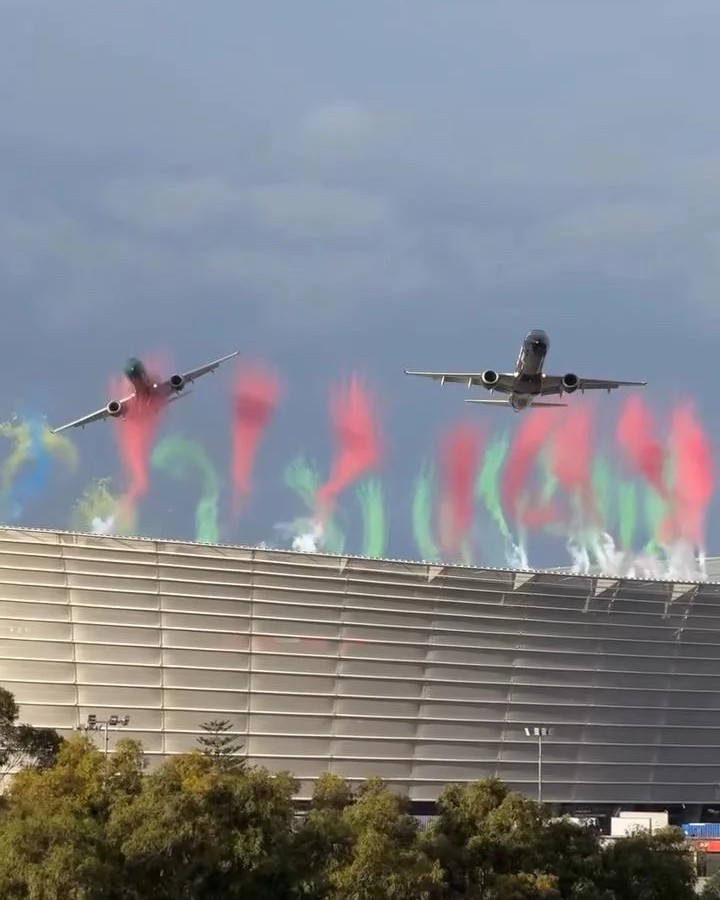
CAPE TOWN — A pre-match aerial display has ignited intense debate across South Africa after a pair of commercial Airlink aircraft performed an ultra-low flypast over Cape Town’s DHL Stadium yesterday.
The dramatic stunt took place just moments before the highly anticipated second test of the “Rugby’s Greatest Rivalry” series between the Springboks and New Zealand’s All Blacks, leaving spectators awestruck.
Tracking data
According to precise tracking data analyzed by Flightradar24, the lead aircraft cleared the top of the stadium roof by less than 50 feet.
Determining the exact height above the terrain required a meticulous calculation using ADS-B altitude data.
While the aircraft reported a baseline barometric altitude of 50 feet above mean sea level at standard pressure, correcting for the local air pressure (a QNH of 1 019 hPa) placed the planes at an actual altitude of 205 to 210 feet.
Given that the DHL Stadium stands near sea level at a structure height of 164 feet, the structural clearance for the lead aircraft was calculated to be a razor-thin 41 to 46 feet.
Public reaction to the breathtaking spectacle has been highly polarized.
While many rugby fans inside the stadium and online celebrated the flypast as a thrilling display, others quickly took to social media and online forums to voice sharp criticism.
Concerns
Aviation enthusiasts and citizens alike expressed deep concern over the risks of manoeuvring large commercial jets so close to a densely packed stadium structure and a populated urban area.
According to Flightradar24, Airlink directly addressed the mixed reactions this morning
The regional carrier acknowledged the online public anxiety but strongly defended the operation, emphasizing that the entire flight was heavily regulated.
Airlink revealed that the complex formation demanded careful planning and physical rehearsals, specifically designed to safely navigate the low altitude at a controlled speed of approximately 150 knots.
Furthermore, the airline credited the South African Civil Aviation Authority (SACAA) and Air Traffic Navigation Services (ATNS) for providing the necessary guidance, formal approval, and operational support to pull off the event.
To mitigate risk, the two-ship formation was operated by an elite, highly experienced flight crew.
Each individual aircraft carried three senior captains on board, serving respectively in the vital roles of commander, co-pilot, and safety/technical officer.
Airlink confirmed that recorded flight data from both jets validates that the flypast complied entirely with the SACAA’s approved safety limits.
The visual display featured two distinctly branded aircraft. The lead jet was an Embraer E195, registered as ZS-YDE, sporting a sleek, custom black “Rugby’s Greatest Rivalry” livery.
It was flanked closely by a second Embraer E190, registered as ZS-YAE, which wore a vibrant green version of the exact same commemorative style.
ALSO READ: Cape Town wins double honours at World Travel Awards Africa

