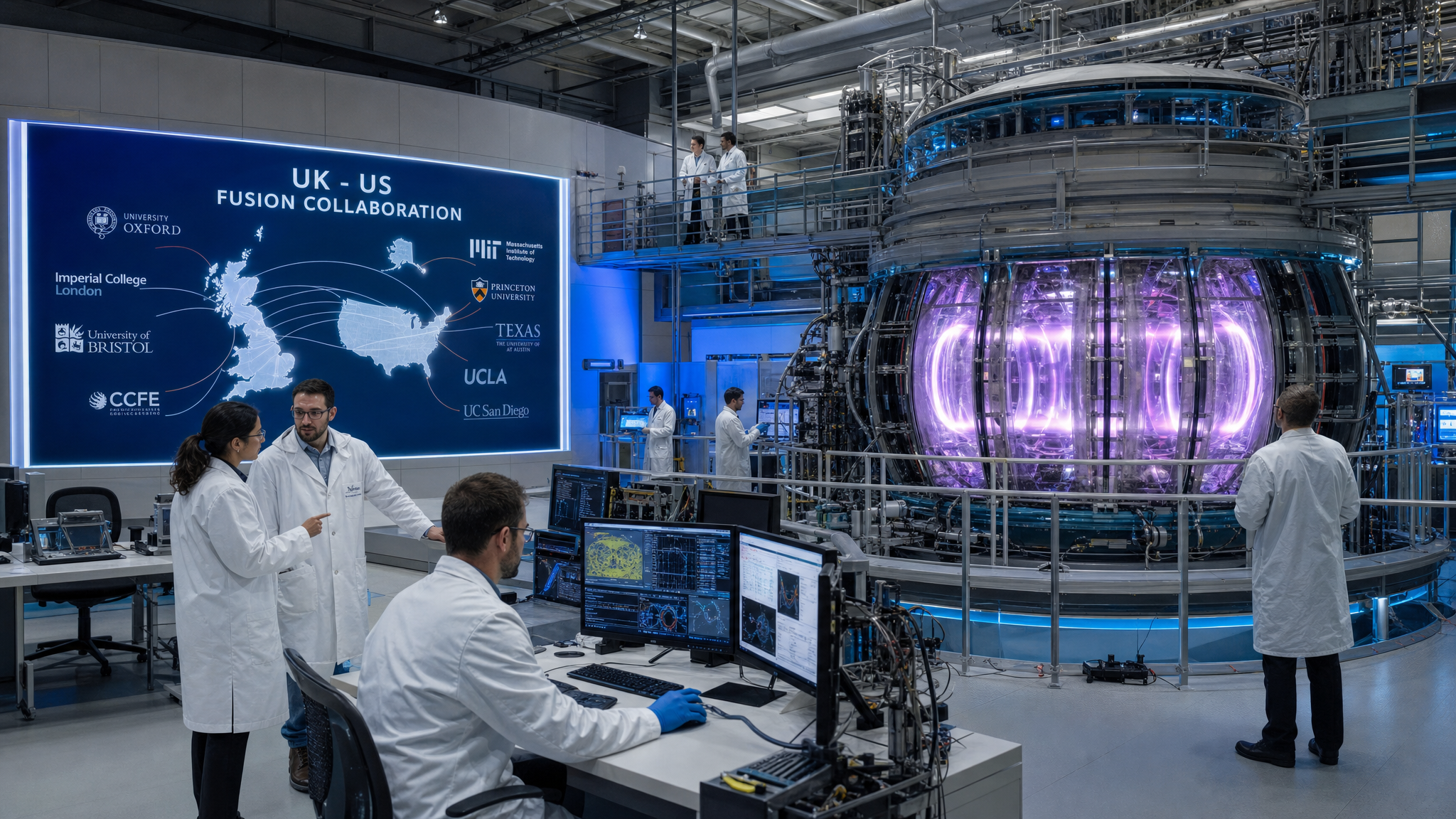
BIRMINGHAM – Leading British universities have joined a new partnership with the US-based University Fusion Association (UFA). The collaboration aims to strengthen transatlantic cooperation in fusion energy.
Framed within the UK-US Technology Prosperity Deal, the agreement focuses on fusion research, engineering deployment and workforce development. Furthermore, it creates opportunities to exchange expertise, information and skills that support fusion energy development.
Fusion energy seeks to replicate the process that powers the Sun, using extreme heat to fuse light atomic nuclei and release energy. Scientists are developing the technology as a potential source of reliable, low-carbon electricity.
A Memorandum of Understanding (MoU) sets out plans to build the scientific, engineering and skills ecosystem needed for future fusion power plants.
US partners
The UFA includes major American institutions. Among them are Caltech, Columbia University, Cornell University, the Massachusetts Institute of Technology (MIT), several University of California campuses and the University of Illinois Urbana-Champaign.
Building talent
Arunodaya Bhattacharya, chair in fusion energy at the University of Birmingham, said fusion remains one of the most anticipated long-term clean energy technologies. In addition, he said it has the potential to provide large quantities of reliable, low-carbon electricity.
“This landmark agreement brings together key British universities and our American counterparts, forging a transatlantic partnership to drive progress in fusion energy,” Bhattacharya said.
Moreover, he stressed the need to develop people and talent for a robust, inclusive and diverse fusion workforce. “It will help the UK and US create the ecosystem needed for future fusion power plants,” he said.
Birmingham ranks as a global leader in fusion materials. Recently, Bhattacharya joined the steering committee of the international MatDB4Fusion initiative. The programme aims to accelerate fusion energy development through improved access to high-quality materials data. In fact, Birmingham currently stands as the only university in the world represented on the programme.
Institutional support
Rachel O’Reilly, pro-vice-chancellor for research at Birmingham, said the university is renowned for its fusion research and training. “We are proud to join this international effort to develop the technologies, talent and partnerships required to make commercial fusion power a reality,” she said.
Meanwhile, David Capper, director for new nuclear strategy and fusion energy at the UK Department for Energy Security and Net Zero (DESNZ), said delivering fusion will require collaboration across academia, industry and government. “Universities have an important role in making fusion possible, which is why we welcome partnerships like the one being forged today,” he said.
Growing participation
An initial 16 UK universities will take part. However, the flexible structure of the agreement invites further institutional participation. This allows additional universities to join in the coming months.
Matthew Lanctot, acting research division director at the US Department of Energy (DoE) Fusion Energy Services, said the partnership will strengthen the publicly funded research base that drives fusion innovation. “By connecting expertise across the Atlantic, this partnership can help close critical gaps on the path to commercial fusion,” he said.
ALSO READ: Eskom concludes Eastern Cape consultations on controversial Thyspunt nuclear plant